Presidential Fitness Test: Treat the Memo as Advisory—for Now

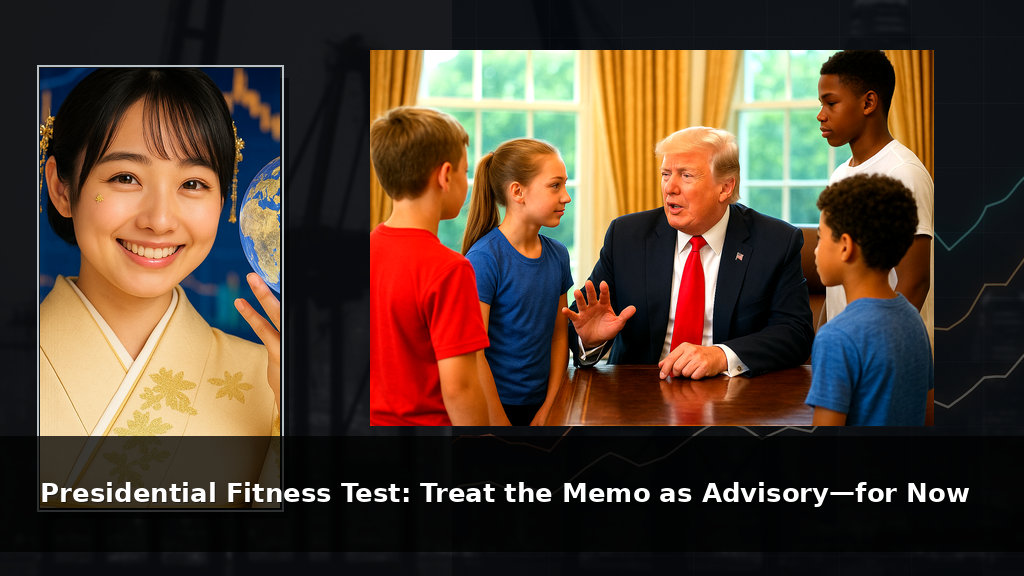
Source: https://x.com/i/status/2051705879360061921
Observation
On May 5, 2026, President Donald J. Trump signed a presidential memorandum in the Oval Office to restore the Presidential Fitness Test Award, following a July 31, 2025 executive order that reestablished the program and revitalized the President’s Council on Sports, Fitness & Nutrition. The order names the Department of Health and Human Services (HHS) to administer the program with support from the Education Department (ED). The announcement sits against fresh National Health and Nutrition Examination Survey (NHANES) data showing 21.1% of U.S. children ages 2–19 had obesity in 2021–2023. (bloomberg.com)
The question that matters for a general business reader is whether this memorandum remains advisory guidance or becomes a de facto national mandate via grants and appropriations. The instrument is soft in form, but federal fiscal levers can standardize practice nationally if they are attached later.
Our call: if you are a corporate government‑affairs lead or strategy head in education/health IT, treat the memo as advisory for the next two quarters—through September 30, 2026. Hedge for a mandate only if you see grant‑conditionality or appropriations riders emerge.
Policy & Legal Structure
A natural concern is whether “voluntary” federal programs become mandatory once funding hooks arrive. Those hooks are not present yet. The May 5 action signals intent and tasks HHS to operationalize; by itself it does not alter state authority over PE testing or create enforceable conditions. (bloomberg.com)
To convert signaling into constraint, the administration needs one of three channels. First, HHS/ED could embed conditions in Notices of Funding Opportunity (NOFOs) or grant terms—for example, requiring districts to report on fitness benchmarks to be eligible for funds. Such conditions would appear on Grants.gov or in the Federal Register. Second, Congress could legislate a rider in FY2027 appropriations tying K–12 health/PE dollars to alignment with the Presidential Fitness Test—an instrument controlled by appropriators, not HHS. Third, HHS/ED could publish reporting guidance that, while not statutory, uses existing data collections to pressure districts—still bounded by the Administrative Procedure Act (APA) and Spending Clause limits.
Federalism is the counterweight. State education agencies already set student‑assessment policy. California, for example, has a statutory FITNESSGRAM® requirement (Education Code §60800) that it can align with—or ignore—the federal award framework. Local districts and PE teachers remain the on‑the‑ground decision‑makers; without funding conditions, their incentives to change practice are mixed. Visible opposition cohorts (state legislatures, state attorneys general, education unions) could also litigate if agencies move from guidance to compulsion, extending timelines. (cde.ca.gov)
Put simply: the current instrument is advisory; the path to a national mandate runs through grant language or appropriations text that does not yet exist. The earliest realistic inflection point is the FY2027 cycle, which turns on actions due by September 30, 2026 (the end of the federal fiscal year). Until such text appears, pricing a mandate into budgets or product roadmaps is premature. (usa.gov)
Nine Star Ki Reading
Read HHS as an authority figure—the agency leadership charged with making this real. In that lens, HHS aligns with Six White Metal (Roppaku Kinsei, 六白金星), an archetype of the “大臣”: formal office, decisiveness, command.
The agency’s background is establishment and hierarchy—procedures, institutional memory, finish‑oriented management. What is showing now is the same star acting at 乾宮: public authority and top‑down direction, the posture of issuing guidance and building centralized toolkits. Because these are aligned, the assertiveness you see is backed by institutional capacity. The next move (兌宮) implies a shift from asserting authority to shaping reception—communications, persuasion, reputational push. Practically, expect HHS to publish materials, then sell them to states and districts. That reinforces the point above: visible guidance and outreach first, not immediate compulsion.
Recommendations
If you are a government‑affairs lead at an education/health IT vendor, an equity PM covering K–12 health/PE exposure, or a strategy head at a large district‑facing supplier, position for optional guidance this year. Stand up light‑touch readiness (reporting modules, data‑exchange mapping, communications collateral) and open dialogue with the President’s Council on Sports, Fitness & Nutrition (PCSFN) within the Office of Disease Prevention and Health Promotion (ODPHP). Defer capital expenditures (capex) and go‑to‑market (GTM) bets premised on a nationwide mandate until you see fiscal hooks. Your upside hedge is speed: have a grant‑condition response plan and pricing model ready if appropriations or NOFOs flip the switch. (odphp.health.gov)
- ODPHP/PCSFN guidance: treat as a mandate only if an HHS toolkit explicitly requires district/state reporting or cites grant eligibility. Threshold: explicit “required reporting/eligibility” language posted; horizon: 1–3 months. (odphp.health.gov)
- Grants.gov/Federal Register: watch for at least one HHS or ED NOFO that conditions school‑health funds on Presidential Fitness Test benchmarks. Threshold: one or more NOFOs referencing the test as an eligibility factor; horizon: 3–6 months.
- FY2027 appropriations: House/Senate report or rider tying K–12 health/PE dollars to alignment. Threshold: presence in committee reports or enacted text by September 30, 2026; horizon: through the FY2027 cycle. (usa.gov)
- Litigation signal: a filed federal complaint alleging unlawful spending conditions or APA violations. Threshold: one or more cases on Public Access to Court Electronic Records (PACER); horizon: within 12 months (risk rises quickly if grants go conditional).
Caveats and Open Questions
- HHS/ED could move faster than expected: if a NOFO or implementation guidance appears that conditions eligibility or imposes required reporting tied to the Fitness Test, the advisory reading fails. This would be observable on Grants.gov or in the Federal Register within 3–6 months.
- Congress could decide the question: an FY2027 appropriations rider conditioning school health/PE funds on adoption would convert guidance into a de facto mandate. Watch House/Senate Appropriations reports through September 30, 2026. (usa.gov)
- Voluntary standardization could compress timelines: if 15+ large states publicly adopt alignment by year‑end 2026, national vendors should treat it as a de facto standard even absent federal compulsion.
Lead‑time question: will a NOFO or appropriations rider explicitly conditioning funds on the Presidential Fitness Test appear by September 30, 2026—and are you positioned to pivot within 30 days if it does?
![胡塞武装袭击推高油价,红海运输韧性成为下一道考验 [简体中文/繁體中文]](https://storage.ghost.io/c/60/6b/606b2e51-3e7d-4c53-b82b-952cb2b9b30b/content/images/size/w600/2026/10/feature-72.png)
![伝えたいことが定まらぬ怒りの一通|An angry message, its meaning unsettled — 2026-10-24 [日本語/English/中文/Español]](https://storage.ghost.io/c/60/6b/606b2e51-3e7d-4c53-b82b-952cb2b9b30b/content/images/size/w600/2026/10/feature-71.png)
![2026-10-23 Market Briefing | Nasdaq, Brent, Cable Capacity [English/Español]](https://storage.ghost.io/c/60/6b/606b2e51-3e7d-4c53-b82b-952cb2b9b30b/content/images/size/w600/2026/10/feature-70.png)