2026-05-25 Market Briefing| Nikkei 65,158 | SCFI 2,140.66 | NVIDIA $81.6B — 2026-05-25


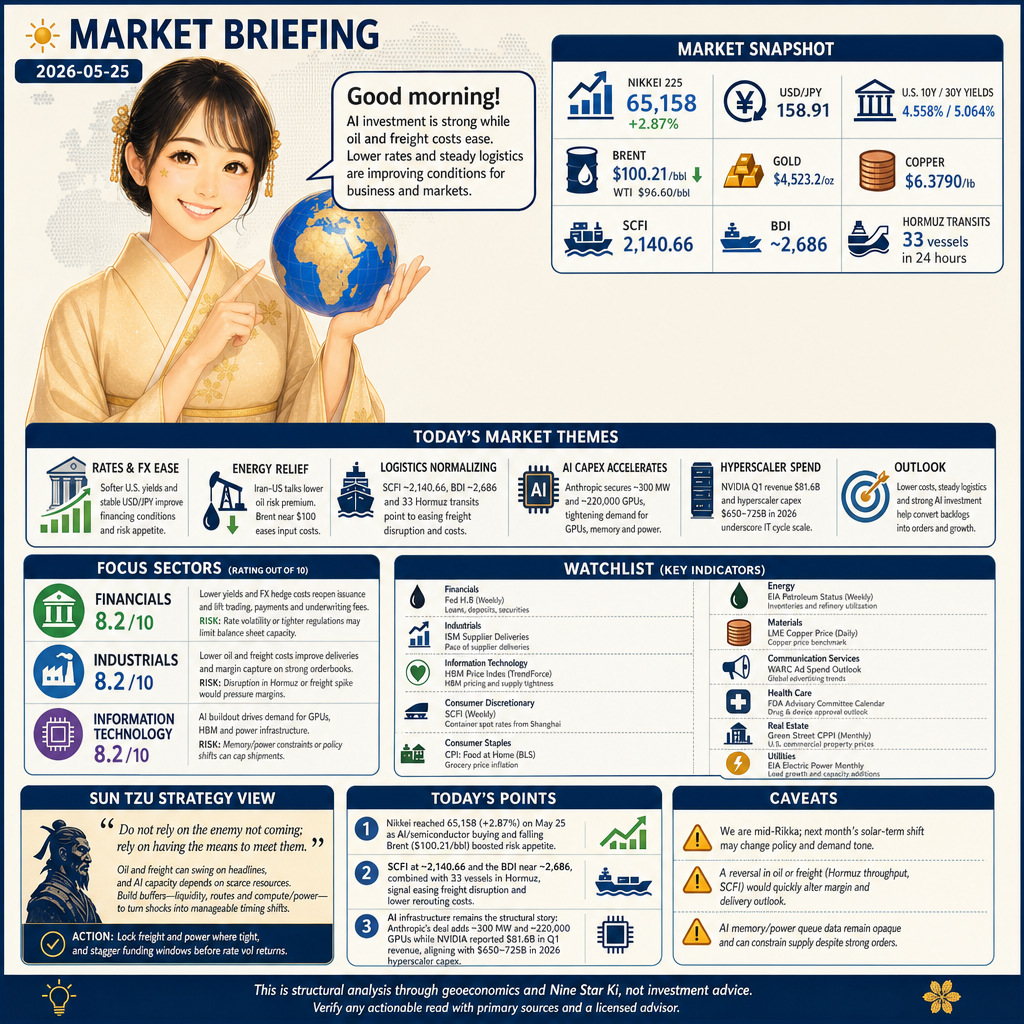
Good morning. Risk opened firm as AI buildout spending met easing energy and freight pressures. Softer U.S. yields and a stable USD/JPY backdrop improved financing conditions, while Iran‑US talks trimmed the oil risk premium. Today’s read links AI capex, logistics normalization, and rates into a single operating tape.
Stocks and FX
65,158 on the Nikkei 225 (+2.87%) set the tone as AI/semiconductor leaders drove gains, per ChosunBiz. 158.91 on USD/JPY and U.S. 10Y/30Y yields at 4.558%/5.064% eased FX‑hedge and discount‑rate pressure, supporting issuance and risk-taking. For Financials, that lifts underwriting and trading fees; for IT and Communication Services, it sustains multiple support and ad‑spend visibility.
Commodities
$100.21/bbl Brent and $96.60/bbl WTI on May 25 (Investing.com) priced in Iran‑US truce hopes, cutting the geopolitical premium; gold printed $4,523.2/oz and copper $6.3790/lb in the same snapshot. Lower crude tempers refinery and freight inputs for Industrials and Consumer Discretionary, and it softens inflation expectations feeding back into rates. Materials ride copper’s setup, but inventory swings can still move margins.
World Affairs
33 vessels transited the Strait of Hormuz in 24 hours, well below the ~140/day pre‑war baseline but up from crisis lows, per Critical Threats. More throughput directly reduces tanker insurance premia and rerouting costs, aligning with Brent near $100/bbl. Energy, Materials, and Industrials see lower input volatility; logistics‑linked Real Estate (ports, DCs) also benefits as schedules normalize.
Supply Chain
2,140.66 on the SCFI and ~2,686 on the BDI (AJU Press citing Shanghai Shipping Exchange and Baltic reporting) signal stabilized, still‑elevated freight costs with improving reliability. Combined with 33 Hormuz transits, lead‑time variance narrows and insurance surcharges fade. Export‑heavy Industrials and Consumer Discretionary gain margin and delivery predictability; Materials see cleaner arbitrage on cross‑border flows.
AI
300+ MW and ~220,000 GPUs secured by Anthropic via SpaceX’s Colossus 1 (Forbes) expand near‑term inference capacity, tightening demand for GPUs, HBM memory, and advanced packaging. Power and interconnect become tangible constraints, pulling Real Estate (data centers) and Utilities into the AI stack. Vendor procurement advantages and siting speed determine who converts capex to revenue first.
Industry News
$81.6B in quarterly revenue at NVIDIA (company release) and $650–725B in 2026 hyperscaler capex (S&P Global Ratings) define the current IT spend cycle’s scale. The mix channels into GPUs, HBM, substrates and data‑center development, lifting IT revenues and pulling through to Materials and power‑dense Real Estate. Tight memory supply can extend lead times and raise ASPs into H2.
Industry Forecast
Today's Setup
2026-05-25 is a Three Blue Wood (Sanpeki Mokusei, 三碧木星) day inside a Five Yellow Earth (Goou Dosei, 五黄土星) month and a One White Water (Ippaku Suisei, 一白水星) year under Rikka (Beginning of Summer). Expect initiation and conversion to matter: easing financing costs and steadier logistics help turn backlogs into orders and shipments, while policy‑gated, longer‑duration assets should filter noise around rates and permitting.
Focus Sectors
- Financials (8.2/10): 4.558%/5.064% on the U.S. 10Y/30Y and USD/JPY at 158.91 (ChosunBiz) lower discount‑rate and FX‑hedge frictions, reopening issuance and lifting trading and payments volumes. That operating leverage boosts fee lines when fixed costs hold. Risk/watch: a rate‑volatility spike can shut windows and swing VaR; tighter Basel endgame rules may constrain balance‑sheet risk capacity first at large banks.
- Industrials (8.2/10): 2,140.66 on SCFI and ~2,686 on BDI (AJU Press) plus Brent near $100.21/bbl (Investing.com) and 33 Hormuz transits (Critical Threats) reduce fuel and reroute costs so backlogs convert to shipments. Faster deliveries and steadier inputs support margin capture on existing orderbooks. Risk/watch: a relapse in Hormuz throughput or a renewed SCFI surge would re‑introduce delivery variability and squeeze margins.
- Information Technology (8.2/10): NVIDIA’s $81.6B quarter and hyperscaler capex tracking $650–725B (company release; S&P Global) confirm a broad AI buildout, while Anthropic’s 300+ MW/~220k GPU deal (Forbes) spotlights near‑term demand for GPUs, HBM, CoWoS capacity and power. Vendors with procurement and siting advantages convert earliest. Risk/watch: HBM/substrate concentration and grid‑interconnect delays can cap shipments despite strong orders; export‑control shifts may redirect deliveries.
Watchlist
- Financials: Federal Reserve H.8 (Assets and Liabilities of Commercial Banks) — weekly loan/deposit growth and securities holdings for U.S. banks.
- Industrials: ISM Manufacturing Supplier Deliveries Index (Institute for Supply Management) — pace of supplier deliveries; faster deliveries support backlog conversion.
- Information Technology: TrendForce HBM (high-bandwidth memory) contract price index — tracks pricing and supply tightness for AI memory.
- Consumer Discretionary: Shanghai Containerized Freight Index (Shanghai Shipping Exchange) — weekly spot container rates from Shanghai across major lanes.
- Consumer Staples: BLS CPI: Food at Home (U.S. Bureau of Labor Statistics) — monthly grocery‑price inflation that drives retailer pricing posture.
- Energy: EIA Weekly Petroleum Status Report (U.S. Energy Information Administration) — U.S. crude/product inventories and refinery utilization.
- Materials: LME Copper official cash price (London Metal Exchange) — daily benchmark for copper pricing and near‑term supply/demand tightness.
- Communication Services: WARC Global Ad Spend Outlook (WARC) — periodic forecasts and updates on global advertising budgets across media.
- Health Care: U.S. FDA Advisory Committee Calendar (Food and Drug Administration) — scheduled panel meetings that influence drug and device approval odds.
- Real Estate: Green Street Commercial Property Price Index (Green Street) — monthly private‑market pricing for U.S. commercial real estate.
- Utilities: EIA Electric Power Monthly (U.S. Energy Information Administration) — generation mix, capacity additions and retail sales that reveal load growth and cost pass‑through.
Caveats
We sit mid‑Rikka; a solar‑term shift next month can change the policy and demand tone around rates and construction calendars. A reversal in oil or freight (Hormuz throughput, SCFI) would quickly alter today’s margin and delivery read, and AI memory/power queue data remain opaque.
Sun Tzu Strategy View
Sun Tzu wrote: —— Do not rely on the enemy not coming; rely on having the means to meet them.
Oil and freight can swing on headlines, and AI capacity depends on scarce HBM and interconnection slots. Building buffers—liquidity, diversified shipping routes, and alternative compute/power—turns shocks into manageable timing shifts instead of P&L hits.
Action: Pre‑position contingency: lock freight and power where tight, and stagger funding windows before rate vol returns.
Today's Points
- Nikkei reached 65,158 (+2.87%) on May 25 as AI/semiconductor buying and falling Brent ($100.21/bbl) boosted risk appetite.
- SCFI at ~2,140.66 and the Baltic Dry Index near ~2,686, combined with 33 vessels reported transiting Hormuz, point to easing freight disruption and lower rerouting costs.
- AI infrastructure remains the structural story: Anthropic’s deal gives ~300 MW and ~220,000 GPUs of capacity while NVIDIA reported $81.6B in Q1 revenue, aligning with hyperscaler capex tracking $650–725B for 2026.
This is structural analysis through geoeconomics and Nine Star Ki, not investment advice. Verify any actionable read with primary sources and a licensed advisor.