Hormuz Shoot‑Back Doctrine Raises Costs Faster Than It Restores Flow

Source: https://x.com/i/status/2052727810947444952
Observation
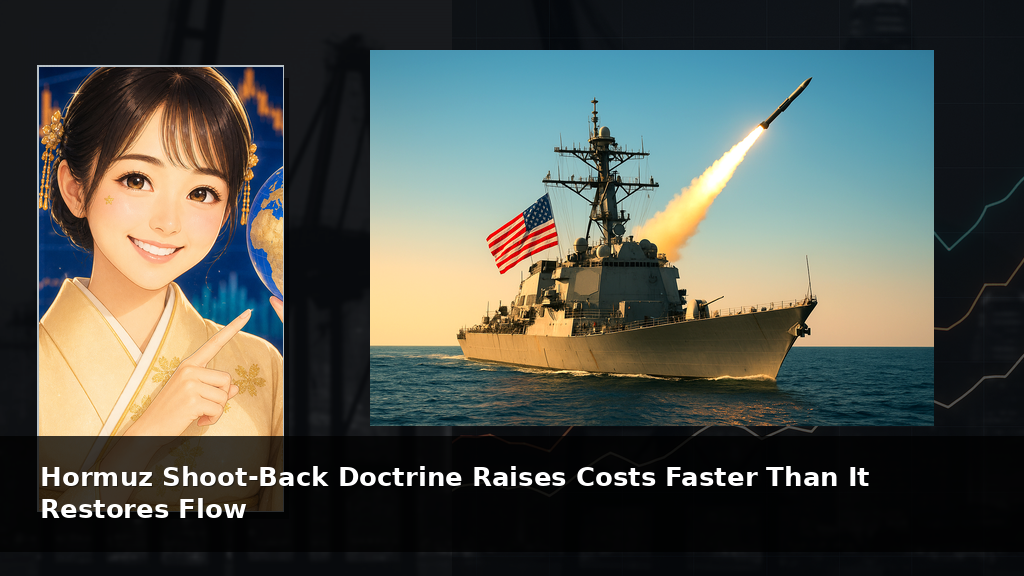
From May 4–7, 2026, U.S. Central Command (CENTCOM) said Iranian missiles, drones and fast boats engaged three U.S. guided‑missile destroyers — USS Truxtun, USS Rafael Peralta and USS Mason — as they transited the Strait of Hormuz. U.S. forces intercepted inbound threats and carried out self‑defence strikes on Iranian launch, command‑and‑control (C2) and intelligence, surveillance and reconnaissance (ISR) sites; CENTCOM also said no U.S. assets were struck.
On May 4, U.S. forces said they destroyed six Iranian small boats during an operation to reopen transit and shot down missiles and drones threatening shipping. On May 5, Secretary of State Marco Rubio described the posture as defensive — “there’s no shooting unless we’re shot at first.” The chokepoint stakes are large: roughly 20 million barrels per day of oil and products typically move through Hormuz, per the International Energy Agency.
The live question is whether a lower threshold for U.S. kinetic “shoot‑back‑if‑shot” responses reduces harassment or, instead, routinises escalation and raises economic costs across insurance, routing and energy pricing. This matters because the transmission from naval posture to freight, premiums and Brent is fast, and mis‑positioning on a false reopening narrative carries material portfolio and supply‑chain costs.
Our stance: for equity portfolio managers with Energy/Industrials/Shipping exposure, hedge for escalation and re‑price chokepoint risk higher through the next 60–90 days; do not buy a quick‑normalisation narrative on the basis of convoyed transits alone.
Geoeconomic Structure
A fair pushback is that firm defensive fire deters: if destroyers crush small‑boat swarms and shoot down drones, harassment should ebb and traffic should resume. The structure on the ground disagrees. What escorts restore in individual passages, they often erase in aggregate through persistent insurance pricing, commercial caution and adversary adaptation — the channels that actually govern volume and cost.
Start at the node that matters: Hormuz is a narrow gate where military and commercial decisions compress into a few miles of sea room. CENTCOM can and did move U.S. warships through it. But the corridor’s usable capacity is not set by warships; it is set by three gatekeepers the U.S. does not control. First, underwriters in the Lloyd’s market and Protection and Indemnity (P&I) clubs determine whether owners will even accept liftings: when war‑risk surcharges climb toward 1% of hull value (vs. ~0.25% baseline), many owners decline voyages or demand freight that prices out marginal cargoes. Second, carriers and charterers — Maersk, CMA CGM, Hapag‑Lloyd, and energy traders’ charter desks — decide whether to accept escorted transits or flip networks to Cape of Good Hope routings that add 10–14+ days and tie up tonnage. Third, the IRGC’s asymmetric lever is structurally cheap to escalate: a minefield, a mis‑tagged drone or a dispersed missile battery can complicate convoys at far lower cost than the U.S. incurs to defend them.
Translate that into chokepoint economics. A routinised shoot‑back doctrine reduces the perceived political cost to both sides of firing. That makes armed contact less exceptional and more frequent. Frequency — not the outcome of any single exchange — is what insurers and operators price. Even if no U.S. hull is struck, repeated engagements keep premiums elevated, sustain exclusions, and make unescorted transits commercially non‑standard. Carriers then publish avoidance advisories, charterers re‑price loading windows, and the physical market shifts to longer routes. The chokepoint, in other words, re‑opens for some politically important escorted sailings while the market as a whole pays more to avoid it. That is escalation without headline escalation.
There is also a feedback to the IRGC’s playbook. Convoy logic is legible and targetable. Each additional convoy creates a predictable rhythm for harassment with plausible deniability — small‑boat probes, loitering munitions, spoofing. The U.S. can suppress this tactically, but the mere existence of predictable military transits invites sensors and shooters into tighter contact. That increases the probability of miscalculation, an errant round causing civilian harm, and a political response in Tehran — precisely the pathway from self‑defence to tit‑for‑tat. In chokepoint vocabulary: escorts are a projection instrument; insurers and carriers are the financial/operational gatekeepers; the IRGC is the asymmetric lever. The interaction among these three raises the all‑in delivered cost of using Hormuz faster than escorts restore the corridor’s commercially usable capacity.
Markets transmit the shift immediately. War‑risk premia are set weekly; Very Large Crude Carrier (VLCC) spot rates on Gulf→Asia legs can jump 50% in a fortnight on sustained rerouting; and Intercontinental Exchange (ICE) Brent crude front‑month futures react intraday to convoy headlines. Even if CENTCOM achieves 10–12 daily commercial Hormuz transits under escort, the mix of elevated premiums and stretched tonnage produces a higher floor for landed costs. That higher floor persists until two things change together: underwriters cut surcharges back toward ~0.5% and at least two top‑tier liners publish “resume routine Hormuz transit without escort” notices. Short of that, the risk is sticky because the gatekeepers who matter are pricing rhythm, not rhetoric.
Nine Star Ki Reading
We read the commercial carriers — Maersk, CMA CGM, Hapag‑Lloyd and the energy trading desks that book them — as the place where the military posture turns into real costs. Through this lens, the carriers align with Four Green Wood (Shiroku Mokusei, 四緑木星), anchored in the image of the “商社”: the networked intermediary that survives on relationships, exchange and credibility. It fits: these firms sell connectivity and reassurance as much as they sell slot space.
In background, their nature is to preserve ties and keep lanes open — to be the connective tissue in trade. What is showing now is the same connective actor sitting at Center (Chūkyū, 中宮): a point that closes one pattern and opens another. Concretely, carriers are weighing, at the centre of the network, whether to accept escorted Hormuz transits with reputational risk, or to formalise longer Cape routings and pass costs through. Because the background and current posture are aligned, the choices they make now will not be a bluff or a passing feint; they will crystallise quickly into public advisories and contracts that others must follow.
Placement in the cycle matters for timing. From Center, the next move is toward Northwest (Kenkyū, 乾宮) — a shift from deliberation to outward assertion and rule‑setting. In practice, that reads as carriers moving from internal risk committees to external, binding choices: published routing notices, charter‑party clauses on war‑risk, and hard commitments on convoy acceptance. Once those appear, insurers and cargo owners will align around them, making the new pattern sticky until the cycle returns to Center again. That is why the current window is decisive for rerouting — not because of metaphysics, but because the network node that binds costs together is poised to act from the centre and then to harden its stance.
Recommendations
If you are an equity portfolio manager with Energy, Industrials and Shipping exposure, hedge for escalation‑driven friction rather than pricing a clean reopening. Keep gross exposure but raise risk premia: prefer tanker owners with optionality and insurers with balanced Gulf exposure; fade quick‑normalisation narratives in Gulf‑exposed refiners and freight‑sensitive industrials. Use carrier advisories and insurance pricing — not political statements — as your confirmation signals.
- Daily Hormuz commercial transits (Kpler vessel‑tracking; S&P Global Commodities at Sea). Signal: >12/day sustained for 14 days = reopening; <3/day sustained = effective closure. Horizon: 1–2 weeks.
- ICE Brent crude front‑month futures. Signal: sustained >$110 for 5 sessions or a >5% intraday jump on convoy headlines = market pricing of supply risk. Horizon: real‑time/daily.
- War‑risk hull premium for Persian Gulf (Lloyd’s/P&I — Protection and Indemnity — clubs). Signal: ≥1.0% of hull value sustained = segmentation persists; ≤0.5% within 2–4 weeks = normalisation path. Horizon: weekly broker updates.
Caveats and Open Questions
Three conditions would force us to walk back the escalation‑risk stance:
- Iran’s harassment actually ebbs: if CENTCOM and credible open‑source tallies show a 30–90 day period with no attempted drone/missile/small‑boat engagements, the deterrence thesis gains empirical support and premiums should ease.
- Commercial confidence returns without escorts: if at least two top‑tier liners (e.g., Maersk, CMA CGM, Hapag‑Lloyd) resume routine Hormuz transits without military escort — evidenced by customer advisories and Automatic Identification System (AIS) patterns — the corridor is functionally back.
- Underwriters relent quickly: if Lloyd’s/P&I war‑risk surcharges fall below ~0.5% and exclusions are lifted within 2–4 weeks, insurers are telling us the rhythm of kinetic contact no longer drives pricing.
Lead‑time question: within the next 30–45 days, do war‑risk premiums remain at or above 1% and major carriers keep avoidance notices in place (validating the escalation‑risk thesis), or do premiums fall below 0.5% and two global liners resume unescorted transits (supporting the deterrence view)?
![2026-10-23 マーケットブリーフィング|──AI期待から物理供給力へ [日本語/中文]](https://storage.ghost.io/c/60/6b/606b2e51-3e7d-4c53-b82b-952cb2b9b30b/content/images/size/w600/2026/10/feature-68.png)
![2026-10-22 Market Briefing | Brent, French Yields, Gold [English/Español]](https://storage.ghost.io/c/60/6b/606b2e51-3e7d-4c53-b82b-952cb2b9b30b/content/images/size/w600/2026/10/feature-67.png)
![2026-10-22 マーケットブリーフィング|──原油高と長期金利が迫る業界選別 [日本語/中文]](https://storage.ghost.io/c/60/6b/606b2e51-3e7d-4c53-b82b-952cb2b9b30b/content/images/size/w600/2026/10/feature-66.png)