After Xi–Putin 2026: Institutionalization, Eastward Rewire, and Japan's Dilemma (Part 3)

Russia’s Change Seen on the Tracks at Zabaikalsk
At the freight station in Zabaikalsk, Russian container trains head toward Manzhouli. The visible objects here are not tanks but railways, not mobilization but customs clearance, not ideology but cargo. Russia’s war continues in the west, but the wiring of the state extends east.
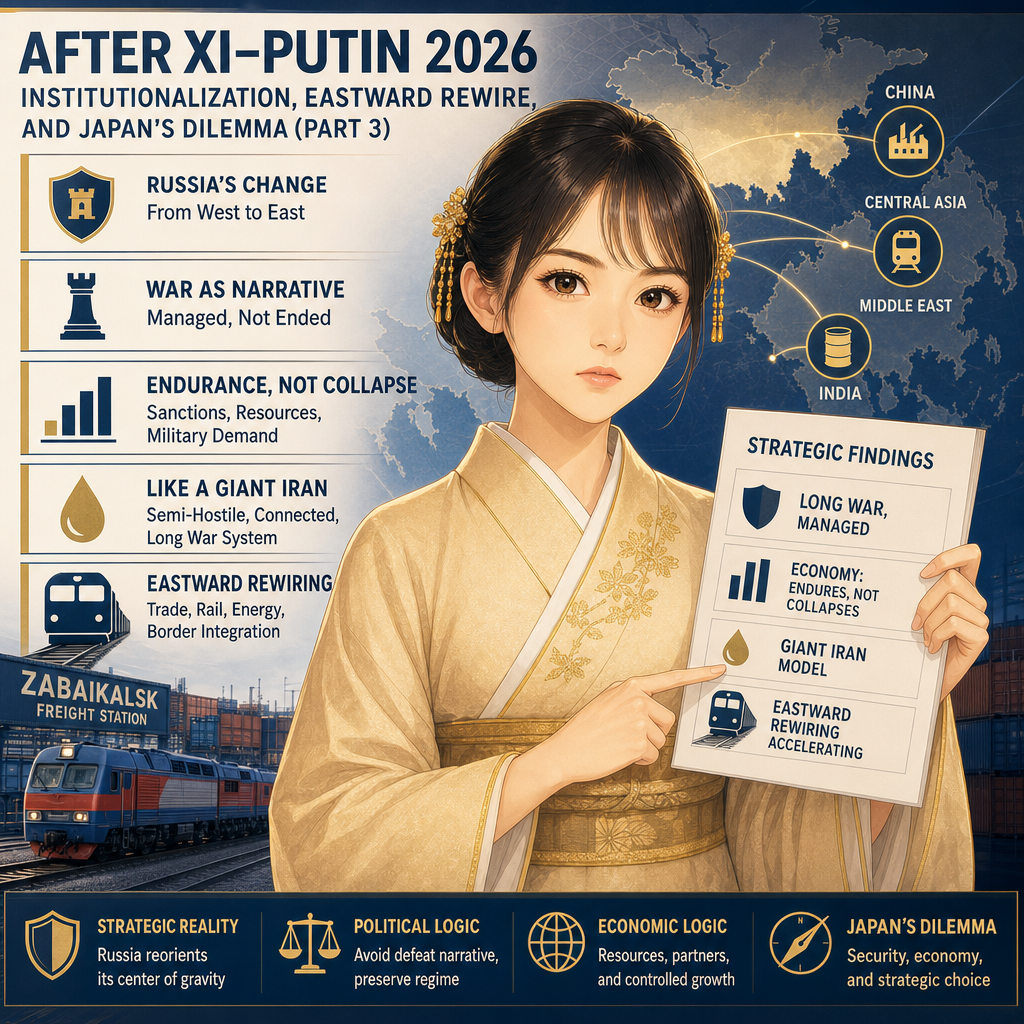
Calling this change simple “dependence on China” is too crude. Russia is transforming from a resource power deeply connected to Europe into an inland Eurasian state that endures under sanctions and shifts its center of gravity toward China, Central Asia, the Middle East, and India. The purpose of the war is changing as well. The conquest of all Ukraine carries less weight than regime survival, military prestige, the fixation of already occupied territories, and the preservation of a domestic narrative that says Russia has not been defeated.
Making Defeat Invisible Matters More Than Total Victory
For the Kremlin, the truly dangerous outcome is not the failure to subdue all Ukraine. The danger is that the Russian state becomes understood at home as defeated. This is why the language of war shifts easily. It moves from maneuver warfare to the maintenance of defensive lines, from the subjugation of Ukraine to the protection of Russian-speaking residents, and from expansion into Europe to the prevention of NATO aggression.
In this frame, a fixed front line is not defeat. It is narrative reorganization. The Korean War, the Iran-Iraq War, the India-Pakistan border, frozen conflicts (long-stalemate conflicts) in the former Soviet space, and Donbas from 2014 to 2022 all show that modern wars do not always end in total victory. Exhaustion freezes a line, while mutual non-recognition, sanctions, and intermittent attacks remain.
Drones, long-range strikes, and satellite surveillance now make decisive breakthroughs harder and low-cost continuous attacks easier. When the political cost of agreement looks higher than the cost of continuing conflict, war does not end. It becomes managed.
In a discussion of the prolonged Ukraine crisis, Xinhua reported Ukraine’s direct losses at $195 billion and its reconstruction costs over the next decade at $588 billion, about three times the country’s GDP. It also put Ukraine’s 2025 public debt-to-GDP ratio at 108.6 percent and its budget deficit at 1.9 trillion hryvnia, or about $45 billion. Xinhua added a poverty rate of 36.9 percent and noted that more than 52 percent of citizens do not expect conditions to improve. At the same time, it reported domestic Russian support for the “special military operation” at 65 percent (Xinhua). This set of figures shows a war that exhausts both sides but remains politically hard to exit.
Russia’s exit therefore resembles a redefinition more than a declaration of victory. For the domestic audience, the “special military operation” is recast as a long war of homeland defense, and the front line is described not as a temporary military line but as a national defense line. The requirement is not a military breakthrough. It is a story that does not look like defeat.
Not North Korea, but a Giant Iran
The view that Russia is turning into North Korea contains part of the reality. A long-war system, a narrative of national mobilization, semi-disconnection from the Western economic sphere, patriotic education, a defense-industry-centered economy, and an emphasis on encirclement by foreign enemies all belong to the pattern of a closed wartime state.
But Russia cannot become North Korea. It is a resource exporter, an energy supplier, and a state with deep connections to the world economy. It has vast transaction zones with China, India, the Middle East, and Central Asia. Its elite class is not fully severed from international assets.
The closer model is a giant Iran: a state in semi-hostility with the West, enduring under sanctions through military industry and resources, strengthening economic links with China, continuing proxy wars and low-intensity conflicts, and prolonging managed tension rather than reaching a full peace.
Chinese-language media also do not see the Russian economy as close to collapse. Xinhua stated that the Russian economy, while under pressure from Western sanctions, has shown a degree of resilience. It listed GDP growth at -2.1 percent in 2022 and +3.5 percent in 2023, with industrial production up 3.6 percent, manufacturing up 7.5 percent, fixed-asset investment up 10 percent, corporate profits up 24 percent, and national wages up 8 percent in 2023 (Xinhua).
This is not healthy growth. The same analysis put the military-industrial complex’s contribution to economic growth at about one-third. It also noted the Russian central bank’s key rate at 16 percent, inflation at 7 to 7.5 percent against a 4 percent target, unemployment at 2.9 percent, manufacturing vacancies at 660,000, agricultural vacancies at 200,000, and the share of settlements in national currencies at 65 percent. The numbers indicate not collapse, but endurance through military demand, resources, and control.
China Daily introduced the view of a Russian scholar that Chinese outward investment supports Russia’s trade diversification and long-term economic resilience (China Daily). People’s Daily argued that the two economies are strongly complementary, while much of their potential has not yet been converted into practical projects (People’s Daily). In this reading, Russia is not a failed loser. It is a resource and security partner with weaknesses that remains usable over a long period.
War fatigue looks sharper from the West. Reuters reported that Ukrainian drone attacks forced major refineries in central Russia to halt or reduce operations, with the affected capacity equal to about one-quarter of refining capacity and more than 30 percent of gasoline output (Reuters). Russia is not strong in a simple sense. It is changing into a form that is harder to break.
The Eastward Rewiring Advancing in the Far East
While Moscow manages the story of the war, another reality advances in the Far East and Siberia. There, the daily subjects are not victory and defeat, but the Chinese market, resource exports, railways, electricity, tourism, and border trade.
EastRussia reported that the industrial production index in the Far Eastern Federal District reached 103.8 percent year-on-year in the first quarter of 2026, above the all-Russian average of 100.3 percent. The article put the extraction sector at 104.8 percent, first among all federal districts. It recorded industrial production at 115 percent in Amur Oblast, 110.6 percent in the Jewish Autonomous Oblast, and 109.8 percent in Sakhalin Oblast. It also reported manufacturing at 260 percent in Magadan Oblast, extraction at 117.6 percent in the Jewish Autonomous Oblast, 116.3 percent in Kamchatka Krai, 116.1 percent in Khabarovsk Krai, and 113.5 percent in Zabaykalsky Krai (EastRussia). This is not a picture of Russia sinking evenly. It is a picture of some regions rising through the eastward shift.
Railways show this change in its most concrete form. According to EastRussia’s feature on logistics corridors, China-Europe trains numbered 1,034 in January and February 2026, up 48.4 percent year-on-year, while load volume rose 43.2 percent. The Zabaikalsk-Manzhouli route handled 4,867 trains in 2025, up 11.2 percent, and 506,000 TEU (twenty-foot equivalent units), up 8.6 percent. Traffic from Europe to China reached 2,977 trains, up 21 percent. Operating routes reached 21, connecting more than 60 Chinese cities with 14 countries (EastRussia).
Trade through Manzhouli in the first quarter of 2026 reached 31.76 billion yuan, about 428.7 billion rubles, up 51 percent year-on-year, while transport volume reached 640,000 tons, up 27.2 percent. Through Zabaikalsk, as many as 16 trains and more than 900 containers moved per day. While maritime container freight rates rose 200 percent, rail freight rates rose only 8 to 9 percent. Manzhouli accounts for 70 percent of Russia-China land transport. The new 12-kilometer Zabaikalsk-Manzhouli line under construction is expected after completion to handle about 50 trains per day and increase annual freight capacity by 11 million tons. Approved overseas projects number 148, with cumulative value exceeding $1 billion.
This corridor changes not only exports, but also the composition of the Russian market. Chinese cars accounted for 51.7 percent of Russian new-car sales in 2025. Registrations of Chinese companies in Russia rose 32 percent year-on-year from January to September 2024 and accounted for 34 percent of new registrations. From 13 percent in 2021, the answer is clear: Chinese companies are filling the space left by sanctions.
The Narrow Pipes of Gas, Electricity, and Tourism Grow Wider
Energy pipes are also growing eastward. Interfax reported that Gazprom is preparing to begin supply to China through the Far Eastern route and plans to start delivery in January 2027 at up to 12 billion cubic meters per year (Interfax). The existing Power of Siberia pipeline has a long-term contracted supply volume of 38 billion cubic meters per year. Actual supply in 2025 reached 38.8 billion cubic meters. After an agreement to increase volume, the figure moves toward 44 billion cubic meters per year. Power of Siberia 2 and the Soyuz Vostok route are discussed at a scale of 50 billion cubic meters per year.
Yet regional infrastructure remains fragile even as outward corridors expand. In Buryatia and Zabaykalia, tight electricity supply and demand have produced moves to expand seasonal restrictions on cryptocurrency mining into a year-round ban. The reported scope covers 13 regions until 2031, with affected equipment capacity of about 550 MW and an estimated load reduction of 320 MW on the Siberian power system (EastRussia). Resources and logistics extend outward, but local electricity remains thin. This is the distortion of the eastward shift.
Human movement points in the same direction. China reportedly extended visa-free entry for Russian citizens until the end of 2027. In 2025, Russian citizens made more than 2 million visits to China, while Chinese citizens made more than 1 million visits to Russia. Chinese travelers accounted for about 50 percent of inbound tourists to Russia, and Chinese tourist visits to Russia in 2024 reached 848,000 (EastRussia). In the Far Eastern tourism industry, however, dissatisfaction remains because the handling of Chinese group tours is concentrated among some operators, and Russian-side companies do not capture enough profit.
Siberian Resources Turn Toward the Chinese Market
In Siberia, the redirection of resource exports is even more explicit. Kommersant reported on Siberia-China trade and stated that coal exports are strongly shaped by the Chinese market (Kommersant). Coal exports in the first half of 2024 totaled 45.6 million tons, down 11 percent from 51.3 million tons a year earlier. Total coal exports in 2023 reached 102 million tons out of an overall 208 million tons, and export value reached $14.3 billion, exceeding gas at $11.7 billion. Yet Kuzbass mining from January to October 2024 totaled 163.8 million tons, down 8.2 percent, and the coal sector recorded losses of 4.9 billion rubles over eight months that year.
Agricultural products and timber also swing with Chinese demand. In the 2023/24 agricultural year, wheat exports rose 2,300 percent to 147,000 tons, peas rose 305 percent to 321,000 tons, barley rose 352 percent to 419,000 tons, and rapeseed rose 37 percent to 326,000 tons. By contrast, sawn timber exports in the first nine months of 2024 totaled 7.3 million tons, down 9 percent, while roundwood totaled 1.2 million tons, down 18 percent. China’s share of sawn timber exports stood at 76 percent, or 5.3 million tons, down 11 percent. Russia’s exports to China from January to September 2024 rose 1.7 percent to $97.2 billion, and China’s exports to Russia rose 2.4 percent to $83.15 billion. Bilateral growth exists, but the structure remains tightly bound to resource prices and demand fluctuations.
Oil follows the same pattern. Russian oil exports to China in May 2024 were put at 32.38 million tons, down 14.2 percent year-on-year and 23.9 percent from the same month of the previous year. Russia still retained its position as China’s largest oil supplier. The agreement on oil transport to China through Kazakhstan has been extended until 2034, showing that Russia’s eastward exports depend not only on Siberia but also on Central Asian transit space.
Russia’s Margin Narrows in Central Asia
Eastward rewiring does not simply strengthen Russia. In Central Asia, Russian influence becomes relative rather than dominant. Russian Deputy Foreign Minister Mikhail Galuzin stated that the United States and the EU are trying to secure Central Asia’s critical minerals, rare earths, and transport corridors, and that this is not merely economic competition but an attempt to push Russia out of the region (Izvestia).
At the same time, Russia does not publicly treat China’s advance into Central Asia as a problem. Dmitry Peskov stated that the rapprochement between China and Central Asian countries does not affect Russian interests (Vedomosti). This is less a statement of reassurance than an acknowledgment of a reality Russia has to accept. China enters through markets, investment, resources, and infrastructure. The West enters through minerals and corridors. Russia can no longer control the region through the vocabulary of a historical sphere of influence alone.
The visible fact is that Russia is not monolithic. The Kremlin center uses closer ties with China as grand strategy against the United States and Europe. Moscow and European Russia remain the centers of politics, finance, defense industry, and conscription burdens, and they place higher priority on preventing disorder and visible defeat than on victory itself. Siberia and the Far East are moved by the Chinese market, resource exports, logistics, tourism, and labor shortages. Central Asia becomes a buffer zone where Russia, China, and the West intersect.
Is an Eastward Russia Strong or Weak?
The eastward shift is not proof of Russian strength. It is the process by which a state that lost connection with Europe rewires itself to avoid collapse. Railways move, gas flows, coal and agricultural products sell, and Chinese cars fill the market. But electricity is insufficient, labor is short, price-setting power declines, and Russia’s margin in Central Asia narrows.
In this sense, Russia’s future is not that of an empire achieving total victory. It is moving closer to a giant Iran-type state: refusing to acknowledge defeat, fixing the front line, relying on resources and military industry under sanctions, and becoming deeply embedded in an eastern economic sphere centered on China.
This is not stability. It is not collapse either. That is precisely why it can last. Russia is searching for a path that preserves the state while it manages war in the west, reconnects its economy in the east, and loses room for maneuver in Central Asia.
The next part examines what Japan seeks to preserve and what it seeks to switch as it faces a Russia tilting east.
Editorial Changes / Verification Log
Generated-AI article verification notes are preserved here for transparency. Expand for before/after edits and source checks.
1. (unspecified section) — sentence_split
Before:
This is why the language of war shifts easily from maneuver warfare to the maintenance of defensive lines, from the subjugation of Ukraine to the protection of Russian-speaking residents, and from expansion into Europe to the prevention of NATO aggression.
After:
This is why the language of war shifts easily. It moves from maneuver warfare to the maintenance of defensive lines, from the subjugation of Ukraine to the protection of Russian-speaking residents, and from expansion into Europe to the prevention of NATO aggression.
Reason: Long sentence broken for clarity while preserving all contrasts.
2. (unspecified section) — gloss_added
Before:
506,000 TEU, up 8.6 percent.
After:
506,000 TEU (twenty-foot equivalent units), up 8.6 percent.
Reason: Added brief parenthetical gloss to avoid a comprehension block on TEU.
3. (unspecified section) — sentence_split
Before:
EastRussia reported that the industrial production index in the Far Eastern Federal District reached 103.8 percent year-on-year in the first quarter of 2026, above the all-Russian average of 100.3 percent. The same article put the extraction sector at 104.8 percent, first among all federal districts, with industrial production at 115 percent in Amur Oblast, 110.6 percent in the Jewish Autonomous Oblast, and 109.8 percent in Sakhalin Oblast. It also reported manufacturing at 260 percent in Magadan Oblast, extraction at 117.6 percent in the Jewish Autonomous Oblast, 116.3 percent in Kamchatka Krai, 116.1 percent in Khabarovsk Krai, and 113.5 percent in Zabaykalsky Krai.
After:
EastRussia reported that the industrial production index in the Far Eastern Federal District reached 103.8 percent year-on-year in the first quarter of 2026, above the all-Russian average of 100.3 percent. The article put the extraction sector at 104.8 percent, first among all federal districts. It recorded industrial production at 115 percent in Amur Oblast, 110.6 percent in the Jewish Autonomous Oblast, and 109.8 percent in Sakhalin Oblast. It also reported manufacturing at 260 percent in Magadan Oblast, extraction at 117.6 percent in the Jewish Autonomous Oblast, 116.3 percent in Kamchatka Krai, 116.1 percent in Khabarovsk Krai, and 113.5 percent in Zabaykalsky Krai.
Reason: Separated dense statistics into shorter sentences to improve readability.
4. (unspecified section) — connective_trimmed
Before:
At the same time, Xinhua reported domestic Russian support for the “special military operation” at 65 percent.
After:
It reported domestic Russian support for the “special military operation” at 65 percent.
Reason: Removed redundant connective to tighten flow without altering meaning.