After Xi–Putin 2026: Institutionalization, Eastward Rewire, and Japan's Dilemma (Part 1)

Two Narratives Standing Side by Side in the Great Hall of the People
On May 20, 2026, President Xi Jinping and President Vladimir Putin stood side by side in Beijing’s Great Hall of the People. Both the Chinese Foreign Ministry and the Kremlin confirmed that Putin made an official visit to China on May 19–20, 2026, and held talks with Xi in the same building on May 20. The Chinese Foreign Ministry described the meeting as a deepening of the “comprehensive strategic partnership of coordination.” It also stated that the two countries issued joint statements on extending the China-Russia Treaty of Good-Neighborliness and Friendly Cooperation, building a fairer and more equitable international order, and promoting multipolarity. The basis for this account is set out in the Chinese Foreign Ministry’s meeting announcement and joint statement announcement.
Read only through Western headlines, the scene becomes simpler. Reuters and Washington Post-type coverage centered on criticism of the United States’ missile defense concept, the display of coordination against Washington, Russia’s dependence on China, and the absence of a formal agreement on Power of Siberia 2. AP placed the meeting a few days after Trump’s visit to China. In Western pages, the Beijing handshake often fit into two contexts: the formation of an anti-U.S. bloc and the unresolved status of a major gas project.
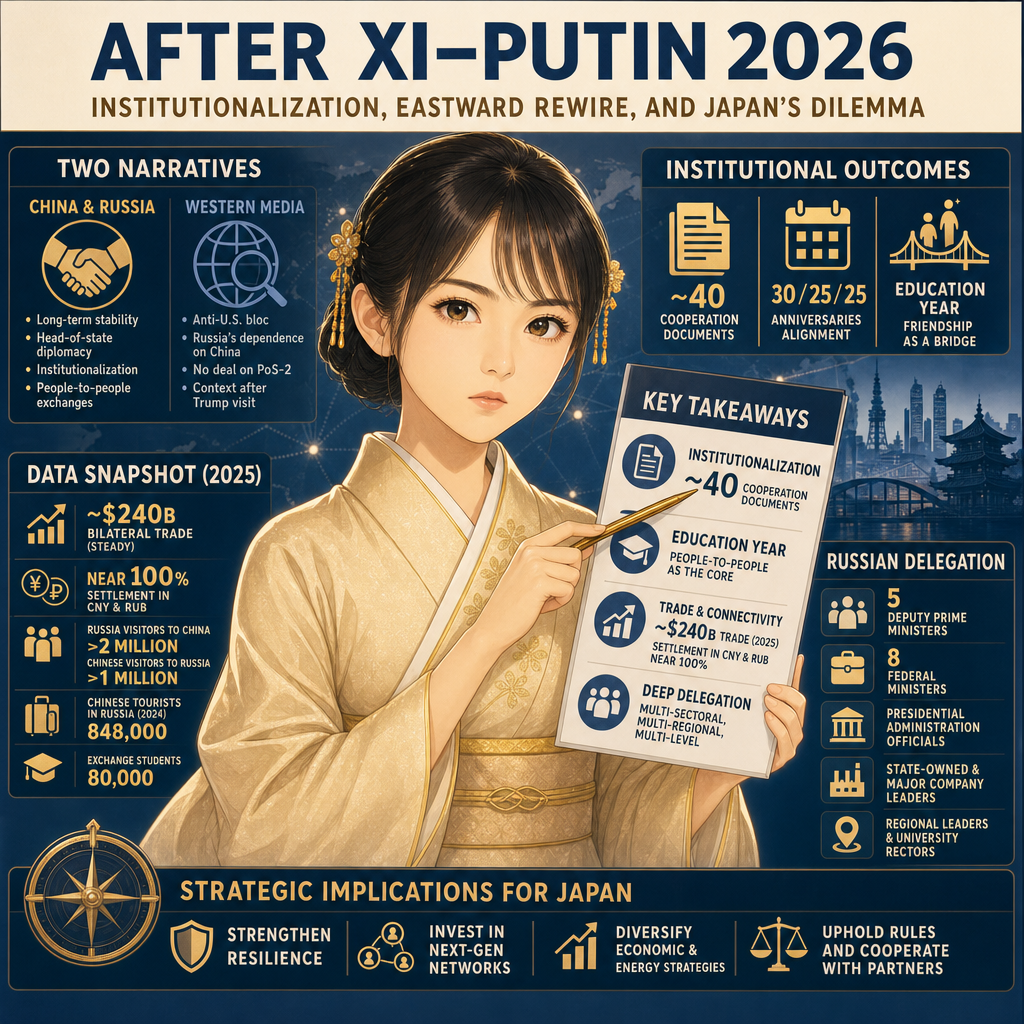
The same meeting looked different in Chinese- and Russian-language messaging. The Chinese side foregrounded “long-term stability,” “head-of-state diplomacy,” “education and people-to-people exchanges,” and “institutionalization.” The Russian side stressed “relations between equal major powers,” “42 documents,” and the scale of its delegation. The divergence lay less in the facts themselves than in which facts each side made central.
What the Counting Method Revealed
The number of signed documents shows this difference in meaning especially clearly. The Chinese Foreign Ministry stated that, in addition to 20 documents signed in the presence of the two leaders, an equal number in other fields were signed or achieved, for a total of roughly 40 cooperation documents covering areas such as trade, education, and science and technology. RIA Novosti reported that 42 documents were signed as the overall result of the visit, while another RIA article stated that 20 joint documents were signed in the presence of the leaders. This is not a contradiction so much as a distinction between documents counted at the central leaders’ event and outcome documents adopted or signed across the entire visit. The Chinese account is in the Chinese Foreign Ministry; the Russian total is in RIA Novosti; and the documents signed in the leaders’ presence are in a separate RIA Novosti report.
This difference in counting was not a mere public-relations discrepancy. The Chinese side showed which fields gained institutional connections. The Russian side showed how many results the visit produced. The Beijing meeting was staged not only as a friendly photograph between leaders but also as a bundle of documents linking ministries, companies, universities, and regions.
In the context of institutionalization, the arrangement of anniversaries also mattered. Chinese media discussed the meeting within several milestones: the 30th anniversary of the China-Russia strategic partnership of coordination, and the 25th anniversaries of both the Treaty of Good-Neighborliness and Friendly Cooperation and the Shanghai Cooperation Organization (SCO). Xinhua used expressions such as “higher-quality comprehensive strategic coordination” and “supporting each country’s national development and rejuvenation.” It emphasized a long-term, healthy, stable, and high-quality relationship more than opposition to the United States in itself. This framing appears clearly in Xinhua.
The Quiet Central Actor: The Education Year
On the same schedule at the Great Hall of the People, an event received less attention in Western coverage. People’s Daily gave prominent treatment to Xi and Putin’s joint attendance that afternoon at the opening ceremony of the “China-Russia Education Year,” positioning education as a “bridge” that connects public sentiment and carries forward friendship. Compared with headlines on the military or energy, the event looked subdued. In terms of building the next generation of human networks, however, it stood close to the core of institutionalization. The report appears in People’s Daily.
Supplementary data also show the depth of education and people-to-people exchange. China-Russia bilateral trade in 2025 was about $240 billion, the same level as in 2024, and exceeded $200 billion for the third consecutive year. The share of bilateral settlement in rubles and yuan approached nearly 100%. In the same year, Russian visits to China exceeded 2 million, Chinese visits to Russia exceeded 1 million, and Chinese nationals accounted for about 50% of inbound tourists to Russia. In 2024, Chinese tourist visits to Russia numbered 848,000, and the total number of exchange students between China and Russia was reported at 80,000. Taken alone, these figures look like trade and mobility statistics. Beijing’s emphasis lay in the role of movement and study as circuits that embed political relations into the next generation.
Xinhua also reported that the two leaders viewed a photo exhibition together and stated that Xi and Putin had met more than 40 times since 2013. The phrase “the guidance of the heads of state is the greatest advantage” carried the promotional tone of Chinese-style head-of-state diplomacy. The structure presented institutions as supported not only by treaties and documents, but also by sustained trust between the top leaders. This staging appears strongly in a Xinhua feature.
The Depth of the Delegation Shown by Russia
Russian-language media emphasized more than the number of documents. RIA Novosti reported that Putin’s accompanying delegation included five deputy prime ministers, eight federal ministers, presidential administration officials, heads of state-owned and major companies, leaders of several regions, and university rectors. This composition meant Russia sought to present its relationship with China not as protocol confined to leaders’ diplomacy, but as a practical relationship spanning industry, regions, and education. The delegation’s composition appears in RIA Novosti.
This staging also mattered for the Russian side. Seen from the West, Russia is often depicted as the party deepening its dependence on China. In RIA’s narrative, however, the Beijing visit was an event in which an “equal strategic partner” accumulated many documents, and the depth of the working delegation served as evidence reinforcing that equality. Here again, the facts were the same, but the presentation differed.
The Unresolved Issues Picked Up by Western Reporting
Western reporting did not miss the point. On Power of Siberia 2, Reuters reported that a “general understanding” had been reached, but details such as price and timing remained unresolved and no formal agreement had been concluded. The absence of a decision on a major gas project is an important fact in measuring the meeting’s results. This point follows Reuters.
At the same time, as AP reported, the meeting took place after Trump’s visit to China, which created a strong incentive to read U.S.-China relations alongside China-Russia relations. Reuters also reported the meeting through a structure in which Xi and Putin criticized the United States while failing to reach a major gas agreement. AP’s placement appears in AP News, and Reuters’ meeting report appears in Reuters.
The reading of official wording still requires care. The center of the Chinese Foreign Ministry’s messaging is its reference to unilateralism, hegemonism, and global governance reform. It is natural to read this as criticism aimed at the United States. Extending that reading to an indirect naming of Japan as well requires separate evidence. The Chinese Foreign Ministry’s regular press conference appears here.
Summary of Part 1
The largest difference around the Beijing meeting was not whether it produced results, but what counted as a result. The West saw coordination against the United States, the absence of agreement on Power of Siberia 2, and Russia’s dependence on China. The Chinese side showed treaty extension, head-of-state diplomacy, the Education Year, people-to-people exchange, and long-term stability. The Russian side sought to demonstrate relations between equal major powers through 42 documents and the depth of its working delegation.
Therefore, reading the meeting as having “limited results” solely through the success or failure of an energy agreement misses the main line that Beijing and Moscow displayed at home and abroad. China and Russia staged not a short-term transaction, but the work of embedding the relationship into education, regions, ministries, companies, treaties, and trust between leaders. The handshake in the Great Hall of the People was less an alliance declaration than a ritual of long-term fixation.
The next installment examines how China connects this long-term fixation to its diplomatic positioning.
Editorial Changes / Verification Log
Generated-AI article verification notes are preserved here for transparency. Expand for before/after edits and source checks.
1. (unspecified section) — sentence_split
Before:
The Chinese Foreign Ministry described the meeting as a deepening of the “comprehensive strategic partnership of coordination” and stated that the two countries issued joint statements on extending the China-Russia Treaty of Good-Neighborliness and Friendly Cooperation, building a fairer, more reasonable, just, and equitable international order, and promoting multipolarity.
After:
The Chinese Foreign Ministry described the meeting as a deepening of the “comprehensive strategic partnership of coordination.” It also stated that the two countries issued joint statements on extending the China-Russia Treaty of Good-Neighborliness and Friendly Cooperation, building a fairer and more equitable international order, and promoting multipolarity.
Reason: Split a long sentence and trimmed repetitive adjectives for readability without changing claims.
2. (unspecified section) — connective_trimmed
Before:
Read only through Western headlines, the scene becomes far simpler.
After:
Read only through Western headlines, the scene becomes simpler.
Reason: Removed unnecessary intensifier to keep the declarative register tight.
3. (unspecified section) — other
Before:
The basis for this account appears in the Chinese Foreign Ministry’s meeting announcement and joint statement announcement.
After:
The basis for this account is set out in the Chinese Foreign Ministry’s meeting announcement and joint statement announcement.
Reason: Rephrased for clearer attribution while keeping the same citations.
4. (unspecified section) — sentence_split
Before:
This is not so much a contradiction as a distinction between documents counted at the central leaders’ event and outcome documents adopted or signed across the entire visit.
After:
This is not a contradiction so much as a distinction between documents counted at the central leaders’ event and outcome documents adopted or signed across the entire visit.
Reason: Minor reordering and simplification to improve flow.
5. (unspecified section) — sentence_split
Before:
People’s Daily gave prominent treatment to Xi and Putin’s joint attendance that afternoon at the opening ceremony of the “China-Russia Education Year,” positioning education as a “bridge” that connects public sentiment and carries forward friendship.
After:
People’s Daily gave prominent treatment to Xi and Putin’s joint attendance that afternoon at the opening ceremony of the “China-Russia Education Year.” It positioned education as a “bridge” that connects public sentiment and carries forward friendship.
Reason: Split for clarity and to keep sentence length manageable.
6. (unspecified section) — connective_trimmed
Before:
At the same time, as AP reported, the meeting took place after Trump’s visit to China, which created a strong incentive to read U.S.-China relations alongside China-Russia relations.
After:
At the same time, as AP reported, the meeting took place after Trump’s visit to China, creating a strong incentive to read U.S.-China relations alongside China-Russia relations.
Reason: Removed a filler relative clause to streamline without altering meaning.