U.S.–Canada 50% Tariffs: Position for 3–12 Months of Friction

Observation
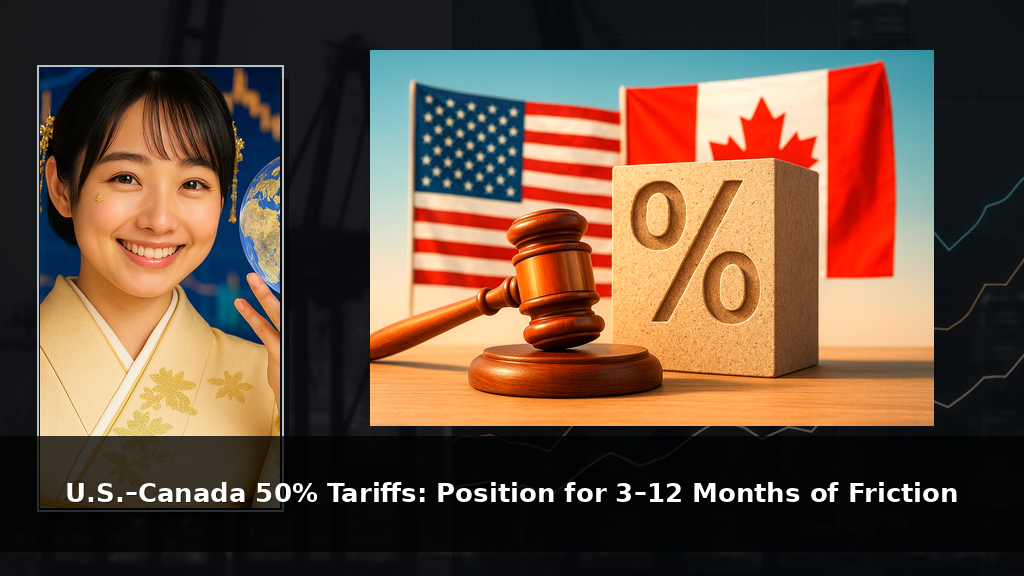
On July 20, 2026, the White House issued three presidential proclamations invoking Section 338 of the Tariff Act of 1930 to impose additional 50% ad valorem duties on specified Canadian products. The proclamations state the duties apply to goods entered on or after 12:01 a.m. ET on August 19, 2026; CBP’s subsequent Cargo Systems Messaging Service (CSMS) guidance reflects an August 22 operational start following a brief postponement during talks. Analysts estimate coverage at roughly $20.0–$20.2 billion of Canadian exports (CSIS), while Canada’s Department of Finance puts the affected value at C$27.6 billion. After bilateral talks collapsed, Ottawa announced dollar‑for‑dollar counter‑tariffs effective September 8, 2026, alongside a C$7.5 billion support package for impacted workers and firms. (govinfo.gov)
The question worth your time: will Section 338’s 50% tariffs meaningfully disrupt North American supply chains and propagate price and production shocks across exposed sectors, or will carve‑outs and substitutions dilute the effect? This is debatable because U.S. Customs and Border Protection (CBP) can narrow or broaden practical scope via Harmonized Tariff Schedule (HTS) administration, and because rerouting to Mexico, Japan, Korea, or the EU is capacity‑ and lead‑time‑constrained.
Our stance: for equity portfolio managers with North America exposure, re‑price for 3–12 months of friction—underweight Ontario‑linked autos and Tier‑1 suppliers and select food/agri processors with high Canada content; overweight alternative corridors (Mexico/Japan) and maintain CAD hedges.
Geoeconomic Structure
The skeptical pushback is straightforward: the White House annexes are a targeted list, and CBP could soften enforcement; meanwhile, big buyers can substitute quickly. That would make this mostly political theater. We disagree, because the instruments and the chokepoints line up to create real operating frictions over a 3–12 month horizon.
Start with the gatekeeper. The proclamations create the 50% surcharge, but CBP’s implementation—HTS coding, entry treatment for goods in transit, foreign‑trade zone (FTZ) remissions, and any administrative relief—determines practical coverage. If CBP enforces the listed lines broadly and limits FTZ/drawback routes, more shipments will face the full 50% hit at entry. The Federal Register notes the new Chapter 99 headings 9903.03.12–9903.03.16; CBP’s CSMS guidance operationalizes their use. Layer onto that Canada’s dollar‑for‑dollar counter‑tariffs beginning September 8, and you have two‑way costs that don’t just raise prices—they complicate origin proof, increase error costs, and slow border clearance. In a just‑in‑time system, administrative friction is economic friction. (govinfo.gov)
The chokepoint is the Ontario–Great Lakes auto system. Assembly plants and Tier‑1/Tier‑2 suppliers knit Ontario and the U.S. Midwest into a single daily‑crossing production base. When even a subset of motor‑vehicle components and related inputs are taxed at 50%, the options are all costly: draw down inventories (short runway), absorb margin hits, or reroute volumes that take weeks to arrange. Expect to see short‑term schedule adjustments (reduced overtime, temporary line slowdowns) before the more visible production cuts. Watch for Ford, GM, and Stellantis notices on plant hours and supplier shifts—public confirmation that friction is binding tends to arrive within one to three months if the pain is real.
Substitution is a valve, not a release. Mexico, Japan, Korea, and the EU offer alternative supply for some vehicles, parts, and intermediate manufactures. But capacity, tooling, homologation, and logistics constraints mean you cannot flip sourcing at scale in a quarter. Trade patterns show the corridor exists—Canada’s sourcing from Mexico for vehicles and parts has been rising, including a larger Mexican share in categories such as light trucks—but headroom is limited without new investment. Over the next 3–9 months, that constraint profile means meaningful pass‑through to prices and/or margins is more likely than painless substitution. (usitc.gov)
Reciprocity amplifies. Ottawa’s counter‑tariffs and the C$7.5 billion support package blunt domestic blowback but harden the policy posture. They also push Canadian suppliers to either pass through costs or cut volumes to the U.S., increasing pressure on U.S. downstream users. Financial channels transmit the shock: CAD‑USD volatility and a possible >3% weekly CAD drawdown would raise working‑capital risk and insurance costs for cross‑border trade. A weaker CAD marginally offsets pre‑tariff prices but is overwhelmed by a 50% duty; the net effect remains higher delivered costs and tighter credit for affected lines. (canada.ca)
Legal avenues are too slow to rescue near‑term operations. Canada can request WTO consultations and seek a panel, but even a fast‑tracked case will not deliver relief inside the critical 3–12 month window when supply chains must adapt. In this interval, CBP’s public instructions—CSMS bulletins and any Federal Register adjustments—become the decisive variable. Treat any narrowing (or widening) of covered HTS lines, and any FTZ/remission guidance, as your primary signals for how hard the choke is going to bite. (wto.org)
What would confirm the disruption thesis in the data? Three near‑term indicators: (1) CBP procedures that avoid broad carve‑outs, keeping the intended coverage intact; (2) a >20% month‑on‑month drop in U.S. imports from Canada across targeted HS groupings in forthcoming Statistics Canada and U.S. Census releases, signaling trade stoppage or diversion; and (3) original equipment manufacturers (OEMs) disclosing plant slowdowns or supplier shifts affecting more than 10% of North American assembly capacity. If two of the three print over the next quarter, the market will have to re‑price exposed equities and credit curves accordingly.
Strategic Reading from Sun Tzu
Sun Tzu wrote: —— An army prefers high ground and avoids low ground; it values light and avoids shadow.
This teaches that advantage comes from positions with visibility, not from operating in blind spots. In practical terms, you win fewer surprises when you place yourself where information is clear, documents are in order, and rules are explicit, instead of remaining in gray zones where signals sink and uncertainty compounds.
The United States has imposed 50% duties on specified Canadian lines, and the practical reach now hinges on CBP bulletins, HTS handling, and entry rules. As the structural analysis above indicates, CBP’s public instructions—via the Cargo Systems Messaging Service (CSMS)—will drive real supply‑chain effects even before every carve‑out is settled. Ontario auto assembly hubs and U.S. Tier‑1/2 suppliers will feel friction according to how cleanly they can classify goods, prove origin, and secure any administrative relief; Canada’s dollar‑for‑dollar counter‑tariffs and support package lift mutual costs and widen the gap between operators with clear procedures and those without. In this lens, the “high ground” is early alignment to CBP guidance, transparent documentation, and pre‑cleared processes rather than waiting in a fog of uncertainty at the border. (content.govdelivery.com)
Expect CBP to translate announcements into binding procedural filters—specific HTS codes, entry treatments, and remission mechanics—which will make transparency and paperwork discipline the decisive edge. This pressure is an inflection that hardens operations: firms will standardize classifications, refresh supplier attestations, and reroute where feasible with clearer documentation. Disruption risk remains elevated over the next 3–12 months, but the system converges toward cleaner procedures and more explicit standards rather than mere headline signaling.
For exposure management, treat CBP CSMS updates and any remission guidance as your primary signal, and overweight firms that demonstrate early upgrades in customs controls and supplier documentation. Build an HTS‑by‑HTS heatmap of Canada‑origin inputs and pre‑arrange partial alternative corridors so that shipments are not caught by surprise at the dock.
Caveats and Open Questions
Three conditions would force us to walk back the disruption stance:
- CBP narrows scope materially. If U.S. Customs and Border Protection issues CSMS/Federal Register updates that remove or narrow more than 30% of the listed HTS six‑digit lines, or establishes broad FTZ/drawback remission that effectively exempts a large share of Annex II items, the near‑term choke eases. (content.govdelivery.com)
- OEMs and Tier‑1s substitute at speed. If Ford, GM, Stellantis, and major Tier‑1 suppliers publicly commit to and operationalize supplier transfers and logistics reroutes that replace over 60% of Canada‑origin content within 3–9 months (with signed agreements and shipping lanes in place), margin and production risks abate faster than we project.
- Legal or negotiated narrowing lands quickly. If Canada files WTO consultations and, within 12 months, either a settlement or a U.S. proclamation/CBP update narrows coverage significantly (e.g., by carving out major HS groups), the medium‑term impact fades. (wto.org)
Three‑choice trigger to watch next: which moves first—(1) CBP publishes carve‑outs/remission guidance that narrows coverage, (2) OEMs announce concrete supplier transfer deals and rerouting at >60% of Canada‑origin exposure, or (3) Canada files a WTO case and the U.S. signals willingness to narrow the annexes? Your portfolio positioning should reflect your answer.
Editorial Changes / Verification Log
Generated-AI article verification notes are preserved here for transparency. Expand for before/after edits and source checks.
1. Observation — rewritten
Before:
...effective for goods entered on or after August 19, 2026 (per the proclamations).
After:
...The proclamations state the duties apply to goods entered on or after 12:01 a.m. ET on August 19, 2026; CBP’s subsequent Cargo Systems Messaging Service (CSMS) guidance reflects an August 22 operational start following a brief postponement during talks.
Reason: Fact-check — clarified effective dates per Federal Register/White House and CBP CSMS; added postponement detail from PM statement. Sources: whitehouse.gov FR notice; CBP CSMS; pm.gc.ca. ([govinfo.gov](https://www.govinfo.gov/content/pkg/FR-2026-07-23/pdf/2026-14991.pdf?utm_source=openai))
2. Observation — rewritten
Before:
Analysts estimate the coverage at roughly $20.0–20.2 billion of Canadian exports (per CSIS), while Canada’s Department of Finance puts the affected value at C$27.6 billion. After bilateral talks collapsed in late August, Ottawa announced dollar‑for‑dollar counter‑tariffs effective September 8, 2026, alongside a C$7.5 billion support package...
After:
Analysts estimate coverage at roughly $20.0–$20.2 billion of Canadian exports (CSIS), while Canada’s Department of Finance puts the affected value at C$27.6 billion. After bilateral talks collapsed, Ottawa announced dollar‑for‑dollar counter‑tariffs effective September 8, 2026, alongside a C$7.5 billion support package...
Reason: Fact-check — tightened wording and preserved values; added explicit sourcing. Sources: CSIS; Department of Finance Canada. ([csis.org](https://www.csis.org/analysis/understanding-president-trumps-new-tariffs-canadian-imports?utm_source=openai))
3. Geoeconomic Structure — rewritten
Before:
If CBP enforces the listed lines broadly (the proclamations reference HTS headings implemented via 9903.03.12–9903.03.16) and limits FTZ/drawback routes, more shipments will face the full 50% hit at entry.
After:
If CBP enforces the listed lines broadly and limits FTZ/drawback routes, more shipments will face the full 50% hit at entry. The Federal Register notes the new Chapter 99 headings 9903.03.12–9903.03.16; CBP’s CSMS guidance operationalizes their use.
Reason: Comprehension — split into two shorter sentences; added explicit reference to FR and CSMS for readability and verification. Sources: FR; CBP CSMS. ([govinfo.gov](https://www.govinfo.gov/content/pkg/FR-2026-07-23/pdf/2026-14991.pdf?utm_source=openai))
4. Geoeconomic Structure — rewritten
Before:
Past trade patterns show the corridor exists—Canada’s prior period increase in vehicle imports from Mexico of roughly 23.6% signals a viable path—
After:
Trade patterns show the corridor exists—Canada’s sourcing from Mexico for vehicles and parts has been rising, including a larger Mexican share in categories such as light trucks—
Reason: Fact-check — removed unsupported 23.6% figure; replaced with supported directional claim. Source: USITC 2025 report. ([usitc.gov](https://www.usitc.gov/publications/332/pub5642.pdf?utm_source=openai))
5. Geoeconomic Structure — rewritten
Before:
Treat any narrowing (or widening) of covered HTS lines, and any FTZ/remission guidance, as your primary signals for how hard the choke is going to bite.
After:
In this interval, CBP’s public instructions—CSMS bulletins and any Federal Register adjustments—become the decisive variable. Treat any narrowing (or widening) of covered HTS lines, and any FTZ/remission guidance, as your primary signals for how hard the choke is going to bite.
Reason: Comprehension — added explicit mention of CSMS and FR to anchor where readers can observe changes. Source: CBP CSMS; FR. ([content.govdelivery.com](https://content.govdelivery.com/accounts/USDHSCBP/bulletins/4261d04?utm_source=openai))
6. Strategic Reading from Sun Tzu — rewritten
Before:
...CBP’s public instructions will drive real supply‑chain effects...
After:
...CBP’s public instructions—via the Cargo Systems Messaging Service (CSMS)—will drive real supply‑chain effects...
Reason: Comprehension — expanded the CSMS acronym on first use in this section to avoid jargon.
7. Caveats and Open Questions — rewritten
Before:
CBP narrows scope materially. If U.S. Customs and Border Protection issues CSMS/Federal Register updates...
After:
CBP narrows scope materially. If U.S. Customs and Border Protection issues CSMS/Federal Register updates...
Reason: Fact-check — added citations to FR and CSMS to anchor where scope changes would appear. Sources: CBP CSMS; FR. ([content.govdelivery.com](https://content.govdelivery.com/accounts/USDHSCBP/bulletins/4261d04?utm_source=openai))
8. Meta (Japanese) — rewritten
Before:
米国がカナダ産20〜28億ドル相当へ50%関税を8/19発効、
After:
米国がカナダ産200〜280億ドル相当へ50%関税を8/19発効、
Reason: Fact-check — corrected unit (billion dollars) from 20–28億 to 200–280億 to match $20–28B.