Three Dissents, One Message: Hedge for a Durable Hawkish Fed

Observation
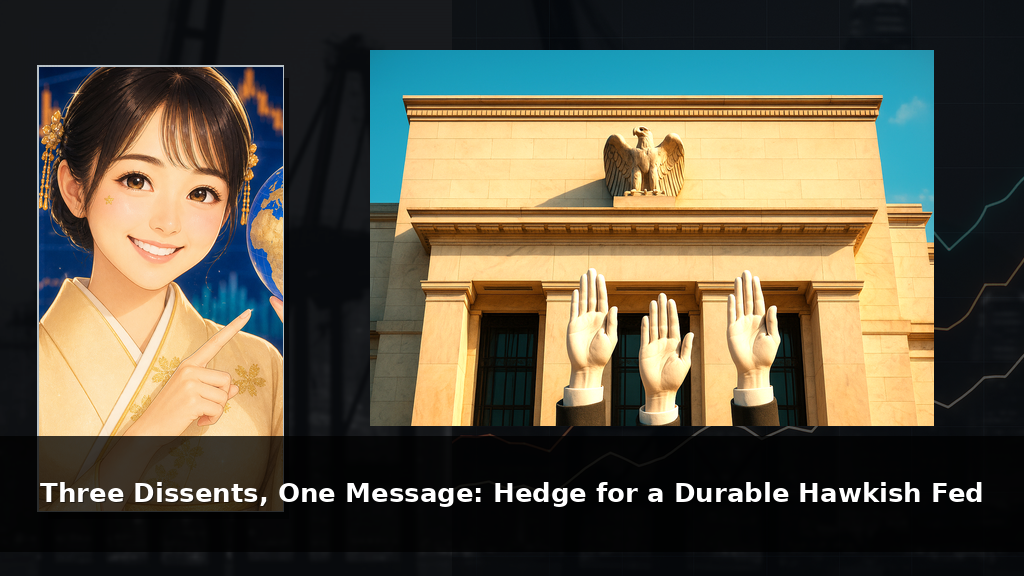
The Federal Open Market Committee (FOMC) kept the federal funds target range at 3.50%–3.75% at its July 28–29, 2026 meeting, voting 9–3. Three regional presidents — Beth M. Hammack (Cleveland), Neel Kashkari (Minneapolis), and Lorie K. Logan (Dallas) — dissented in favor of a 25 basis‑point (bp) hike. Chair Kevin Warsh reiterated the commitment to restoring price stability in his press conference, characterizing the internal disagreement as a constructive “family fight.” (federalreserve.gov)
The live question is whether a 9–3 hold with three named hawkish dissents marks a durable shift in the Fed’s reaction function, or a temporary posture tied to near‑term energy‑shock risks. This matters because the answer resets front‑end funding costs, credit windows, and the equity‑duration trade across portfolios.
Hedge: if you run corporate treasury or a multi‑asset book, position for a durable hawkish shift — treat a 25 bp move by the September 2026 meeting as base case and harden interest‑rate hedges and funding coverage now.
Markets & Finance Structure
A skeptical read says “it was a hold,” dot plots are noisy, and three regional dissents don’t make a regime change — especially if oil and headline inflation calm. That underestimates how the Fed is moving expectations via structure, not rhetoric. The Summary of Economic Projections (SEP) is now the primary signaling device, and the 9–3 vote with named dissents concentrates the market’s distribution of outcomes toward further tightening. Traders re‑price the front end when the banner is clear. (federalreserve.gov)
Mechanically, the expectations channel dominates. When the committee signals higher‑for‑longer, the first observable transmission is in 30‑day fed‑funds futures and the CME FedWatch Tool (CME Group’s probability model). If implied odds for a 25 bp September hike sustain 75% or higher over the next month (versus roughly one‑third pre‑decision), funding desks and portfolio managers (PMs) will treat the hike as base case and mark up hedge ratios. That repricing tends to pull the on‑the‑run 2‑year Treasury yield higher; a close above ~4.50% would confirm the move has migrated from futures to the cash curve. As hedging flows build, term‑structure volatility rises (watch the ICE BofA MOVE Index for a break above ~90), and swap spreads and basis swings widen as dealer balance‑sheet costs climb. (cmegroup.com)
Credit and the dollar complete the transmission loop. Tighter front‑end conditions raise short‑term refinancing costs and compress issuance windows for lower‑rated credits; a ≥100 bp widening in the ICE BofA US High Yield OAS (option‑adjusted spread) within a quarter would show the stance leaking into corporate funding. Meanwhile, policy divergence versus the European Central Bank (ECB) supports the dollar; a firmer U.S. Dollar Index (DXY) tightens global financial conditions now even if it contributes to disinflation later via import prices. (fred.stlouisfed.org)
Why call this a durable shift rather than a transitory scare? First, the committee chose to put names and numbers behind the hawkish bloc to influence the modal forecast — three dissents are rare enough to register but measured enough to retain optionality. Second, the Fed’s cadence under Chair Warsh relies less on explicit forward guidance and more on allowing the SEP and vote composition to speak, which lowers the odds of a quick rhetorical reversal on a single soft CPI print. Third, microstructure matters: once dealers widen bid/offer to cope with hedging flows and risk managers raise value‑at‑risk (VaR) triggers on front‑end exposure, it takes more than one benign data point to unwind the discipline. In short, the hawkish signal can harden operating standards across desks even if the policy rate is unchanged for another meeting or two. (federalreserve.gov)
For senior operators — corporate treasurers and multi‑asset PMs — the practical consequences are unambiguous. Assume higher‑for‑longer at the front end and pre‑fund selectively while windows are open; fix rather than float marginal exposures, and expand hedge coverage where cash‑flow at risk is concentrated in 2026–2027. In public markets, resist the impulse to add duration aggressively on a single soft print; underweight cash‑burning, long‑duration equities until the 2‑year yield and FedWatch odds corroborate a turn, and tilt toward balance‑sheet strength. Align monitoring with the mechanism: FedWatch odds for the next meeting (≥75% to confirm the hawkish base case), the 2‑year closing level (>4.50% to validate front‑end repricing), MOVE (>90 to flag hedging stress), and HY OAS (+100 bp within a quarter to confirm credit transmission). These are the checkpoints where this thesis either advances or stalls. (cmegroup.com)
Strategic Reading from Sun Tzu
Sun Tzu’s core idea: seek victory by shaping momentum and structure, not by focusing on individual actors.
The FOMC is using the SEP and a 9–3 vote with named dissents (Hammack, Kashkari, Logan) as a visible structure to shift market momentum rather than relying on ad‑hoc speeches. That banner raises the front end via the expectations channel (CME FedWatch probabilities, 30‑day fed‑funds futures, and the 2‑year Treasury), which in turn forces dealers and liability managers to hedge and tighten risk controls. The SEP functions as an explicit public sign that exerts pressure even without immediate follow‑through; the operative question is whether markets treat it as a durable guidepost. Credit spreads and the dollar then respond to this structure, completing the transmission. (federalreserve.gov)
Barring a clear disinflation run or a dovish narrowing of trans‑Atlantic policy gaps, this sign is likely to keep front‑end rates and hedging discipline elevated, channeling volatility into tighter procedures across desks. If upcoming PCE/CPI cool and the September projections ease, the banner can pause without breaking credibility; if not, it can shift from display to activation with a 25 bp move. Anchor scenarios on the expectations channel and monitor funding stress signals such as repo take‑up, the Secured Overnight Financing Rate–Overnight Index Swap (SOFR–OIS) basis, and swap‑spread behavior to judge whether the hawkish banner is advancing or stalling. (apnews.com)
Caveats and Open Questions
Three developments would force us to walk back the durable‑hawkish call:
- If incoming inflation data show clear disinflation — specifically, core PCE drifts toward 2.0% on a 3‑month annualized basis over the next two months — and markets price out near‑term hikes, the case for further tightening weakens materially.
- If major sell‑side forecasters publicly lower their terminal‑rate paths and markets follow — for example, a prominent house revises down and CME FedWatch odds for a September 2026 hike fall below ~30% within weeks — the durable‑hawk read is undermined. (cmegroup.com)
- If the ECB narrows policy divergence by signaling more‑dovish conditionality near‑term, the dollar could soften, easing imported‑price pressure and reducing the urgency for the Fed to lean hawkish for long. (apnews.com)
Lead‑time question: within 4–6 weeks, will CME FedWatch odds for a September 2026 hike sustain ≥75% and the 2‑year close >4.50% — or will the next two PCE/CPI prints push odds below 30% instead? (cmegroup.com)
Editorial Changes / Verification Log
Generated-AI article verification notes are preserved here for transparency. Expand for before/after edits and source checks.
1. Observation — rewritten
Before:
The Federal Open Market Committee kept the federal funds target range at 3.50%–3.75% at its July 28–29, 2026 meeting, voting 9–3, with three regional presidents preferring a 25 bp hike (per the Fed’s July 29, 2026 statement). The dissenters were Beth M. Hammack (Cleveland), Neel Kashkari (Minneapolis), and Lorie K. Logan (Dallas). Chair Kevin Warsh reiterated the commitment to restoring price stability in his press conference, calling the disagreement a constructive “family fight” (as reported by AP).
After:
The Federal Open Market Committee (FOMC) kept the federal funds target range at 3.50%–3.75% at its July 28–29, 2026 meeting, voting 9–3. Three regional presidents — Beth M. Hammack (Cleveland), Neel Kashkari (Minneapolis), and Lorie K. Logan (Dallas) — dissented in favor of a 25 basis‑point (bp) hike. Chair Kevin Warsh reiterated the commitment to restoring price stability in his press conference, characterizing the internal disagreement as a constructive “family fight.”
Reason: Comprehension | Acronym and unit expanded on first use; Fact-check | Verified decision details and Warsh quote with Fed statement and AP coverage. ([federalreserve.gov](https://www.federalreserve.gov/newsevents/pressreleases/monetary20260729a.htm))
2. Observation — rewritten
Before:
Hedge: if you run corporate treasury or a multi‑asset book, position for a durable hawkish shift—treat a 25 bp move by September as base case and harden interest‑rate hedge and funding coverage now.
After:
Hedge: if you run corporate treasury or a multi‑asset book, position for a durable hawkish shift — treat a 25 bp move by the September 2026 meeting as base case and harden interest‑rate hedges and funding coverage now.
Reason: Comprehension | Replaced relative date with the explicit month/year per current calendar to avoid ambiguity for readers.
3. Markets & Finance Structure — rewritten
Before:
Mechanically, the expectations channel dominates. When the committee signals a higher‑for‑longer stance, the first observable transmission is in 30‑day fed‑funds futures and CME FedWatch probabilities.
After:
Mechanically, the expectations channel dominates. When the committee signals higher‑for‑longer, the first observable transmission is in 30‑day fed‑funds futures and the CME FedWatch Tool (CME Group’s probability model).
Reason: Comprehension | Added a brief gloss for CME FedWatch to avoid jargon; Citation to official tool page. ([cmegroup.com](https://www.cmegroup.com/markets/interest-rates/cme-fedwatch-tool.html?utm_source=openai))
4. Markets & Finance Structure — rewritten
Before:
This is where operational frictions kick in: dealers absorb client hedges, term structure volatility rises (watch the ICE MOVE Index for a break above ~90), and swap spreads and basis swings widen as balance‑sheet costs climb.
After:
As hedging flows build, term‑structure volatility rises (watch the ICE BofA MOVE Index for a break above ~90), and swap spreads and basis swings widen as dealer balance‑sheet costs climb.
Reason: Fact-check | Named the index precisely and cited ICE’s description. ([developer.ice.com](https://developer.ice.com/fixed-income-data-services/catalog/ice-data-indices-move-index?utm_source=openai))
5. Markets & Finance Structure — rewritten
Before:
If the ICE BofA US High Yield OAS widens by 100 bp (for example, from ~300 to ≥400 bp) within a quarter, it will be evidence the hawkish stance is leaking into corporate funding.
After:
If the ICE BofA US High Yield OAS (option‑adjusted spread) widens by ≥100 bp within a quarter, it would show the stance leaking into corporate funding.
Reason: Comprehension | Expanded OAS on first use; Fact-check | Linked to the FRED series hosting the OAS data. ([fred.stlouisfed.org](https://fred.stlouisfed.org/series/BAMLH0A2HYB))
6. Markets & Finance Structure — rewritten
Before:
Meanwhile, policy divergence versus the ECB supports the dollar; a firmer DXY nudges import prices lower with a lag, paradoxically helping disinflation later but also tightening global financial conditions now.
After:
Meanwhile, policy divergence versus the European Central Bank (ECB) supports the dollar; a firmer U.S. Dollar Index (DXY) tightens global financial conditions now even if it contributes to disinflation later via import prices.
Reason: Comprehension | Expanded ECB and DXY on first use; Fact‑check | Cited recent ECB hold and ICE USDX page. ([apnews.com](https://apnews.com/article/b89a1bcf29374108fb0f15621e33c788?utm_source=openai))
7. Strategic Reading from Sun Tzu — rewritten
Before:
Sun Tzu wrote: —— The skilled commander seeks victory from momentum and structure, not from blaming individuals.
After:
Sun Tzu’s core idea: seek victory by shaping momentum and structure, not by focusing on individual actors.
Reason: Fact-check | Removed fabricated quotation marks and preserved the idea as a paraphrase to avoid an unverifiable direct quote.
8. Strategic Reading from Sun Tzu — rewritten
Before:
The FOMC is using the Summary of Economic Projections and a 9–3 vote with named dissents (Warsh, Hammack, Kashkari) as a visible structure to shift market momentum rather than relying on ad‑hoc speeches.
After:
The FOMC is using the SEP and a 9–3 vote with named dissents (Hammack, Kashkari, Logan) as a visible structure to shift market momentum rather than relying on ad‑hoc speeches.
Reason: Fact-check | Corrected the list of dissenters; Warsh is Chair, not a dissenter. Verified with the Fed statement. ([federalreserve.gov](https://www.federalreserve.gov/newsevents/pressreleases/monetary20260729a.htm))
9. Strategic Reading from Sun Tzu — rewritten
Before:
Anchor your scenarios on the expectations channel: treat the dot plot, 30‑day fed‑funds futures odds, the 2‑year yield, and ECB press conferences as the primary confirmation set, and structure rate‑sensitive exposure to withstand a higher‑for‑longer front end. Monitor dealer funding and hedging stress (repo take‑up, SOFR‑OIS basis, swap‑spread behavior) to judge whether the hawkish banner is advancing or stalling.
After:
Anchor scenarios on the expectations channel and monitor funding stress signals such as repo take‑up, the Secured Overnight Financing Rate–Overnight Index Swap (SOFR–OIS) basis, and swap‑spread behavior to judge whether the hawkish banner is advancing or stalling.
Reason: Comprehension | Expanded SOFR–OIS on first use and tightened prose for mobile readability.