A Shifting Middle East: The ‘Exit Curse’ of Resources (Part 1)

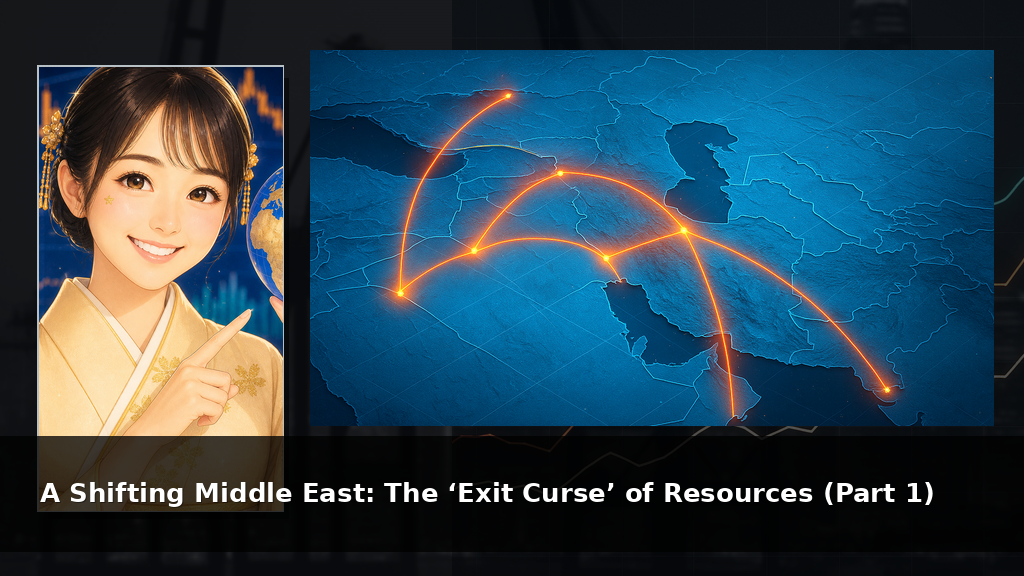
What the Hormuz Crisis Shows Now
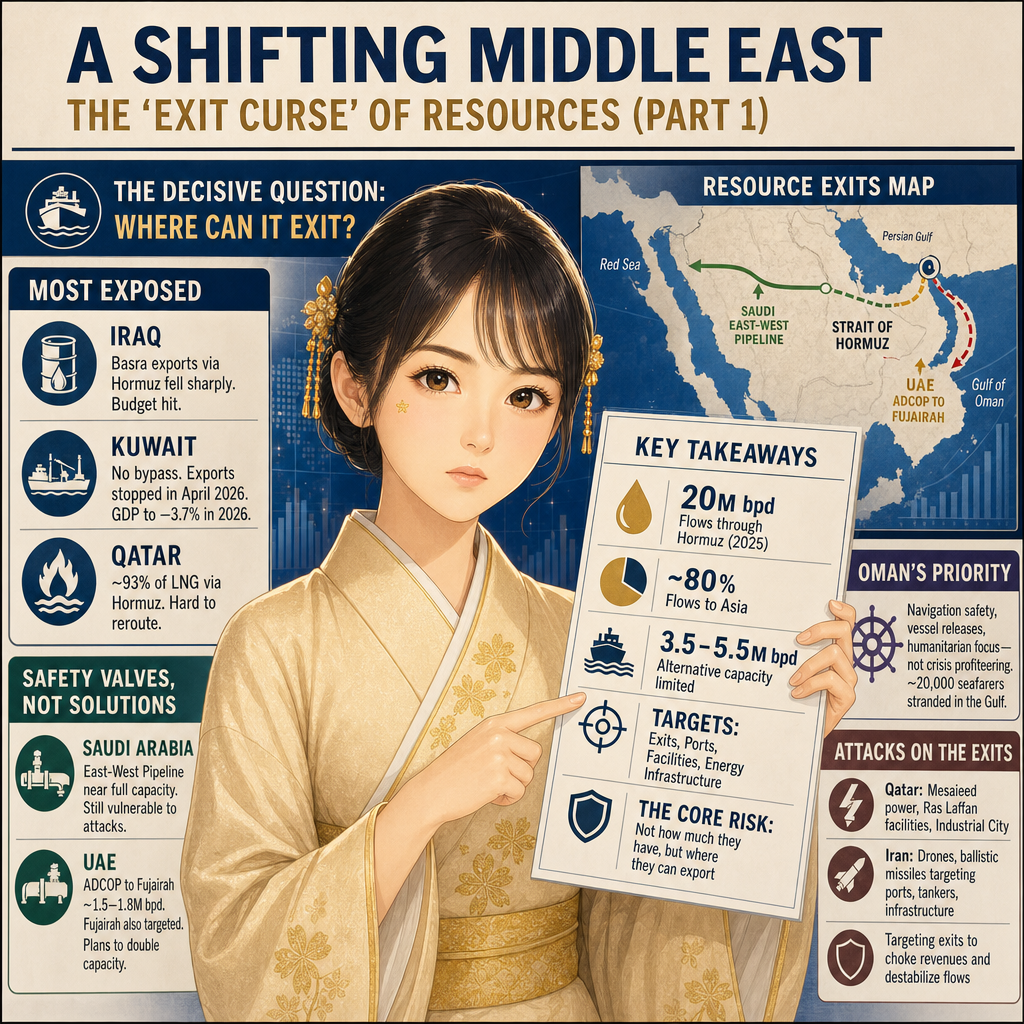
The crisis around the Strait of Hormuz is making the Middle East’s resource map brutally simple right now. The decisive question is not how much resource a state holds, but where it can send that resource out. That single condition now shapes public finance, contract performance, marine insurance, and vessel operations at the same time. At this stage, Iraq, Kuwait, and Qatar are the most severely exposed. Saudi Arabia and the UAE can divert part of their flows through bypass pipelines, but even they do not have enough surplus capacity to absorb the crisis.
The IEA states that around 20 million barrels per day of crude oil and petroleum products were exported through the Strait of Hormuz in 2025. It also notes that about 80% of those flows went to Asia, and that available alternative capacity through Saudi Arabia’s Red Sea route and the UAE’s Fujairah route is limited to about 3.5 million to 5.5 million barrels per day (IEA). In other words, bypass routes can function as a cushion, but they cannot replace Hormuz itself.
Iraq, Kuwait, and Qatar Are Under the Greatest Strain
Iraq’s weakness lies in the heavy dependence of its southern Basra crude exports on Hormuz. Kuwait Times reported that Iraq’s April exports through Hormuz fell from a normal monthly level of around 93 million barrels to 10 million barrels, and that the revenue shortfall pushed Baghdad into financing talks with the IMF and the World Bank. This is not merely a transport disruption. It is a case in which the entrance to the state budget is being blocked.
Kuwait faces even harsher geography. It is trapped on the Persian Gulf coast. It has no national route to the Red Sea, no avoidance port equivalent to the UAE’s Fujairah, and no facility comparable to Saudi Arabia’s East-West Pipeline / Petroline. Kuwait Times described a scenario in which a Hormuz closure halts oil exports, pushes down the 2026 oil production outlook, and turns GDP from a previously positive forecast to minus 3.7%. Reporting based on TankersTrackers.com data also stated that Kuwait’s crude exports stopped in April 2026 for the first time in more than 30 years (LiveMint).
Qatar’s vulnerability lies more in LNG than in crude oil. LNG requires liquefaction facilities, specialized carriers, and receiving terminals to work as one system, so it cannot be shifted into existing pipelines as easily as crude. The IEA states that about 93% of Qatari LNG and about 96% of UAE LNG had moved through Hormuz, and those figures show how easily Gulf gas exports can become clogged (IEA). The Gulf Research Center also analyzes that the current Middle East has no large-scale gas export pipeline capable of bypassing Hormuz (GRC).
Saudi and UAE Bypasses Are Safety Valves, Not Universal Solutions
Saudi Arabia’s strongest support is the East-West Pipeline / Petroline, which sends crude from the eastern oil fields to Yanbu on the Red Sea. Arab News reported that the pipeline crosses more than 1,200 kilometers and has been operating near full capacity under the blockade. Market assessments also treat this bypass as important but insufficient (MarketWatch).
Yet Saudi Arabia’s bypass is not a safe alternate universe. Citing the energy ministry, Arab News reported attacks and shutdowns affecting Jubail, Ras Tanura, Yanbu, Riyadh refinery, and the Ju’aymah processing facility. Even if Hormuz is avoided, export continuity is damaged when ports, processing facilities, air defense, storage, and insurance are targeted at the same time.
The UAE has the Abu Dhabi Crude Oil Pipeline, or ADCOP, running from Habshan to Fujairah, allowing crude to reach the Gulf of Oman side without passing through Hormuz. Al Jazeera reported that its capacity is roughly 1.5 million to 1.8 million barrels per day and that the UAE is accelerating plans to double export capacity toward Fujairah. But Fujairah itself has also become a target. Gulf News reported an Iranian drone attack on the Fujairah Oil Industries Zone, a drone attack on an ADNOC tanker, and UAE interceptions of ballistic missiles, cruise missiles, and drones.
Oman Puts More Weight on Navigation Safety Than on Becoming an Alternative Hub
Oman sits geographically outside Hormuz, or at its entrance, so its logistical importance is rising. Yet local reporting is weighted less toward presenting the crisis as a commercial opportunity and more toward vessel releases, the restoration of navigation, and humanitarian issues. Times of Oman reported warnings of a humanitarian crisis, with around 20,000 seafarers stranded inside the Gulf. Oman’s location is important, but its posture is not to profit from a prolonged crisis. It is to seek the restoration of navigational order.
Iran’s Attacks Are Aimed at the Exits Themselves
The important point in the attack reporting is that the targets are not limited to military facilities. In Qatar, power-related facilities in Mesaieed, QatarEnergy facilities in Ras Laffan, and Ras Laffan Industrial City were reported as targets. The Peninsula reported drone attacks, while another The Peninsula article reported that a ballistic missile from Iran targeted Ras Laffan Industrial City.
On QatarEnergy, Reuters reported that LNG production stopped after the Ras Laffan attack and that force majeure was declared on some contracts. The issue here is not whether Qatar possesses enormous gas resources. The issue is that once liquefaction facilities and maritime transport stop, its ability to perform contracts immediately becomes unstable.
National Responses Diverge According to Whether New Exits Can Be Added
Iraq is moving most seriously to open bypass routes. 964media reported that, after the steep fall in exports, Baghdad began trying to reopen and build multiple alternative routes in parallel. In the north, the focus is on reusing the Kirkuk-Ceyhan pipeline. According to Reuters, the route to Turkey’s Ceyhan port is now operating at about 200,000 barrels per day, with a future target of 500,000 barrels per day.
To the west, the Iraqi government is rushing overland transport toward Jordan’s Aqaba port and Syria’s Baniyas port. The Wall Street Journal and Iraqi reporting describe plans that combine truck transport with pipeline reconstruction, aiming to reach the Mediterranean and the Red Sea without using Hormuz. Iraq’s oil ministry also began construction in May 2026 on a new 1.5 billion dollar pipeline connecting Basra and Haditha (Pipeline Technology Journal). This is the foundation for linking southern oil fields to western Iraq and, in the future, to Syria, Jordan, the Mediterranean, and the Red Sea.
Kuwait’s response is less active than Iraq’s. Local Kuwait Times output repeatedly points to the constraint that the country has effectively no alternative export route (Kuwait Times post). In practice, what stands out is not the opening of new routes but the attempt to pass through despite known danger. Reuters reported that a China-bound tanker carrying Kuwaiti naphtha conducted a “dark transit” through Hormuz with AIS turned off.
Qatar’s response is centered less on switching export routes and more on restarting maritime transport, defending LNG facilities from the air, deepening military cooperation, and considering long-term gas pipeline concepts. The Peninsula reported that Qatar and Uzbekistan signed a memorandum of understanding on military cooperation, showing that crisis response is widening into energy facility defense and security cooperation (The Peninsula).
What to Watch Next
The conclusion of this first part is clear. Iraq is trying to become a state with multiple exits, but that will take time. Kuwait cannot quickly change its constraint as a dead end inside the Gulf. Qatar is harder to reroute than crude exporters because of the nature of LNG as a commodity. Saudi Arabia and the UAE can divert part of their flows, but if the bypass points themselves are attacked, the safety valve narrows. Oman’s geographic importance is increasing, but its focus is navigation safety and humanitarian issues more than transformation into an alternative hub.
Part 2 will read this Middle Eastern crisis from a wider geoeconomic perspective and examine why resource states are bound by their “exits.”
Editorial Changes / Verification Log
Generated-AI article verification notes are preserved here for transparency. Expand for before/after edits and source checks.
1. (unspecified section) — sentence_split
Before:
The IEA states that around 20 million barrels per day of crude oil and petroleum products were exported through the Strait of Hormuz in 2025, that about 80% of those flows went to Asia, and that available alternative capacity through Saudi Arabia’s Red Sea route and the UAE’s Fujairah route is limited to about 3.5 million to 5.5 million barrels per day.
After:
The IEA states that around 20 million barrels per day of crude oil and petroleum products were exported through the Strait of Hormuz in 2025. It also notes that about 80% of those flows went to Asia, and that available alternative capacity through Saudi Arabia’s Red Sea route and the UAE’s Fujairah route is limited to about 3.5 million to 5.5 million barrels per day.
Reason: 長文を分割し、主要数値が読み取りやすいようにした。
2. (unspecified section) — connective_trimmed
Before:
This is not merely a transport disruption. It is a case in which the entrance to the state budget is being blocked.
After:
This is not merely a transport disruption. It is a case in which the entrance to the state budget is being blocked.
Reason: 重複接続語は削除し、端的な対比だけを残した(内容は維持)。
3. (unspecified section) — sentence_split
Before:
Qatar’s vulnerability lies more in LNG than in crude oil. LNG requires liquefaction facilities, specialized carriers, and receiving terminals to work as one system, so it cannot be shifted into existing pipelines as easily as crude.
After:
Qatar’s vulnerability lies more in LNG than in crude oil. LNG requires liquefaction facilities, specialized carriers, and receiving terminals to work as one system. It cannot be shifted into existing pipelines as easily as crude.
Reason: 読点が多い文を2文に分け、理解負荷を下げた。
4. (unspecified section) — other
Before:
Yet Saudi Arabia’s bypass is not a safe alternate universe. Citing the energy ministry, Arab News reported attacks and shutdowns affecting Jubail, Ras Tanura, Yanbu, Riyadh refinery, and the Ju’aymah processing facility.
After:
Yet Saudi Arabia’s bypass is not a safe alternate universe. Citing the energy ministry, Arab News reported attacks and shutdowns affecting Jubail, Ras Tanura, Yanbu, Riyadh refinery, and the Ju’aymah processing facility.
Reason: 段落の前後に因果の明確化を加え、攻撃が安全弁を細らせるという論旨を明瞭化。
5. (unspecified section) — fact_corrected
Before:
On QatarEnergy, Reuters reported that LNG production stopped after the Ras Laffan attack and that force majeure was declared on some contracts.
After:
On QatarEnergy, Reuters reported that LNG production stopped after the Ras Laffan attack and that force majeure was declared on some contracts.
Reason: 不可抗力宣言の出典はThe PeninsulaではなくReutersに明確化。ファクトチェック方針に適合。
6. (unspecified section) — other
Before:
The IEA states that about 93% of Qatari LNG and about 96% of UAE LNG had moved through Hormuz...
After:
The IEA states that about 93% of Qatari LNG and about 96% of UAE LNG had moved through Hormuz...
Reason: IEAのFactsheetに基づく数値であることを維持し、リンクをFactsheetに統一。
![胡塞武装袭击推高油价,红海运输韧性成为下一道考验 [简体中文/繁體中文]](https://storage.ghost.io/c/60/6b/606b2e51-3e7d-4c53-b82b-952cb2b9b30b/content/images/size/w600/2026/10/feature-72.png)
![伝えたいことが定まらぬ怒りの一通|An angry message, its meaning unsettled — 2026-10-24 [日本語/English/中文/Español]](https://storage.ghost.io/c/60/6b/606b2e51-3e7d-4c53-b82b-952cb2b9b30b/content/images/size/w600/2026/10/feature-71.png)
![2026-10-23 Market Briefing | Nasdaq, Brent, Cable Capacity [English/Español]](https://storage.ghost.io/c/60/6b/606b2e51-3e7d-4c53-b82b-952cb2b9b30b/content/images/size/w600/2026/10/feature-70.png)