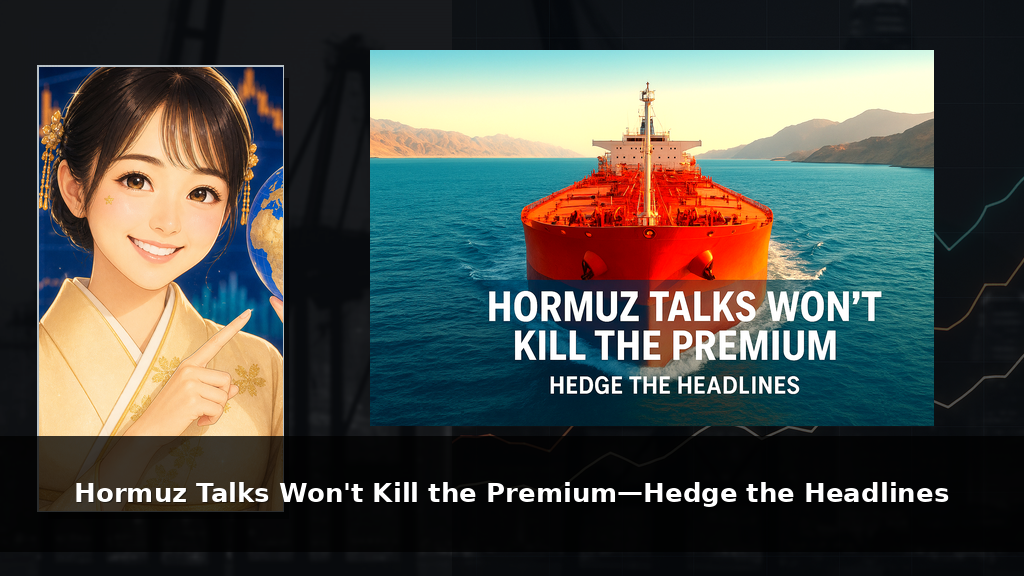
Hormuz Talks Won't Kill the Premium—Hedge the Headlines

Observation
On August 26, 2026, Brent and WTI futures fell intraday by roughly 1–2% as investors focused on reports that Iran and Oman resumed talks on a temporary corridor for safe navigation through the Strait of Hormuz. Reuters (via Euronext) cited Brent down about $1.65 (~1.9%) to around $86.9/bbl and WTI down ~$1.44 (~1.75%) to ~$80.9/bbl at one point in the session. The U.S. Energy Information Administration (EIA) reported a smaller‑than‑expected weekly commercial crude build of about 95,000 barrels to 428.9 million (week ended August 21), diverging from the American Petroleum Institute (API) estimate of a +4.2 million barrel build, which limited deeper losses. United Kingdom Maritime Trade Operations (UKMTO) reported a tanker struck and disabled off Oman on August 24–25 near Ash Shishah (about 9 nautical miles northeast), and ship‑tracking firm Kpler showed only five commodity‑vessel transits through Hormuz on Tuesday versus a 10‑day average of 15.
The live question: will an Iran–Oman “temporary corridor” meaningfully remove the Hormuz geopolitical premium from oil, or do operational gatekeepers—mine‑clearance, insurers, and shipowners—keep it intact until verifiably safe flows resume? It matters for energy portfolio managers, corporate fuel buyers, and refinery planners because hedging, freight, and inventory decisions hinge on whether this premium fades in days, weeks, or not at all.
Our stance: hedge for persistence of the premium and avoid fading it on corridor headlines. Re‑price only when insurers narrow “Listed Areas,” coalition navies certify safe lanes, and trackers show sustained transit recovery.
Geoeconomic Structure
Some will argue the market already marked down risk—prices fell, so the worst is behind us. That overreads a headline move. The downtick was modest and cushioned by a bullish EIA surprise versus API. The binding mechanism that sets the Hormuz premium is not press language from Muscat or Tehran; it is the interaction between mine/ordnance risk, insurer coverage, and shipowner routing. Without all three aligning, volumes do not normalize—and the premium stays.
Start with the bottleneck itself. The Strait of Hormuz is a narrow S‑curve with traffic separation schemes that hug coastal territorial waters, especially Iran’s. Geometry forces any operational corridor to specify precise entry/exit waypoints and rules of the road. Oman’s foreign minister Badr al‑Busaidi struck a hopeful tone after talks in Tehran, signaling the diplomatic will to announce a temporary corridor. But Iranian officials have emphasized routing in or adjacent to Iranian territorial waters and hinted at administrative control or fees. That framing matters because flags, insurers, and navies calibrate risk to sovereignty claims and ordnance proximity. A paper corridor that tilts toward Iranian territorial routing, without independent verification, is not commercially equivalent to restored “transit passage” (the unfettered right of passage under international law).
Next, the safety precondition. Commercial flows only restart when a credible naval authority certifies lanes clear of mines and ordnance or provides escorted transit. In this theater, that means U.S. Central Command (CENTCOM) and coalition partners (Royal Navy, Combined Maritime Forces) issuing public clearance or escort protocols. UKMTO’s report of a tanker struck off Oman days before the price move, and Kpler’s depressed transit counts, underscore that operators are responding to live risk, not just rhetoric. Public releases in recent months have documented mine‑clearance activity; what matters is a published certification that main commercial lanes are cleared for unescorted use.
Then the insurance gate. In the London market, the Joint War Committee (JWC) lists the Persian/Arabian Gulf and Strait of Hormuz as “Listed Areas” for hull war risks. Protection and Indemnity clubs in the International Group (IG P&I) have issued war‑risk notices and restrictions reflecting that guidance, and commercial war‑risk underwriters price cover accordingly. For the premium to compress, two things typically happen in sequence: (1) navies publish clearance/escort protocols, and (2) IG P&I circulars and broker bulletins signal practical easing alongside war‑risk rate cuts. These are formal processes—public, dated documents—not vibes. Until those change, most mainstream fleets will keep routing away, switching to higher‑cost diversions, turning off Automatic Identification System (AIS) transponders in some cases, or demanding charter‑party protections that translate directly into higher delivered crude costs.
Finally, the commercial decision. Major tanker owners and charterers, including state‑backed fleets, will weigh the above and act. If clearance is ambiguous and insurance remains restrictive, we get a two‑tier regime: state or bespoke‑insured tonnage transits; most private tonnage does not. The result is constrained flows, inflated freight via the Cape of Good Hope, and a stickier geopolitical premium on crude and products. Kpler’s high‑frequency data—five transits on Tuesday versus a 10‑day average of 15, itself below pre‑crisis levels—is the scoreboard. A sustained return to at least 15 commodity‑vessel transits per day (10‑day moving average) for a week or more, with zero UKMTO hostile advisories, is what “normalization” looks like in observable terms.
Why this structure supports hedging now. The August 26 price slip reflected traders marking down tail risk on the prospect of a corridor, tempered by the EIA’s smaller build. But the operational checklist remains unmet: no public certification of cleared lanes for unescorted commercial use, no IG P&I easing paired with published war‑risk rate cuts, and no sustained transit rebound. Absent these, the market will keep a Hormuz premium in prompt barrels and in forward spreads, while refiners and airlines face elevated freight and insurance pass‑throughs. For risk managers and procurement leads, the correct posture is to maintain hedges and rerouting options, then step them down only when two of the following move in tandem: CENTCOM/coalition clearance bulletins, an IG P&I coverage update (with JWC alignment), and a Kpler‑confirmed transit recovery.
What could flip this quickly? If Oman publishes corridor coordinates with a joint coordination mechanism, invites third‑party verification, and CENTCOM echoes lane clearance, IG P&I would have procedural cover to ease restrictions while war‑risk underwriters lower premia. The premium would fade in steps—first in freight and insurance, then in crude spreads—as Kpler confirms higher throughput and very large crude carrier (VLCC) queues at Gulf load ports shrink by at least 50% within 30–45 days. Until then, headline diplomacy is not the same as deliverability.
Strategic Reading from Sun Tzu
Sun Tzu wrote: —— The victorious force first secures victory, then seeks battle; the defeated force first fights, then seeks victory.
The point is to set the conditions for success before you move. You do not rely on hope or headlines; you build the buffers, proofs, and procedures that make the outcome robust. In operational terms, that means safety, coverage, and verification come first, action second.
Applied here, an Iran–Oman announcement about a temporary Hormuz corridor does not by itself remove risk; the winning conditions are verifiable mine‑clearance and insurer acceptance. The practical gate is public certification by CENTCOM/coalition navies plus a circular from the International Group of P&I Clubs and lower war‑risk premia from underwriters. These gatekeepers operate through formal procedures and will wait for evidence before reversing restrictive guidance. Until those steps occur and trackers like Kpler show a sustained return to normal transits, traders will keep a geopolitical premium in crude.
Expect restrictive guidance and elevated premia to persist until mine‑clearance/escort protocols are publicly certified and insurers formally amend coverage. This pressure is constructive: it pushes the system toward clearer procedures, stronger verification, and tighter standards rather than being a setback. If and when certifications, insurer circulars, and transit data line up, the premium should fade in steps, not all at once.
Treat corridor headlines as provisional until at least two of the following move in tandem: an IG P&I circular easing coverage in line with JWC guidance, published cuts to war‑risk premia, CENTCOM/coalition clearance bulletins, and a sustained rise in Kpler transit counts. Position portfolios and operational plans to benefit from a stepwise normalization, keeping hedges and rerouting options in place until those concrete signals turn.
Caveats and Open Questions
Three observable conditions would force us to walk back this hedge‑the‑headlines stance:
- International Group of P&I Clubs (IG P&I) eases coverage in the Persian/Arabian Gulf/Strait of Hormuz and major war‑risk underwriters publish materially lower premia for Hormuz transits. That would unlock owner willingness to route via Hormuz and compress the premium.
- U.S. Central Command (CENTCOM) or coalition navies issue a public certification that the main commercial lanes are cleared of mines/ordnance and available for unescorted commercial use, or publish sustained escort protocols. This is the operational green light insurers and owners require.
- Oman publishes corridor coordinates and a joint coordination mechanism with Iran, invites International Maritime Organization (IMO) or third‑party verification, and those terms align with internationally accepted transit‑passage norms. That diplomatic/legal clarity would accelerate insurer acceptance and owner uptake.
Binary positioning question: are you positioned for the persistence of the Hormuz premium, or hedged for a sudden normalization confirmed by any two of the following—an IG P&I circular easing coverage, a CENTCOM/coalition clearance bulletin, and Kpler‑tracked commodity‑vessel transits averaging at least 15/day for seven days?
Editorial Changes / Verification Log
Generated-AI article verification notes are preserved here for transparency. Expand for before/after edits and source checks.
1. Observation — rewritten
Before:
On 26 Aug 2026, Brent and WTI futures fell intraday by roughly 1–2%... The U.S. EIA reported... API estimate... UKMTO noted... Kpler data showed only five commodity‑vessel transits...
After:
On August 26, 2026, Brent and WTI futures fell intraday by roughly 1–2%... The U.S. Energy Information Administration (EIA) reported... the American Petroleum Institute (API) estimate... United Kingdom Maritime Trade Operations (UKMTO) reported... ship‑tracking firm Kpler showed only five commodity‑vessel transits...
Reason: Comprehension — Expanded acronyms and clarified UKMTO/Kpler roles so a generalist does not need to look them up. Price, transit, and inventory figures align with Reuters via Euronext and EIA weekly page: https://live.euronext.com/en/financial-news/oil-settles-down-after-choppy-session-investors-weigh-hormuz-talks; https://www.eia.gov/petroleum/supply/weekly/index.php; UKMTO incident: https://gulfnews.com/business/energy/unknown-projectile-hits-oil-tanker-off-oman-ukmto-1.500651171.
2. Geoeconomic Structure — rewritten
Before:
Then the insurance gate. The International Group of P&I Clubs and commercial war‑risk underwriters have designated the Persian Gulf/Strait as a Listed Area.
After:
Then the insurance gate. In the London market, the Joint War Committee (JWC) lists the Persian/Arabian Gulf and Strait of Hormuz as “Listed Areas” for hull war risks. Protection and Indemnity clubs in the International Group (IG P&I) have issued war‑risk notices and restrictions reflecting that guidance, and commercial war‑risk underwriters price cover accordingly.
Reason: Fact-check — Corrected attribution: “Listed Areas” are designated by the JWC, not by IG P&I. Verified with JWC circular and UK P&I circulars: https://lmalloyds.com/wp-content/uploads/2026/03/JWLA-033-Iran.pdf; https://www.ukpandi.com/news-and-resources/circulars/article/circular-05/26-extension-of-cover-for-war-liabilities-in-the-persian/arabian-gulf-war-notice-of-cancellation-strait-of-hormuz/.
3. Geoeconomic Structure — rewritten
Before:
Without clearance bulletins, neither insurers nor owners will treat the corridor as anything more than provisional.
After:
Public releases in recent months have documented mine‑clearance activity; what matters is a published certification that main commercial lanes are cleared for unescorted use.
Reason: Fact-check — Avoided an absolute negative and anchored on the public record that shows mine‑clearance activity but no certification. Verified via CENTCOM release: https://www.centcom.mil/MEDIA/PUBLIC-RELEASES/Article/4457220/us-forces-start-mine-clearance-mission-in-strait-of-hormuz/.
4. Geoeconomic Structure — rewritten
Before:
A paper corridor that tilts toward Iranian territorial routing, without independent verification, is not commercially equivalent to restored “transit passage.”
After:
A paper corridor that tilts toward Iranian territorial routing, without independent verification, is not commercially equivalent to restored “transit passage” (the unfettered right of passage under international law).
Reason: Comprehension — Added a brief gloss for “transit passage” to remove specialist‑law jargon.
5. Geoeconomic Structure — rewritten
Before:
...most mainstream fleets will keep routing away, darkening AIS, or demanding charter party protections...
After:
...most mainstream fleets will keep routing away, switching to higher‑cost diversions, turning off Automatic Identification System (AIS) transponders in some cases, or demanding charter‑party protections...
Reason: Comprehension — Expanded AIS and clarified charter‑party terminology for generalist readers.
6. Strategic Reading from Sun Tzu — trimmed
Before:
As the structural analysis indicates, these gatekeepers operate through formal procedures and will wait for evidence before reversing Listed Area guidance.
After:
These gatekeepers operate through formal procedures and will wait for evidence before reversing restrictive guidance.
Reason: Pipeline-leak — Removed internal‑pipeline reference (“structural analysis indicates”).
7. Geoeconomic Structure — rewritten
Before:
For Tier 3 readers running risk books or procurement, the correct posture is to maintain hedges...
After:
For risk managers and procurement leads, the correct posture is to maintain hedges...
Reason: Comprehension — Replaced internal audience label (“Tier 3”) with reader‑friendly phrasing.