2026-05-29 Market Briefing| AI dealflow, Brent $91.38, FBX $2,233

Good morning. Record equity prints ride AI/cloud dealflow while long yields ease, oil slips on ceasefire headlines, and container costs stay elevated. The mix shifts margins and financing conditions across consumer, materials, and rate‑sensitive assets. Today favors monetization quality and distribution reach over raw volume as policy and platform gatekeepers shape flows.
Stocks and FX
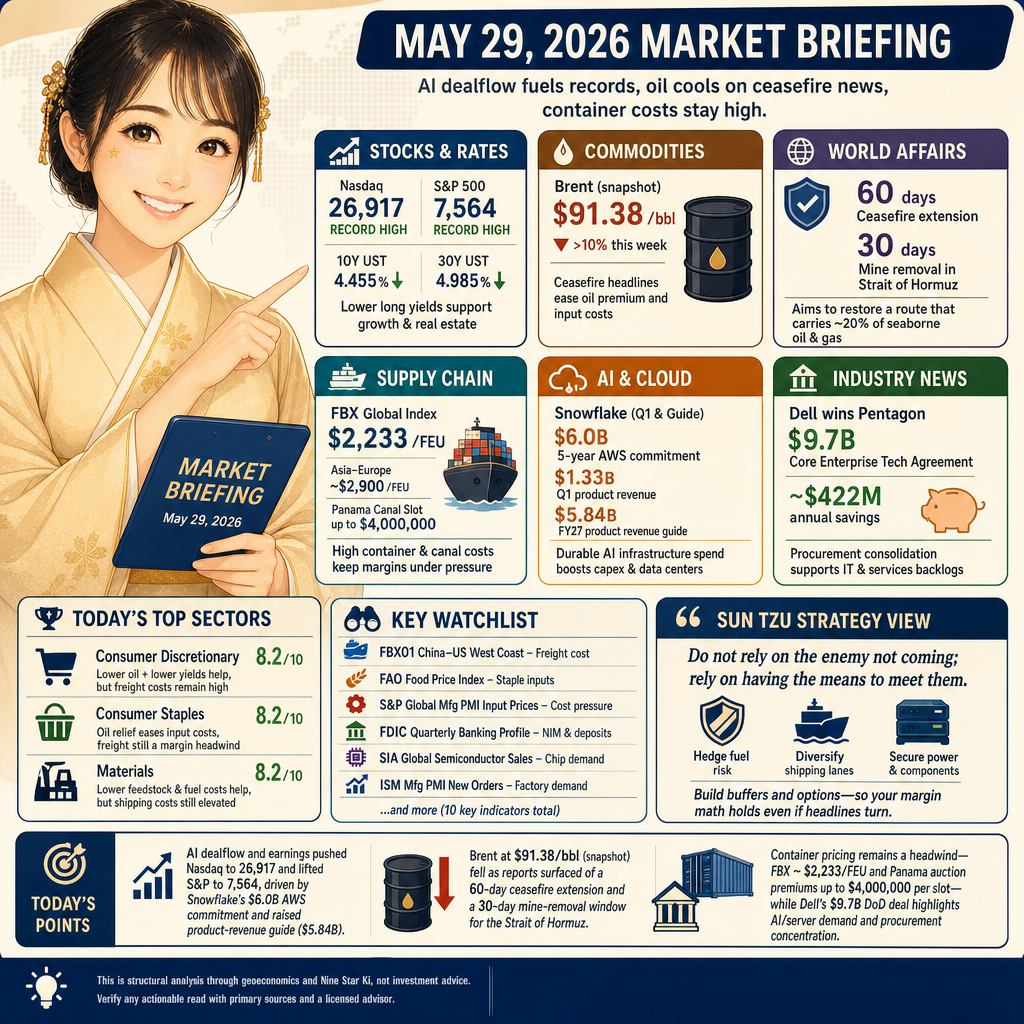
26,917 on the Nasdaq and 7,564 on the S&P 500 set fresh highs as AI/cloud announcements lifted sentiment, per Thomson Reuters. 4.455% on the 10‑year UST and 4.985% on the 30‑year lower discount rates, supporting growth‑stock valuations. 159.260 on USD/JPY and 1.1647 on EUR/USD sharpen FX translation and hedging costs for multinationals and dealers. A tech‑led tape plus easier long yields bolsters Information Technology and Real Estate while splitting Financials between weaker NIM and stronger fee income.
Commodities
91.38 $/bbl for Brent (snapshot) and 87.81 $/bbl for WTI followed Reuters’ reporting of a potential U.S.–Iran ceasefire and steps to reopen Hormuz. A weekly drop of more than 10% trims fuel, packaging, and petrochemical costs while pressuring upstream realizations. If shipping lanes normalize, lower marine insurance and steadier crude/product flows further ease input inflation for Industrials, Materials, and Consumer sectors.
World Affairs
60 days for a ceasefire extension and 30 days for mine removal in the Strait of Hormuz are in the AP‑reported draft, with the goal of restoring a route that once carried about one‑fifth of seaborne oil and gas. A credible framework compresses the oil risk premium, supports trade, and reduces freight insurance. That channels into lower Energy volatility, better transport margins, and an easier macro tape that pairs with softer long yields.
Supply Chain
2,233 $/FEU on the FBX global index, roughly $2,900/FEU on Asia–Europe, and up to $4,000,000 per Panama Canal slot keep landed costs elevated, per Freightos and shipbroker reports. Higher container prices and longer transits stretch inventory cycles and compress retail and manufacturer margins. Logistics providers retain pricing power, while any Hormuz normalization could shorten reroutes and ease schedules.
AI
6.0 billion dollars in a five‑year AWS commitment, $1.33 billion in Q1 product revenue, and a $5.84 billion FY27 guide, Snowflake said via Nasdaq, underscoring durable AI data‑infrastructure spend. That supports hyperscaler capex (capital expenditure) and pulls demand through to compute, memory, advanced packaging, and power. The setup lifts software/platform valuations and increases data‑center build needs across Information Technology, Industrials, and Real Estate.
Industry News
9.7 billion dollars for the Pentagon’s Core Enterprise Technology Agreement with Dell (Breaking Defense) consolidates Microsoft licensing and cloud subscriptions, with about $422 million per year in expected savings. The award enlarges a visible federal revenue pool for software vendors and integrators and can catalyze similar consolidations at other agencies. Procurement centralization supports multi‑year backlogs for federal‑facing IT and services firms.
Industry Forecast
Today's Setup
2026-05-29 runs on Seven Red Metal (Shichiseki Kinsei, 七赤金星) under the month’s Five Yellow Earth (Goou Dosei, 五黄土星) and the year’s One White Water (Ippaku Suisei, 一白水星) during Rikka (Beginning of Summer). Expect a transaction‑heavy tape where platform/policy gatekeepers concentrate flows: input‑cost relief from oil aids margins, financing improves with softer long yields, but elevated container rates keep supply constraints central to planning.
Focus Sectors
- Consumer Discretionary (8.2/10): Freight remains the swing factor as Freightos’ FBX and record Panama slot premiums keep landed costs high, yet Reuters’ Brent slide on AP’s Hormuz ceasefire reporting eases fuel surcharges. Lower U.S. long yields improve financing for big‑ticket items, and a commerce‑heavy tape can re‑activate operating leverage as turn‑times normalize. Risk: oil‑headline reversals or sticky FBX rates can re‑compress gross margins; watch China–US West Coast spot costs.
- Consumer Staples (8.2/10): Oil’s pullback reduces transport, packaging, and petrochemical feedstock pressure just as shelf resets approach, while elevated container rates still tax import‑heavy categories. With concentrated buyers and private‑label competition, price pass‑through will decide margin capture versus share defense. FX (USD/JPY ~159 per Reuters) can skew reported results. Risk: any oil rebound or persistent freight premiums; watch global food‑commodity prints for input pressure.
- Materials (8.2/10): Brent’s retreat narrows naphtha/diesel‑linked costs, improving petrochemical and cement transport economics. Yet container and reroute costs (Freightos, Panama auctions) still bite specialty chemicals and packaging flows even as bulk lanes could normalize if Hormuz reopens. Expect short bursts of margin expansion where feedstock spreads improve fastest. Risks: ceasefire setbacks reinstate oil/insurance premia; extended canal constraints and China demand shifts weigh on volumes.
Watchlist
- Consumer Discretionary: Freightos Baltic Index FBX01 China–US West Coast spot rate (weekly container shipping cost for key retail lanes)
- Consumer Staples: FAO Food Price Index (monthly global basket of food commodity prices that filters into staple input costs)
- Materials: S&P Global Manufacturing PMI Input Prices (monthly cost pressure on industrial supply chains)
- Financials: FDIC Quarterly Banking Profile (net interest margin, deposit trends, and unrealized securities losses for U.S. banks)
- Health Care: FDA CDER monthly approvals (count and type of new drug approvals that influence revenue visibility)
- Industrials: ISM Manufacturing PMI New Orders Index (monthly signal of demand converting into factory output)
- Information Technology: SIA Global Semiconductor Sales (monthly worldwide chip revenue published by the Semiconductor Industry Association)
- Real Estate: MSCI Real Assets RCA CPPI (monthly commercial property price index tracking transaction-based valuations)
- Utilities: EIA Electric Power Monthly (generation mix, retail electricity prices, and utility fuel costs in the U.S.)
- Communication Services: Nielsen The Gauge (monthly U.S. TV viewing share, including streaming’s share that correlates with ad inventory and engagement)
- Energy: EIA Weekly Petroleum Status Report (weekly U.S. crude and product inventories and refinery utilization)
Caveats
If AP’s ceasefire framework stalls or long yields reverse higher, oil and financing conditions would quickly change today’s margin and valuation read. Conversely, a faster‑than‑expected drop in FBX or Panama premiums would accelerate margin repair. We are late in Rikka, and freight/route data are updated weekly, so timing noise and headline volatility can distort near‑term signals.
Sun Tzu Strategy View
Sun Tzu wrote: —— Do not rely on the enemy not coming; rely on having the means to meet them.
Ceasefire drafts can slip, oil premia can snap back, and container congestion can re‑emerge just as AI capex tightens power and component supply. Build buffers and alternatives—fuel hedges, diversified lanes, and flexible procurement—so margin math holds even if headlines turn. Let optionality, not optimism, anchor today’s stance.
Action: Maintain hedges and dual‑source logistics while monitoring oil/FBX prints and data‑center power queues for rapid rebalancing.
Today's Points
- AI dealflow and earnings pushed Nasdaq to 26,917 and lifted S&P to 7,564, driven in part by Snowflake’s $6.0B AWS commitment and raised product‑revenue guide ($5.84B).
- Brent at $91.38/bbl (snapshot) fell as reports surfaced of a 60‑day ceasefire extension and a 30‑day mine‑removal window for the Strait of Hormuz, removing a portion of the war premium and pressuring Energy sector input costs.
- Container pricing remains a supply‑chain headwind—FBX ~ $2,233/FEU and Panama auction premiums up to $4,000,000 per slot—while Dell’s $9.7B DoD deal highlights AI/server demand and procurement concentration that supports Information Technology and Industrials.
This is structural analysis through geoeconomics and Nine Star Ki, not investment advice. Verify any actionable read with primary sources and a licensed advisor.