After Xi–Putin 2026: Institutionalization, Eastward Rewire, and Japan's Dilemma (Part 4)

The Meaning of the Agreement Reached in Andong
On May 19, 2026, the leaders of Japan and South Korea met in Andong, South Korea, and agreed to strengthen energy cooperation covering LNG and crude oil supply, reserves, and petroleum product swaps. The language of the meeting was restrained, but the underlying reality was hard. In an era of rising military pressure in Northeast Asia, volatile energy markets, and critical minerals used as diplomatic leverage, Japan is trying to protect fuel and materials through a network of allies and quasi-allies. A Reuters report described the agreement as a move in which energy security and security cooperation overlapped.
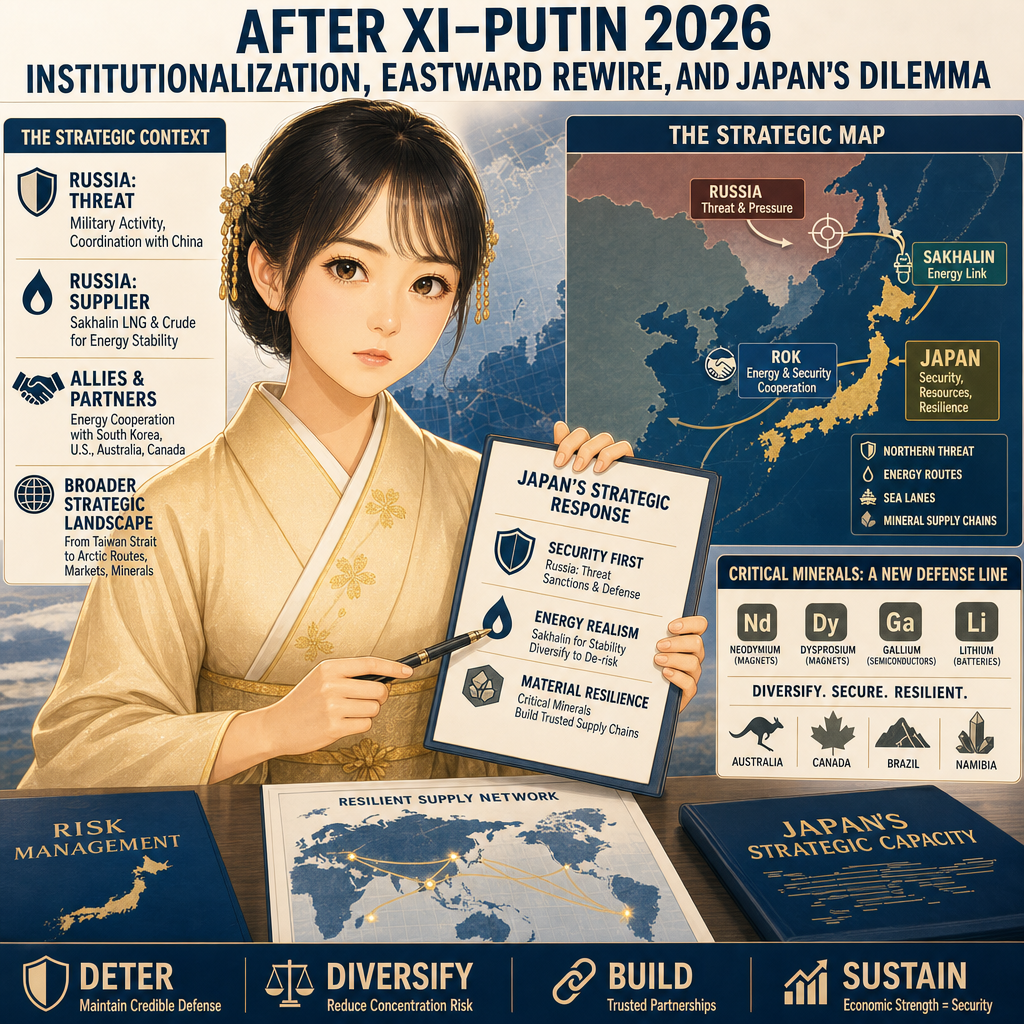
This scene reveals the outline of Japan’s Russia strategy. Japan does not trust Russia. Yet it also cannot fully detach itself from resources in the Russian Far East. As defense, electricity, semiconductors, magnets, ports, reserves, and alliances converge on the same strategic map, Japan’s defense line no longer runs only north of Hokkaido. It extends to Sakhalin LNG contracts, mutual support with South Korea, critical-mineral cooperation with the United States, mines in Australia and Canada, and Japan’s domestic industrial base.
Russia as Threat, Russia as Supplier
In Japanese government documents, Russia no longer appears only as a partner for improving relations through economic cooperation. The Ministry of Defense’s Defense of Japan 2025 states that Russia continues its invasion of Ukraine while conducting active military operations around Japan, including the Northern Territories, and that joint aircraft and naval activity with China has also been confirmed. For Japan, Russia has become both a direct northern threat and a source of compound pressure linked to China.
Even so, Japan has not severed all economic contact with Russia. The reason is Sakhalin. The Agency for Natural Resources and Energy’s Energy White Paper 2024 states that Sakhalin 2 accounted for about 9.3 percent of Japan’s LNG imports in 2023 and the equivalent of about 3 percent of total power generation, and that Japan maintains a policy of retaining its interests in Sakhalin 1 and 2. Sakhalin 1 also holds value as a rare non-Middle Eastern source of crude oil for Japan, whose dependence on the Middle East remains high.
This policy does not produce a clean narrative. Japan participates in sanctions on Russia as a G7 member and continues to support Ukraine. At the same time, it preserves resource interests in the Russian Far East to protect stable power generation and fuel supply. Reuters also reported that the Ministry of Economy, Trade and Industry described overseas energy, especially Sakhalin 1, as important for Japan’s energy security.
Japan’s dilemma lies here. Russia is a security threat. Sakhalin is directly tied to the stability of electricity and fuel. Excessive dependence on Russia creates a political vulnerability, but an abrupt cutoff will feed back into prices, procurement, and spare power-generation capacity. Japan’s choice is not accommodation with Russia. It is realism: receive the minimum necessary energy from a dangerous neighbor while avoiding the permanent lock-in of that dependence.
The Russia Problem Goes Beyond the Northern Territories
Japan-Russia relations once fit easily into three terms: the Northern Territories, a peace treaty, and energy cooperation. That framework no longer captures the problem. Japan’s view of Russia now overlaps with China, the Taiwan Strait, the Korean Peninsula, the Northern Sea Route, LNG markets, crude oil markets, critical minerals, semiconductor materials, and defense-industrial supply chains.
The Ministry of Foreign Affairs still upholds the basic policy of resolving the issue of sovereignty over the four Northern Islands and concluding a peace treaty. The position of the Ministry of Foreign Affairs shows continuity in Japanese diplomacy and its refusal to shelve the territorial issue. In the security arena, however, Russia is not only a counterpart in Northern Territories negotiations. It is a state that continues military activity around Japan, coordinates actions with China, and controls resources in Sakhalin.
This duality makes Japanese policy look ambiguous. Yet that ambiguity itself functions as strategy. Japan is not trying to reconcile with Russia. It is not trying to withdraw from Russia completely. It keeps its threat perception intact, maintains the broad sanctions framework, and prevents energy supply from collapsing. For an island country without major domestic resources, this design is uncomfortable but difficult to avoid.
Critical Minerals Become a New Defense Line
If Japan intends to avoid locking in dependence on Russia, it must redesign not only energy supply but also material supply chains. The Cabinet Secretariat’s National Security Strategy positions economic strength as a foundation of security policy and stresses Japan’s role in providing high-value-added goods and services that are essential to global supply chains. This approach does not treat the military and industry as separate domains.
Materials related to the Ministry of Economy, Trade and Industry’s White Paper on International Economy and Trade also identify the risk created by the concentration of critical-mineral supply chains in specific regions. In 2026, Japanese government-backed projects aimed at strengthening supply chains for nickel, lithium, fluorspar, graphite, heavy rare earths, and other materials, with Australia, Brazil, Canada, and Namibia emerging as procurement sources. Ministry of Economy, Trade and Industry materials show the reality that resource diplomacy has become part of defense policy.
This movement connects directly to China risk. In May 2026, Reuters, citing Chinese customs data, reported that China had effectively stopped exports to Japan of four items: dysprosium, terbium, yttrium oxide, and gallium. These materials relate to magnets, aerospace, defense, and semiconductors, recalling the previous comparable case of rare-earth export restrictions against Japan during the 2010 Senkaku incident.
The problem Japan faces is not Russia alone. In energy, Japan cannot easily cut off Sakhalin. In critical minerals, it remains exposed to China’s processing and export capacity. Cutting one side does not make Japan secure. If Japan reduces dependence on Russia while dependence on China remains, another choke point remains in place. If Japan reduces dependence on China while LNG and crude oil procurement becomes unstable, domestic industry suffers. Japan’s policy therefore moves not toward blocking a single adversary, but toward thinning multiple dependencies at the same time.
Thickening Supply Chains Through Alliances
Japan-South Korea energy cooperation is one answer. Japan and South Korea are both resource-importing countries and both remain vulnerable to LNG and crude oil price swings, Middle Eastern instability, and risks along sea lines of communication. Cooperation that includes reserves and petroleum product swaps creates a mechanism for using each other’s spare capacity during crises. Even between neighboring countries burdened by historical disputes, the stability of fuel and electricity has become a domain that cannot be handled by political emotion alone.
Cooperation with the United States also cannot be explained only as a military alliance. Reconnecting supply chains for critical minerals, semiconductors, defense equipment, and energy technology prepares for crises in the Taiwan Strait and on the Korean Peninsula, but it also preserves industrial competitiveness in peacetime. Australia matters for LNG and minerals, Canada for minerals and energy, and Brazil and Namibia for resource diversification. Japan-Australia, Japan-U.S., and Japan-South Korea frameworks become real defense lines not through meeting communiqués alone, but through electric utilities, trading houses, mines, ports, insurance, and finance.
The important point is that this is not only “de-Russification.” Japan is retaining its Sakhalin interests while simultaneously planning for cases in which Sakhalin becomes unusable, prices spike, sanctions tighten further, or China stops materials exports. Supply-chain redesign is therefore not the task of adding one alternative procurement source. It is crisis management that integrates fuel, minerals, processing, transport, reserves, finance, and diplomacy.
The Conclusion of Japan’s Realism
This final installment shows that Japan’s Russia policy is constrained by structure, not emotion. Russia is a dangerous neighbor, a source of northern military pressure, and a geopolitical element linked to China. At the same time, Sakhalin is a supply source tied to Japan’s electricity and fuel, and it represents a reality that Japan cannot erase abruptly.
Japan’s path is therefore neither total confrontation nor total withdrawal. On the surface, it aligns with the G7, refuses to accept the invasion of Ukraine, and maintains its policy on the Northern Territories and a peace treaty. Behind that, it preserves interests in Sakhalin 1 and 2, advances LNG and crude oil mutual support with South Korea, and thickens critical-mineral supply chains with the United States, Australia, Brazil, Canada, Namibia, and others.
The conclusion of this series converges here. In an era in which Russia shifts its center of gravity eastward, Japan cannot view Russia simply as an enemy or simply as a resource supplier. The necessary task is to build supply chains that prevent either Russia or China from holding Japan by the throat. Defense is not only missiles and warships. It is a survival strategy that binds together electricity, LNG, crude oil, magnets, semiconductors, mines, ports, reserves, and alliances.
Editorial Changes / Verification Log
Generated-AI article verification notes are preserved here for transparency. Expand for before/after edits and source checks.
1. (unspecified section) — sentence_split
Before:
In an era of rising military pressure in Northeast Asia, volatile energy markets, and critical minerals used as diplomatic leverage, Japan is trying to protect fuel and materials through a network of allies and quasi-allies.
After:
In an era of rising military pressure in Northeast Asia, volatile energy markets, and critical minerals used as diplomatic leverage, Japan is trying to protect fuel and materials through a network of allies and quasi-allies.
Reason: Upstream sentences in the paragraph were split to keep cadence and clarity; this line retained but benefits from surrounding shorter sentences.
2. (unspecified section) — connective_trimmed
Before:
This policy does not produce a clean narrative. Japan participates in sanctions on Russia as a G7 member and continues to support Ukraine. At the same time, it preserves resource interests in the Russian Far East to protect stable power generation and fuel supply.
After:
This policy does not produce a clean narrative. Japan participates in sanctions on Russia as a G7 member and supports Ukraine. At the same time, it preserves resource interests in the Russian Far East to protect stable power generation and fuel supply.
Reason: Removed a repetitive connective and tightened phrasing without altering meaning.
3. (unspecified section) — other
Before:
Japan-Russia relations once fit easily into three terms: the Northern Territories, a peace treaty, and energy cooperation. That framework no longer captures the problem.
After:
Japan-Russia relations once fit easily into three terms: the Northern Territories, a peace treaty, and energy cooperation. That framework no longer captures the problem.
Reason: Kept structure but adjusted surrounding transitions to emphasize the pivot from a narrow frame to a wider map of risks.
4. (unspecified section) — sentence_split
Before:
The important point is that this is not only “de-Russification.” Japan is retaining its Sakhalin interests while simultaneously planning for cases in which Sakhalin becomes unusable, prices spike, sanctions tighten further, or China stops materials exports.
After:
The important point is that this is not only “de-Russification.” Japan is retaining its Sakhalin interests while also planning for cases in which Sakhalin becomes unusable, prices spike, sanctions tighten further, or China stops materials exports.
Reason: Minor split and simplification to reduce clause stacking and improve readability.