After Xi–Putin 2026: Institutionalization, Eastward Rewire, and Japan's Dilemma (Part 2)

What Orbán’s Visit to Beijing Revealed
On July 8, 2024, Hungarian Prime Minister Viktor Orbán met President Xi Jinping in Beijing. In Chinese-language media, his back-to-back stops in Kyiv, Moscow, and Beijing were framed not as routine diplomacy by a small European state. They were a “peace mission.” According to the Chinese Foreign Ministry, Xi said that “ceasing fire and ending the war, and restoring peace at an early date” served the common interests of all countries. He added three principles: the battlefield must not expand outward, the fighting must not escalate, and all parties must avoid adding fuel to the fire (Ministry of Foreign Affairs of China).
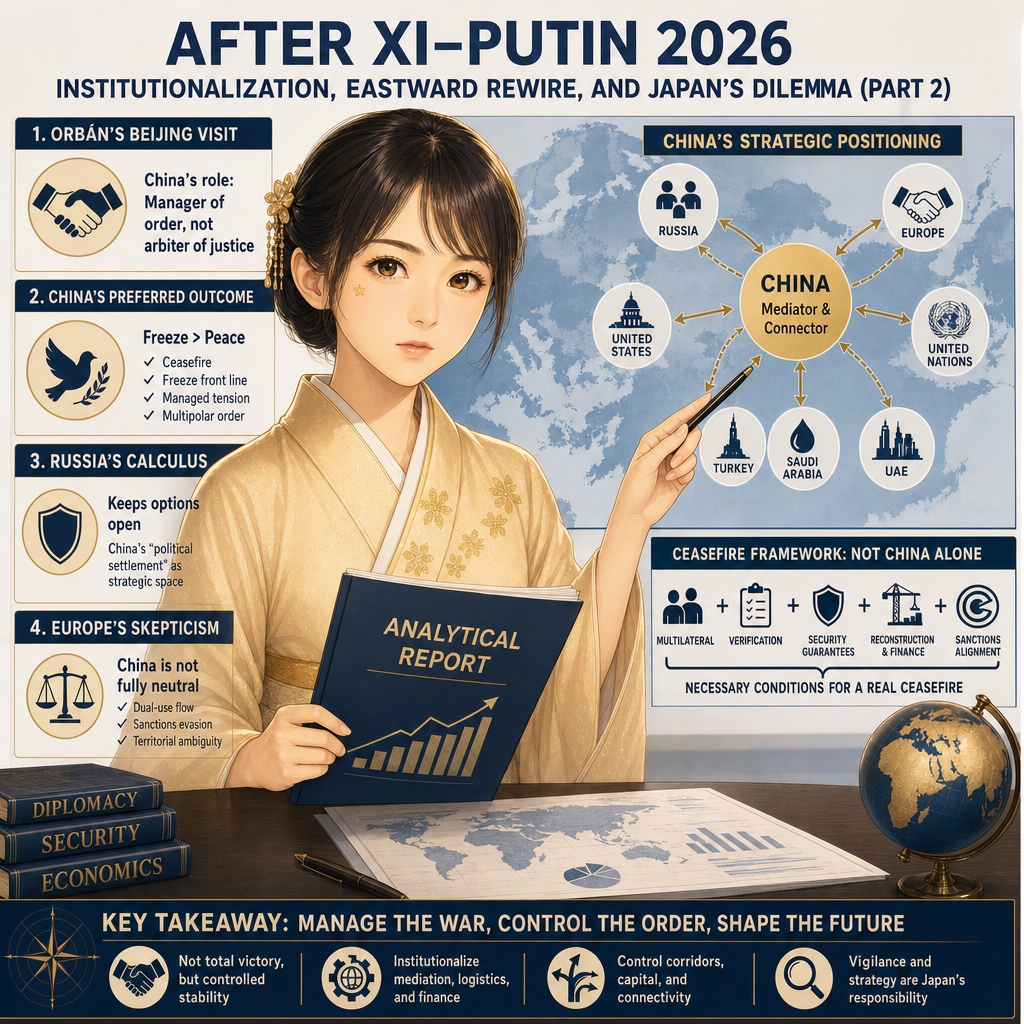
The scene showed that China sees the Ukraine war less as victory or defeat than as a problem of control. Xi did not foreground either Russian victory or Ukrainian victory. He did not speak about the legitimacy of territorial restoration. He spoke about preventing expansion, avoiding escalation, securing a ceasefire, and reopening negotiations. Orbán was also reported to have described China as “an important stabilizing force in promoting world peace,” and he said that “peace does not come by itself; it must be won through effort” (VOA Chinese).
The role China wanted to perform was not that of an arbiter of justice. It was that of a manager of order. Beijing was not promoting the model sought by the West: Russian withdrawal, international legal adjudication, and NATO-led security. It was promoting a ceasefire that preserves face, fixes the front line, prolongs negotiations, and stages a multipolar order. China’s repeated phrase “political settlement” refers less to a complete end to the war than to a shift of wartime conditions into a diplomatically manageable form.
China Wants a Freeze More Than Peace
China has long repeated the vocabulary of its 12-point peace proposal: respect for all countries’ security concerns, opposition to Cold War thinking, ceasefire, dialogue, and opposition to unilateral sanctions. On the surface, this is the language of neutrality. In substance, it points toward preventing the collapse of the Russian system, fixing the front line somewhere, and returning Western exhaustion to a manageable level.
This differs from peace in the Western sense. China prefers ceasefire, freezing, managed tension, phased negotiations, a face-saving landing, and the performance of multipolar order. If the war fully ends, China’s value as a mediator declines. If armistice monitoring, energy reconstruction, infrastructure finance, reconstruction logistics, payment networks, and resource development continue over the long term, China remains a node between the parties.
China displayed the same model in its mediation of the Saudi-Iran rapprochement. The contrast that the United States starts wars while China mediates ceasefires carried major propaganda value for Chinese diplomacy. If a Ukraine ceasefire takes shape, the stage becomes far larger than the Middle East. If China is recognized as an indispensable player in a ceasefire framework spanning Europe, Russia, the United States, the United Nations, Turkey, Saudi Arabia, and the UAE, that recognition itself restages the international order.
China’s ideal, therefore, is not total Russian victory. Russia does not collapse. Ukraine remains a state. Europe becomes exhausted. The United States keeps resources tied down. China assumes roles in mediation, logistics, finance, and resource connectivity. This condition represents China’s preferred geoeconomic interest. It is not a winner-takes-all design. It is a structure in which China stands between exhausted camps and controls corridors, capital, and diplomatic flows.
Russia Is Not Rejecting China’s Exit Route
Russian-language media still frame the war through “special military operation,” “security,” “protection of Russian-speaking residents,” and the claim that the West is prolonging the war (RIA Novosti). Even so, the Russian side has not openly denied China’s peace and mediation line. Instead, it elevates respect for China’s proposals, China’s international role, multipolar order, respect for sovereignty, and dialogue.
Reporting on May 19, 2026, also said that President Vladimir Putin stated that Russia and China were ready to support each other on issues such as protecting sovereignty (Reuters). This does not mean Russia is moving toward an immediate ceasefire. But if Russia accepted nothing except complete military victory, China’s “political settlement” line would obstruct it. In practice, Russia uses that ambiguity.
Russian coverage of Orbán’s visit to China showed the same room for maneuver. RIA Novosti reported on the July 8, 2024 visit and said Orbán had explained his visits to Moscow and Kyiv to Xi (RIA Novosti). For Russia, the ceasefire narrative created by China can serve as a transition not to defeat, but to “political management.” Here, Chinese and Russian interests partly overlap.
From China’s side, Russia’s complete collapse is also undesirable. Nuclear control, instability in Siberia, refugees, turmoil in Central Asia, and renewed Western intervention all pose major risks to Chinese security. At the same time, outright Russian victory is difficult for China to handle. Relations with Europe deteriorate further, and pressure for secondary sanctions intensifies. China’s signal therefore becomes: do not crush Russia, but manage the war.
Europe Does Not Fully Trust China
China’s mediation concept faces a major constraint. Ukraine and Europe do not see China as a fully neutral actor. In Europe, concern is strong over the flow of Chinese components into Russia, dual-use technologies, renminbi settlement, and assistance in sanctions evasion. China speaks as a mediator seeking a ceasefire, but it also appears to be a rear-area supporter of Russia.
This duality makes mediation by China alone difficult. China says it is encouraging reconciliation and negotiation “in its own way,” but that method does not align with Europe’s security instincts. From Ukraine’s perspective, invoking “security concerns” while leaving territorial recovery by the invaded side ambiguous appears to accept part of Russia’s argument. From Europe’s perspective, opposition to unilateral sanctions sounds like language that weakens pressure on Russia.
For that reason, an actual ceasefire framework is unlikely to be built by China alone. A multilayered framework involving China, Turkey, Saudi Arabia, the UAE, the United Nations, and some European actors is more plausible. China will aim not to become the sole judge, but to occupy an indispensable position among multiple mediators. The goal is not complete peace. The goal is to become an indispensable player in managing a ceasefire.
On this point, improving relations with the EU matters to China. As confrontation with the United States intensifies, China does not want a total rupture with the EU. As long as China is fixed in Europe’s view as a state supporting Russia, the distance cannot narrow. But if China creates a narrative that it contributed to a ceasefire, it gains room to split hard-line European opinion toward China and partially restore economic relations.
Taiwan Constrains China’s Language
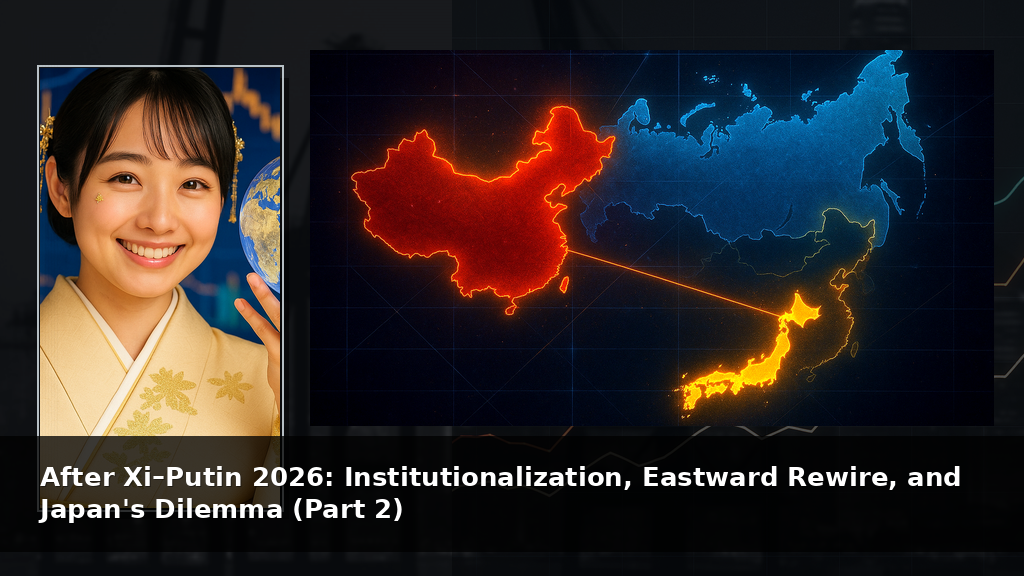
The Taiwan issue most deeply constrains China’s ambiguity. On Ukraine, China speaks of respect for sovereignty and territorial integrity. At the same time, it criticizes NATO expansion, refers to Russia’s security concerns, opposes unilateral sanctions, and calls for a political settlement. From the West’s perspective, this is contradictory. From China’s perspective, it is a coherent vocabulary designed to avoid closing off military options for national unification.
If China accepted the principle that “changing the status quo by force is absolutely evil,” it would bind itself on Taiwan. China does not seek to fully justify Russia’s invasion. But it also cannot join a current that categorically rejects the use of force itself as a matter of international order. China’s statements therefore use multilayered language: historical circumstances, security concerns, Cold War thinking, intervention by external forces, ceasefire, and dialogue.
China is alert to the new international norms being formed through the Ukraine war. Sanctions coalitions, SWIFT exclusion, foreign reserve freezes, technology blockades, semiconductor embargoes, asset confiscation, disruption of maritime insurance, drone and satellite support, and NATO-style logistics support can all be redirected toward a future Taiwan contingency. Terms often used in the Chinese-language sphere, such as “financial war,” “technology war,” “cognitive war,” “public opinion war,” and “weaponization of supply chains,” are also ways of observing Europe’s war as Asia’s future.
In other words, China is not only watching how Russia wins or fails to win. It is watching how the West has institutionalized war. If Russia is defeated, its regime collapses, sanctions succeed, and international isolation is completed, the West gains confidence that it can do the same to China. China wants to prevent that outcome. It is therefore accelerating non-dollar settlement, resource security, technological self-reliance, food security, maritime alternatives, and energy diversification. This is less support for Russia than work to create China’s own strategic depth for the future.
At the same time, China is learning from the Ukraine war how difficult an invasion of Taiwan is. Drones, satellite surveillance, precision strikes, civilian OSINT, Starlink-type communications, long-term logistics, and sanctions resilience are unavoidable elements in any analysis of the Taiwan Strait. For this reason, China does not want Russia’s complete defeat, and it does not want unlimited Russian escalation. Its preferred outcome is to prevent the creation of an international norm that wholly negates military force while pushing the war back into a manageable range.
China’s Peace Is a Device, Not an Exit
Taken together, China’s position cannot be explained only as “pro-Russian.” China cannot cut off Russia, but it cannot fully ride on a total Russian victory. It does not want to destroy relations with Europe, but it does not want to accept a Western-led sanctions order. It does not deny Ukrainian sovereignty, but it also cannot erase its own room for the use of force on Taiwan.
The result is a managed freeze. The front line is fixed. Confrontation remains. Some sanctions continue. Mutual non-recognition continues. But full-scale war is avoided, negotiating venues are preserved, and circuits of reconstruction, logistics, and settlement begin to move. For China, this is not the end of the war. It is a device for reorganizing the war inside the international order.
Within this device, China is a mediator, a provider of capital, a logistics corridor, a buyer of resources, and an objector to the sanctions order. China’s Ukraine diplomacy appears to seek a ceasefire, but it is looking at management rights after the ceasefire. This is not only about rescuing Russia. It is about dividing Europe, reducing United States primacy, and preserving normative space for a Taiwan contingency.
The Orbán meeting in Beijing showed this structure. China speaks of peace. But that peace is not a courtroom that determines winners and losers. It is closer to a control room that keeps the fire small while reorganizing the surrounding order. China does not seek only the war’s curtain call. It seeks a seat at the table that decides who moves the war into a frozen state, in what language, and under what conditions.
Next time, the focus turns to what has begun to change on Russia’s side in response to this Chinese calculation.
Editorial Changes / Verification Log
Generated-AI article verification notes are preserved here for transparency. Expand for before/after edits and source checks.
1. (unspecified section) — sentence_split
Before:
His consecutive visits to Kyiv, Moscow, and Beijing immediately before that meeting were treated in the Chinese-language sphere not as routine diplomacy by a small European state, but as a “peace mission.”
After:
In Chinese-language media, his back-to-back stops in Kyiv, Moscow, and Beijing were framed not as routine diplomacy by a small European state. They were a “peace mission.”
Reason: Shortened and split for clarity while preserving meaning and emphasis.
2. (unspecified section) — connective_trimmed
Before:
At the same time, he said the most important task was to uphold three principles: the battlefield must not expand outward, the fighting must not escalate, and all parties must avoid adding fuel to the fire.
After:
He added three principles: the battlefield must not expand outward, the fighting must not escalate, and all parties must avoid adding fuel to the fire.
Reason: Removed redundant connective to tighten pacing.
3. (unspecified section) — sentence_split
Before:
China displayed the same model in its mediation of the Saudi-Iran rapprochement.
After:
China displayed the same model in its mediation of the Saudi-Iran rapprochement. The contrast that the United States starts wars while China mediates ceasefires carried major propaganda value for Chinese diplomacy.
Reason: Kept original claim and separated the propagandistic contrast to improve flow.
4. (unspecified section) — connective_trimmed
Before:
Reporting on May 19, 2026, also said that President Vladimir Putin stated that Russia and China were ready to support each other on issues such as protecting sovereignty.
After:
Reporting on May 19, 2026, also said that President Vladimir Putin stated that Russia and China were ready to support each other on issues such as protecting sovereignty.
Reason: No factual change; retained sentence but ensured surrounding transitions were concise.
5. (unspecified section) — sentence_split
Before:
For that reason, an actual ceasefire framework is unlikely to be built by China alone. A multilayered framework involving China, Turkey, Saudi Arabia, the UAE, the United Nations, and some European actors is more plausible.
After:
For that reason, an actual ceasefire framework is unlikely to be built by China alone. A multilayered framework involving China, Turkey, Saudi Arabia, the UAE, the United Nations, and some European actors is more plausible.
Reason: Maintained content; emphasized the pivot by separating the alternative framework.
6. (unspecified section) — other
Before:
It is therefore accelerating non-dollar settlement, resource security, technological self-reliance, food security, maritime alternatives, and energy diversification.
After:
It is therefore accelerating non-dollar settlement, resource security, technological self-reliance, food security, maritime alternatives, and energy diversification.
Reason: Left wording intact but ensured list cadence fits the declarative register.