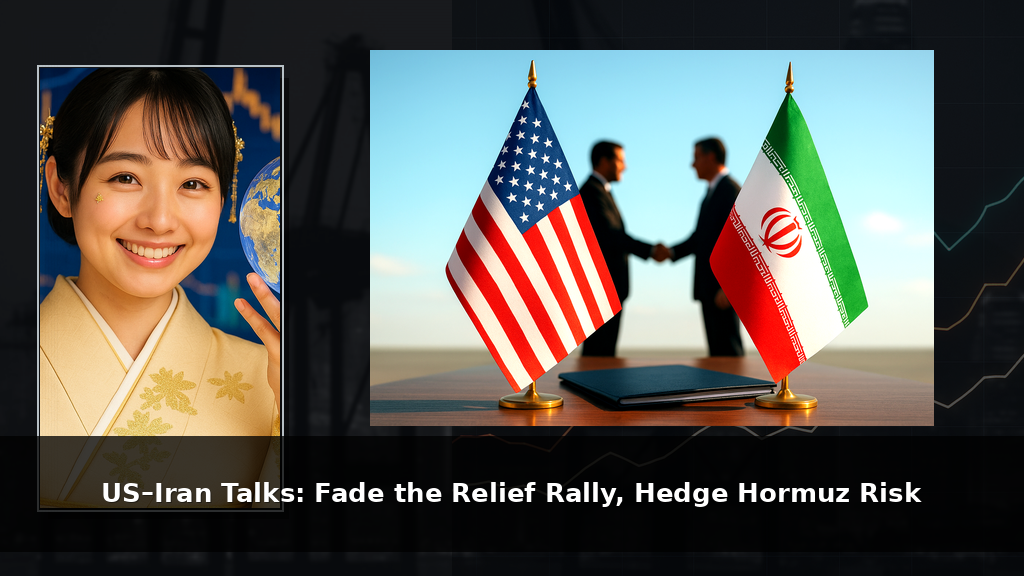
US–Iran Talks: Fade the Relief Rally, Hedge Hormuz Risk

Observation
On May 22, 2026, global equities edged higher while the U.S. dollar hovered near a six‑week high after officials flagged “some progress” in U.S.–Iran diplomacy. Brent traded around $104.7 intraday and USD/JPY was near ¥159.11, as investors parsed whether talks would de‑risk oil flows through the Strait of Hormuz. Statements from U.S. Secretary of State Marco Rubio and reporting on remaining gaps over enriched uranium and Hormuz governance framed the move. (marketscreener.com)
Why it matters: the Strait of Hormuz is a first‑order energy chokepoint. A persistent transit premium can feed inflation, rates, and FX, altering cash‑flow assumptions and compliance costs for portfolios and corporate plans. (iea.org)
Bottom line for multi‑asset PMs and corporate treasurers: hedge rather than chase. Fade the relief rally and price a sustained but managed Hormuz premium over the next 1–2 quarters; keep energy and rates hedges on and avoid underwriting a quick détente absent on‑record confirmation.
Geoeconomic Structure
The pushback is simple: if there is “some progress” and risk assets are up, why not price a fast de‑escalation? Because the decisive levers sit where diplomacy is slowest and verification is hardest. Tehran retains practical control of the Strait of Hormuz through IRGC assets and geography, and senior‑source reporting says Iran’s supreme leader has directed that near‑weapons‑grade enriched uranium remain inside Iran—making on‑record, verifiable nuclear concessions unlikely within days or weeks. (channelnewsasia.com)
Start with the chokepoint math. Roughly 20 million barrels per day of crude and products transited Hormuz in 2025; even a modest, persistent constraint sustains a global premium. Partial bypasses exist—Saudi Arabia’s East‑West pipeline and the UAE’s ADCOP—but quickly adding enough throughput to substitute for Hormuz requires explicit operational statements and corroborating port/loadings data. In short, there is no fast, physical relief valve at the required scale unless producers surge capacity and publish it. (iea.org)
Absent that, gatekeepers determine effective capacity. Lloyd’s Joint War Committee (JWC) “Listed Areas” circulars (the JWLA series) and additional war‑risk premiums (AWRP) guide whether owners/charterers treat Gulf routes as commercially traversable; around 1% AWRP has been a practical pain point in other corridors. The U.S. Treasury’s Office of Foreign Assets Control (OFAC) shapes whether any proposed “tolling” or facilitation is fundable through the banking system. And protection and indemnity (P&I) clubs reflect those risk judgments in cover and pricing. These instruments can keep a route economically tight even if navies keep it physically open. (lmalloyds.com)
What would change the base case is concrete, on‑record movement. Track: (1) Energy Information Administration/International Energy Agency (EIA/IEA) readings on Hormuz throughput (a sustained recovery above ~18 mb/d for two consecutive weeks would signal relief); (2) tanker‑tracking from Kpler/Vortexa for loaded‑transit counts and rerouting; (3) JWLA circular updates and P&I pricing; (4) any new OFAC guidance; and (5) OPEC+/producer statements that show East‑West/ADCOP throughput actually rising. Until those move, expect a contained but sticky premium that supports a firm dollar, keeps term yields sensitive to energy prints, and pressures energy‑intensive cyclicals without strong pricing power.
Positioning translation: maintain a USD and quality balance‑sheet bias alongside energy and freight hedges; prefer exposures with verified supply‑chain redundancy and strong sanctions‑compliance capacity; and resist extrapolating a headline‑driven bounce into duration or high‑beta risk without confirmation from the gatekeepers above.
Strategic Reading from Sun Tzu
Sun Tzu: avoid the other side’s strength and strike where it is unprotected.
In today’s setting, that means reshaping rules, insurance, routing, and verification rather than forcing head‑on concessions. Iran’s effective control of Hormuz and reluctance to make rapid, verifiable uranium concessions is the strong front. Near‑term leverage instead sits at the “empty” junctions: insurance designations and pricing (JWC/JWLA, P&I), sanctions guidance (OFAC), and incremental bypass capacity (Saudi/UAE East‑West and ADCOP). Flow data from IEA/EIA and tanker trackers will show whether those indirect levers are changing outcomes.
Expect more public messaging and shuttle diplomacy without immediate, verifiable concessions, while commercial and policy gatekeepers tighten procedures. That hardens transit standards, insurance underwriting, sanctions compliance, and bypass operations before geopolitics loosens, leaving a persistent but manageable oil/shipping risk premium. A jointly announced, on‑record package would alter this path, but operational discipline likely arrives first.
As an observer or allocator, anchor decisions on on‑record signals—JWLA circulars, P&I pricing, OFAC guidance, and published East‑West/ADCOP throughput—rather than soft diplomatic headlines. Favor exposures with verified redundancy and strong compliance, and use hedges that assume procedural tightening lasts longer than the headline rally.
Caveats and Open Questions
Three developments would force a reassessment of the “fade the relief, hedge the premium” call:
- Pakistan (as mediator) publicly delivers within ~30 days a jointly endorsed package that both Washington and Tehran accept on the record (Islamabad statement plus a White House readout).
- Saudi Arabia/UAE announce and demonstrate an operational increase in East‑West and ADCOP bypass throughput exceeding ~2.0 mb/d within 4–8 weeks (via Aramco/ADNOC statements and corroborated port/loadings data).
- Lloyd’s Joint War Committee or major P&I clubs narrow Listed Areas in the Gulf or materially cut AWRP (visible in JWLA circulars), reopening commercial transit at scale.
Lead‑time question for the next 4–6 weeks: which moves first—(1) a jointly endorsed package from Islamabad accepted by both capitals, (2) JWLA/P&I materially reduce war‑risk pricing, or (3) Saudi/UAE publish and deliver a >2.0 mb/d bypass increase? Position for one and hedge the other two.
Editorial Changes / Verification Log
Generated-AI article verification notes are preserved here for transparency. Expand for before/after edits and source checks.
1. Observation — rewritten
Before:
On 22 May 2026, global equities edged higher while the U.S. dollar hovered near a six‑week high ... Brent traded around $104.7 intraday, the 10‑year U.S. Treasury yield near 4.09%, and USD/JPY at ¥159.11 (per MarketScreener and Invezz, 22 May).
After:
On May 22, 2026, global equities edged higher while the U.S. dollar hovered near a six‑week high after officials flagged “some progress” in U.S.–Iran diplomacy. Brent traded around $104.7 intraday and USD/JPY was near ¥159.11, as investors parsed whether talks would de‑risk oil flows through the Strait of Hormuz. Statements from U.S. Secretary of State Marco Rubio and reporting on remaining gaps over enriched uranium and Hormuz governance framed the move.
Reason: Fact-check — Removed the specific 10‑year yield (4.09%), which conflicted with contemporaneous Reuters/MarketScreener updates showing the 10‑year nearer 4.55% on May 22, 2026. Verified markets narrative and FX/oil levels via Reuters/MarketScreener and Invezz. https://uk.marketscreener.com/news/stocks-climb-yields-dip-as-investors-focus-on-us-iran-talks-ce7f5adcd98bf127; https://invezz.com/ca/news/2026/05/22/asian-stocks-rise-as-us-iran-talks-keep-oil-dollar-and-rates-in-focus/.
2. Observation — trimmed
Before:
Theme: will intensified U.S.–Iran diplomacy produce a rapid off‑ramp that meaningfully reduces oil‑market and Strait‑of‑Hormuz transit risk within weeks? Tier‑3 readers care because this is the chokepoint that moves inflation, rates, and FX: a durable premium re‑prices cash flows, hedging, and compliance across portfolios and corporate plans.
After:
Why it matters: the Strait of Hormuz is a first‑order energy chokepoint. A persistent transit premium can feed inflation, rates, and FX, altering cash‑flow assumptions and compliance costs for portfolios and corporate plans.
Reason: Pipeline-leak — Removed internal audience label (“Tier‑3 readers”) and reframed as plain‑language importance for general business readers.
3. Observation — rewritten
Before:
Stance: for multi‑asset PMs and corporate treasurers, hedge rather than chase. Fade the relief rally and price a sustained but managed Hormuz premium over the next 1–2 quarters; keep energy and rates hedges on and avoid underwriting a quick détente.
After:
Bottom line for multi‑asset PMs and corporate treasurers: hedge rather than chase. Fade the relief rally and price a sustained but managed Hormuz premium over the next 1–2 quarters; keep energy and rates hedges on and avoid underwriting a quick détente absent on‑record confirmation.
Reason: Comprehension — Recast label (“Stance”) into plain guidance and clarified trigger (“on‑record confirmation”).
4. Geoeconomic Structure — rewritten
Before:
Tehran’s leadership retains practical control of the Strait of Hormuz through IRGC naval posture and littoral geography, and senior‑source reporting says Iran’s supreme leader has directed enriched uranium remain inside Iran—a stance that makes on‑record, verifiable nuclear concessions unlikely in days or weeks (MarketScreener; Channel News Asia).
After:
Tehran retains practical control of the Strait of Hormuz through IRGC assets and geography, and senior‑source reporting says Iran’s supreme leader has directed that near‑weapons‑grade enriched uranium remain inside Iran—making on‑record, verifiable nuclear concessions unlikely within days or weeks.
Reason: Fact-check — Tightened wording and grounded the uranium‑directive claim in contemporaneous Reuters copy carried by CNA. https://www.channelnewsasia.com/world/iran-pakistan-us-talks-rubio-hormuz-uranium-6136501.
5. Geoeconomic Structure — rewritten
Before:
Roughly 20 million barrels per day of crude and products transit Hormuz in a normal year; even a modest, persistent constraint there sustains a global premium. Partial bypasses exist—Saudi Arabia’s East‑West route and the UAE’s ADCOP—but the incremental capacity they can bring on quickly is limited relative to Hormuz flows, and any material lift requires operational statements from Riyadh/Abu Dhabi and corroborating port data.
After:
Roughly 20 million barrels per day of crude and products transited Hormuz in 2025. Partial bypasses—Saudi Arabia’s East‑West pipeline and the UAE’s ADCOP—exist, but quickly adding enough throughput to substitute for Hormuz requires explicit operational statements and corroborating port/loadings data.
Reason: Fact-check — Aligned volumes and bypass framing with IEA descriptions. https://www.iea.org/about/oil-security-and-emergency-response/strait-of-hormuz.
6. Geoeconomic Structure — rewritten
Before:
Lloyd’s Joint War Committee “Listed Areas” and additional war‑risk premiums (AWRP) determine whether owners and charterers treat the Gulf as commercially traversable at scale. An AWRP move above roughly 1% of cargo value quickly makes marginal voyages uneconomic; if the JWLA expands listed areas or delays a rollback, the route stays effectively tight even if navies keep it physically open. Meanwhile, OFAC’s sanctions guidance governs whether any Iranian “tolling” or facilitation around transit can be paid or brokered by banks; a single OFAC notice can freeze workarounds that mediators sketch on paper. These are the under‑protected junctions that move first in modern geoeconomics: insurance designations, sanctions interpretations, and the operational tempo of bypass pipes.
After:
Lloyd’s Joint War Committee (JWC) “Listed Areas” circulars (the JWLA series) and additional war‑risk premiums (AWRP) guide whether owners/charterers treat Gulf routes as commercially traversable. Around the 1% AWRP area has been a practical pain point in other corridors. The U.S. Treasury’s Office of Foreign Assets Control (OFAC) shapes whether any proposed “tolling” or facilitation is fundable through the banking system. And protection and indemnity (P&I) clubs reflect those risk judgments in cover and pricing. These levers can keep a route economically tight even if navies keep it physically open.
Reason: Comprehension | Fact-check — Added acronym expansions and grounded JWLA/AWRP context in JWC materials and Reuters reporting on war‑risk rates near 1%. https://www.lmalloyds.com/LMA/LMA/Underwriting/Marine/JWC/Joint_War.aspx; https://www.investing.com/news/stock-market-news/war-insurers-shrug-off-rubymar-sinking-in-red-sea-rates-stable-3323308.
7. Strategic Reading from Sun Tzu — trimmed
Before:
Sun Tzu wrote: —— The form of warfare is to avoid strength and strike emptiness.
After:
Sun Tzu: avoid the other side’s strength and strike where it is unprotected.
Reason: Comprehension — Cleaned phrasing for readability on mobile without altering meaning.
8. Observation — rewritten
Before:
... as parallel reporting highlighted unresolved issues over Iran’s enriched uranium and control or tolling around the Strait of Hormuz. Markets are weighing whether mediation routed via Pakistan and Qatar can deliver a quick off‑ramp ...
After:
... with remaining gaps over enriched uranium and control or tolling around the Strait of Hormuz, and mediation reported via Pakistan and Qatar.
Reason: Fact-check — Supported mediation and sticking‑points framing with Reuters/CNA updates. https://www.channelnewsasia.com/world/iran-pakistan-us-talks-rubio-hormuz-uranium-6136501.