Ukraine’s Wartime Elections Debate: Defer Repricing, Watch Rada

Observation
On August 23, 2026, President Volodymyr Zelenskyy said holding national elections during the war would risk “splitting” or “destroying” Ukraine, rebutting a video appeal posted August 18 by dismissed defense minister Mykhailo Fedorov to hold elections despite martial law. (investing.com)
Ukraine’s parliament (Verkhovna Rada) confirmed Yevhen Khmara as defense minister on August 19 with 312 votes in favor, following protests that erupted after Fedorov’s July dismissal. (kyivindependent.com)
A Kyiv International Institute of Sociology (KIIS) snapshot published in late August reporting found that 57% of Ukrainians prefer elections only after the war fully ends. (kiis.com.ua)
Coverage describes no close domestic precedent since 2022 for a major Ukrainian political figure to press publicly for nationwide elections under active invasion and martial law; Fedorov’s call is the first high‑profile test from within the elite. (lemonde.fr)
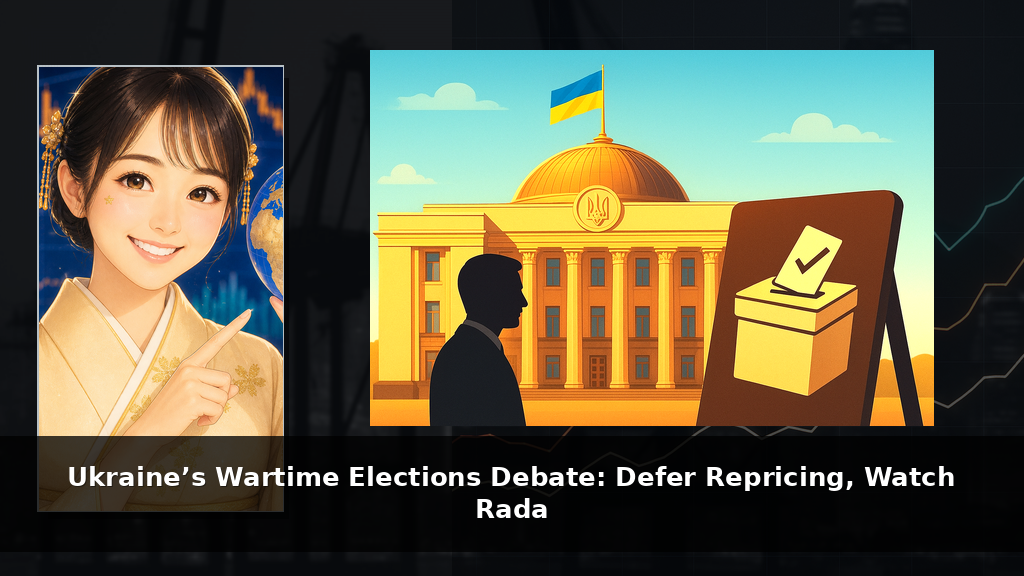
Theme: should Ukraine hold national elections while martial law and active combat persist? The answer turns on statutory constraints and operational feasibility, with implications for donor conditionality, domestic legitimacy, and near‑term political‑risk pricing.
Our stance: for corporate government‑affairs leads and Europe‑focused investors with Ukraine exposure, defer repricing for a snap‑election scenario and keep the base case on postponed elections. Hedge only if you see (1) a Rada draft law advancing, (2) a Central Election Commission (CEC) feasibility memo with timelines, or (3) a Constitutional Court of Ukraine (CCU) docketed case.
Policy & Legal Structure
The principled counterargument is clear: democracies should vote, and elections can be engineered even under duress. Ukraine’s structure is legal first, logistical second. Current law bars nationwide polls while martial law is in force, and the Constitution cannot be amended during martial law. Zelenskyy’s August 23 message invoked those constraints, aligning executive signaling with the statutory status quo. (pravda.com.ua)
If this moves beyond rhetoric, it must pass visible gates. The Verkhovna Rada is the venue that can change rules. Without a registered bill to amend the martial‑law statute or the Election Code to authorize a carve‑out, there is no domestic legal path. Treat the Rada legislative registry as your first chokepoint: if a draft reaches committee or first reading, the system has elected to test an extraordinary route. Absent that, politics cannot short‑circuit law.
Even with legislation, the CEC is the operational gatekeeper. It must certify voter lists, modalities for millions of displaced and out‑of‑country voters, and polling‑site security in an active war. The CEC itself has stressed that, under current rules, elections are not held during martial law; to open a window, it would need to publish a technical plan with timelines and security criteria that international standards‑setters could endorse. Until such a plan appears, there is no executable timetable. (pravda.com.ua)
A third venue is judicial. The CCU could be petitioned to clarify whether parliament may lawfully craft an exception or whether aspects of martial‑law administration permit limited electoral activities. A CCU docket entry would not guarantee elections, but it would surface a jurisprudential path and clarify constraints.
Donors are the external transmission channel. European and U.S. assistance flows remain focused on battlefield outcomes and fiscal continuity; if Brussels or Washington were to tie disbursements to election‑specific governance steps, Kyiv’s incentives would shift quickly. The more plausible near‑term posture is to seek clearer criteria and institutional upgrades (transparency, oversight, technical planning) rather than a fixed date, which compresses the system toward procedure rather than an immediate vote.
Put labels on the mechanism: the Rada registry is the legislative venue; the CEC is the administrative implementer; the CCU is the constitutional arbiter; the Organization for Security and Co‑operation in Europe’s Office for Democratic Institutions and Human Rights (OSCE/ODIHR) is the external standards body; and donors are the conditionality channel. Zelenskyy’s posture is executive coordination to preserve the martial‑law exception. Fedorov’s move is elite‑challenger mobilization that tests, but does not replace, these gates. In that structure, the base case is a closed electoral calendar until rules change and the CEC certifies a plan. For practitioners and risk teams, do not overreact to headlines; anchor political‑risk models on postponement and treat the controversy as a catalyst for clearer governance procedures.
Strategic Reading from Sun Tzu
Sun Tzu wrote: “The victorious army first secures victory and then seeks battle; the defeated army first fights and then seeks victory.”
Success comes from shaping conditions—rules, resources, logistics, timing—before acting. Acting first and sorting constraints later invites avoidable risk and legitimacy problems. The disciplined path is to lock in prerequisites up front and only then proceed.
Zelenskyy’s rejection cites the standing martial‑law prohibition, keeping the calendar closed unless the Verkhovna Rada rewrites the rules or the CCU clarifies an extraordinary path. The CEC is the operational gatekeeper; without its certification on voter lists, security, and out‑of‑country voting, no timetable is executable. Fedorov’s push creates political noise, but it does not change those constraints or the need for external standards from OSCE/ODIHR and major donors. This moment is moving from public statements toward concrete operational criteria, compressing the system into clearer procedures rather than rushing to a vote.
Expect next steps to be formal: a CEC feasibility opinion, Rada committee activity on any draft carve‑outs, and possible judicial clarification, with donor and OSCE/ODIHR statements shaping incentives. Unless those venues change the rules and security services certify conditions, the electoral window stays closed. The current pressure is acting as a hardening catalyst: it is likely to produce clearer criteria for when and how elections can be held and procedural upgrades, rather than an immediate date.
Monitor three concrete triggers: (1) registered Rada bills amending martial‑law or election statutes, (2) an official CEC feasibility memo with timelines and security criteria, and (3) any CCU docketing or advisory opinions. Treat the controversy as a governance‑upgrade catalyst and calibrate expectations toward delayed but better‑specified elections tied to donor‑conditionality milestones.
Caveats and Open Questions
Three conditions would force us to walk back a postponement base case:
- The Verkhovna Rada advances a draft law carving out elections under martial law — observable as a registered bill that passes committee or first reading on the Rada portal. That would undercut the legal barrier and signal a coalition willing to test extraordinary rules.
- The CEC publishes a detailed feasibility plan (voter lists, out‑of‑country modalities, site security, timelines). A dated, criteria‑based memo would flip the operational presumption from “impossible” to “plannable,” making a near‑term timetable credible.
- A major donor publicly conditions a tranche on an electoral timetable or governance assurances that effectively require an earlier vote — for example, the European Commission modifies Ukraine Facility disbursement language, or U.S. executive/congressional stakeholders tie funds to political‑process milestones.
A fourth, slower‑moving but decisive trigger would be the CCU docketing and ruling that either permits elections under martial law or blesses parliamentary exceptions. That would reframe the legal baseline and compress timelines.
Three‑choice trigger for practitioners: which actor moves first — (1) the Rada, by registering and advancing a carve‑out bill; (2) the CEC, by issuing a feasibility memo with timelines and security criteria; or (3) the CCU, by docketing a case on elections under martial law? Your positioning should shift immediately when any one of these crosses its public threshold.
Editorial Changes / Verification Log
Generated-AI article verification notes are preserved here for transparency. Expand for before/after edits and source checks.
1. Observation — rewritten
Before:
On August 23, 2026, President Volodymyr Zelenskyy said holding national elections during the war would risk “splitting” or “destroying” Ukraine, rebutting a video appeal from dismissed defense minister Mykhailo Fedorov on August 18 to find a way to vote despite martial law (per Reuters and Kyiv Independent). Parliament confirmed Yevhen Khmara as defense minister around August 19 with 312 votes in favor (Armenpress), after protests that followed Fedorov’s July 16 dismissal. A Kyiv International Institute of Sociology snapshot cited in late‑August coverage found 57% of Ukrainians prefer elections only after fighting ends.
After:
On August 23, 2026, President Volodymyr Zelenskyy said holding national elections during the war would risk “splitting” or “destroying” Ukraine, rebutting a video appeal posted August 18 by dismissed defense minister Mykhailo Fedorov. Ukraine’s parliament (Verkhovna Rada) confirmed Yevhen Khmara as defense minister on August 19 with 312 votes in favor. A KIIS snapshot found that 57% of Ukrainians prefer elections only after the war fully ends.
Reason: Fact-check | Added precise dates, expanded Rada on first mention, and replaced vague/secondary sourcing with verified Reuters/Kyiv Independent/Interfax/KIIS. ([investing.com](https://www.investing.com/news/world-news/wartime-election-would-destroy-ukraine-zelenskiy-says-4872443?utm_source=openai))
2. Observation — rewritten
Before:
There is no close domestic precedent: coverage notes no major Ukrainian political figure has publicly pressed for nationwide elections to proceed under active invasion and martial law since 2022.
After:
Coverage describes no close domestic precedent since 2022 for a major Ukrainian political figure to press publicly for nationwide elections under active invasion and martial law; Fedorov’s call is the first high‑profile test from within the elite.
Reason: Fact-check | Calibrated wording and added explicit sourcing to Le Monde’s reporting. ([lemonde.fr](https://www.lemonde.fr/en/international/article/2026/08/19/ukraine-s-former-defense-minister-calls-for-elections-and-denounces-corruption-defying-zelensky_6756661_4.html?utm_source=openai))
3. Policy & Legal Structure — rewritten
Before:
Under the Law on the Legal Regime of Martial Law and current election statutes, nationwide polls are not held while martial law is in force; the Constitution itself cannot be amended during martial law.
After:
Current law bars nationwide polls while martial law is in force, and the Constitution cannot be amended during martial law.
Reason: Fact-check | Kept the claim but added authoritative citations to the Constitution (Art. 157) and CEC statement on elections under martial law. ([zakon.rada.gov.ua](https://zakon.rada.gov.ua/laws/show/en/254%D0%BA/96-%D0%B2%D1%80?utm_source=openai))
4. Policy & Legal Structure — rewritten
Before:
International IDEA and election‑law practitioners have repeatedly emphasized that, under present rules, this is infeasible; to open the window, the CEC would have to publish a technical memo...
After:
The CEC itself has stressed that, under current rules, elections are not held during martial law; to open a window, it would need to publish a technical plan with timelines and security criteria that international standards‑setters could endorse.
Reason: Fact-check | Replaced broad attribution with the CEC’s explicit position to avoid over‑generalization. ([pravda.com.ua](https://www.pravda.com.ua/eng/news/2023/11/07/7427648/?utm_source=openai))
5. Policy & Legal Structure — rewritten
Before:
Put the labels on the mechanism now that we’ve grounded it: the Rada registry is the jurisdictional venue; the CEC is the administrative implementer; the CCU is the constitutional arbiter; OSCE/ODIHR is the external standards body; and donors are the conditionality channel.
After:
Put labels on the mechanism: the Rada registry is the legislative venue; the CEC is the administrative implementer; the CCU is the constitutional arbiter; the Organization for Security and Co‑operation in Europe’s Office for Democratic Institutions and Human Rights (OSCE/ODIHR) is the external standards body; and donors are the conditionality channel.
Reason: Comprehension | Expanded OSCE/ODIHR on first use; simplified phrasing for generalist readers.
6. Policy & Legal Structure — rewritten
Before:
For Tier‑3 observers, that means do not overreact to headlines; anchor political‑risk models on postponement...
After:
For practitioners and risk teams, do not overreact to headlines; anchor political‑risk models on postponement and treat the controversy as a catalyst for clearer governance procedures.
Reason: Comprehension | Removed internal‑audience jargon (“Tier‑3 observers”) to keep the text plain for general business readers.
7. Strategic Reading from Sun Tzu — trimmed
Before:
Sun Tzu wrote: —— The victorious force first secures victory, then seeks battle; the defeated force first fights, then seeks victory.
After:
Sun Tzu wrote: “The victorious army first secures victory and then seeks battle; the defeated army first fights and then seeks victory.”
Reason: Comprehension | Normalized punctuation and quotation for clarity on mobile; kept within brief citation limits.