Trump’s Rhetoric Is a Real Geoeconomic Variable in the Iran Talks

Observation
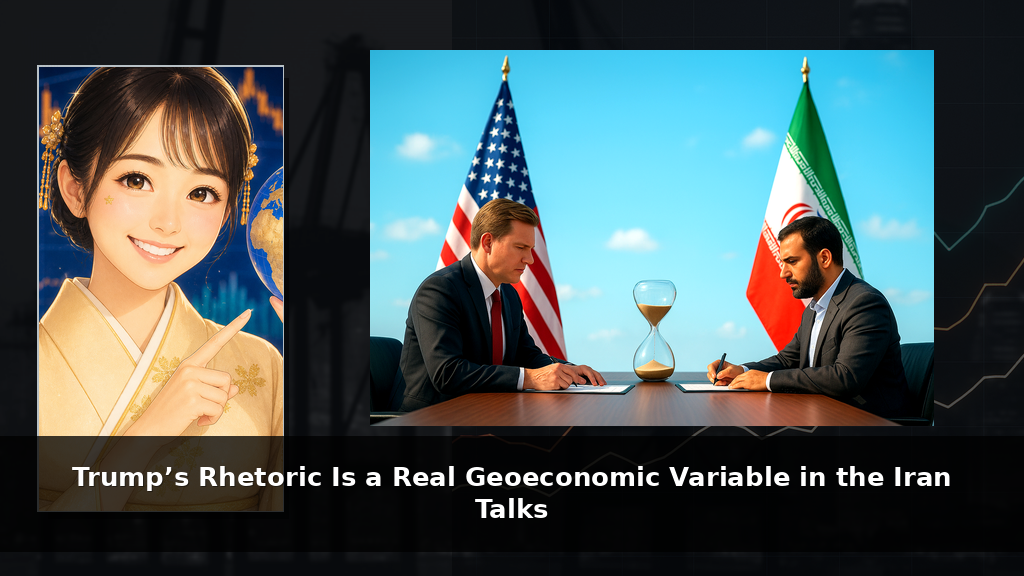
On June 21, 2026, U.S. and Iranian delegations met in Switzerland to advance an interim deal aimed at reopening the Strait of Hormuz, unfreezing Iranian assets, and launching a 60‑day nuclear negotiation window. The U.S. side was led by Vice President J.D. Vance, with envoys Steve Witkoff and Jared Kushner; Iran’s team included parliamentary speaker Mohammad Bagher Qalibaf and Foreign Minister Abbas Araghchi. As talks began, President Donald Trump issued public threats against Iran; Iranian state media and negotiators said the remarks pushed the talks into a “difficult phase,” while Pakistani and Qatari mediators and the Swiss host worked to keep discussions on track. According to AP, U.S. Energy Secretary Chris Wright said 67 ships transited the Strait of Hormuz in the prior 24 hours on June 21, countering Iranian claims of closure. Reuters has reported terms envisioning a 60‑day nuclear‑talks window, while Washington Post coverage has cited figures as high as $300 billion for reconstruction and asset access, with other outlets mentioning smaller immediate tranches (for example, around $25 billion) under discussion.
The practical question for a business reader: do public, extra‑diplomatic threats by a sitting U.S. president materially increase the probability that Iran suspends or conditions direct negotiations — via geoeconomic levers like the Strait and frozen‑asset release? It’s debated because practitioners disagree on whether rhetoric hardens counterparties and gatekeepers (insurers; the U.S. Treasury’s Office of Foreign Assets Control, OFAC; and Gulf funders) or is discounted by on‑site negotiators and mediators.
Our stance: hedge. For energy procurement heads, equity PMs with tanker/refining exposure, and corporate logistics directors, re‑price Q3 baselines for a 60–90 day stall — higher war‑risk premia, slower OFAC licensing, and delayed Gulf financing — rather than a rapid normalization.
Geoeconomic Structure
The skeptical pushback is straightforward: talk is cheap; the waterway remained open; surely mediators can firewall the process. We disagree because shipping coverage, sanctions licensing, and third‑party financing are all sensitive to public escalation signals — even when hulls are still moving. Those gatekeepers convert rhetoric into operating rules.
Start with the chokepoint itself. On June 21, AP reported U.S. officials disputing an Iranian “closure,” noting 67 ships transited within 24 hours. But ambiguity, not just closure, moves markets. When claims and counterclaims proliferate around Hormuz, underwriters and masters default to caution: slow‑steam, await escorts, or defer voyages. The marine‑fuel hub at Fujairah and nearby Gulf ports feel it within days. As presidential rhetoric raises perceived escalation odds, the Lloyd’s market and its Joint War Committee shift posture from tacit latitude to explicit listings and conditions precedent — escorts, routing, and compliance attestations — before re‑instating routine coverage. Once International Group Protection and Indemnity (P&I) clubs tighten circulars, Maersk, Hapag‑Lloyd, and tanker operators re‑price voyages or pause fixtures (charter contracts). That is the gatekeeper transmission channel: the insurance market turns “words” into cost and delay.
Next, the frozen‑asset release. Whether the package is ultimately $300 billion (as cited by Washington Post reporting) or structured around smaller initial cashflows (Reuters and others have noted immediate tranches, sometimes around $25 billion), no money moves without U.S. Treasury/OFAC licensing and cooperating custodians, likely in Switzerland. Public threats from the president make U.S. agencies and correspondent banks more risk‑averse. They will prefer narrowly drawn, performance‑based general licenses and escrow structures over immediate transfers. Swiss institutions, as custodians, are unlikely to jump ahead of explicit, published U.S. guidance. That delays the “first‑tranche” optics Iranian negotiators need to withstand hardliner pressure during the 60‑day nuclear window and increases the probability of tactical pauses.
Third, the political financiers. Gulf participation — Saudi Arabia, the UAE, Qatar — in any reconstruction or investment vehicle is the pragmatic substitute for direct U.S. disbursements. But the same rhetoric that hardens Tehran also complicates Riyadh and Abu Dhabi’s calculus: committing billions amid renewed U.S.–Iran public confrontation is high‑beta diplomacy. Absent clear de‑escalation milestones validated by mediators, finance ministries are likelier to wait for escrow designs with tight triggers, not to book a headline deposit. Again, the gatekeeper effect: when public heat rises, financiers slow‑walk.
A potential counterforce is the alternative‑market hedge — Chinese refiners and Russian rails that already absorb sanctioned Iranian barrels via discounts and off‑book settlement. Those channels blunt Washington’s leverage, but they don’t neutralize insurance and navigational risk at Hormuz. Even gray‑fleet shipments must clear maritime risk thresholds and, in a crisis, may face wider Lloyd’s “Listed Areas” or coordinated interdiction threats that lift costs across the board. The upshot: Beijing’s demand keeps some export revenue flowing; it does not eliminate the stall risk in talks or the operational drag on seaborne flows.
Mediators can insulate — up to a point. Pakistan and Qatar can broker verification timetables, escrow triggers, and technical annexes that restore “light” to the process. But until those instruments are published and OFAC follows with license text, the operational actors — insurers, banks, and Gulf treasuries — will act as if escalation risk is higher. In geoeconomic terms: chokepoints (Hormuz), underwriter gatekeepers (Lloyd’s/JWC/P&I), and financial licensing (OFAC with Swiss custodians) form the critical transmission chain. Presidential rhetoric loads that chain with friction, making a 30–90 day delay more probable than a clean glidepath to an interim text and immediate asset release.
For practitioners, the relevant dials to track are concrete and near‑term. If daily commercial transits sag materially — for example, a sustained drop toward sub‑20 transits/day for 48+ hours — insurance tightening is likely accelerating; a reversion to normal counts alongside unchanged JWC listings would argue the opposite. On the finance side, the earliest reliable signal of momentum is a published OFAC general license or waiver in the Federal Register authorizing a named escrow/special purpose vehicle (SPV), followed by a mediator communiqué detailing verification triggers. Without those, assume the insurance chokepoint and licensing gate remain firm.
Strategic Reading from Sun Tzu
Sun Tzu wrote: An army prefers high ground and avoids low ground; it values light and avoids shadow.
Choose positions where you can see clearly and be seen to be operating by known rules, and avoid opaque ground where hazards hide. In organizational terms, favor transparent, well‑defined procedures and measurable signals over ad‑hoc judgments in murky conditions. Clarity of vantage point reduces surprises and lets you set terms rather than absorb them.
Here, public threats by the U.S. president and mixed claims about the Strait of Hormuz inject ambiguity and political heat into already fragile talks. Insurance gatekeepers at Lloyd’s, the Joint War Committee, and the P&I clubs are the practical vantage point: they are likely to shift from case‑by‑case tolerance to visible, formal listings, escort requirements, and documented mitigations before allowing routine transits. That aligns with the structural read above, which points to leadership centralizing and codifying posture rather than allowing informal exceptions, turning coverage terms into the real lever over shipping behavior and bargaining tempo. Mediator‑driven verification, escrow designs, and clearly published waivers are the kind of “light” these underwriters need to justify any easing.
In the near term, expect war‑risk listings to broaden, premiums to rise, and coverage to hinge on escorts or state guarantees, effectively hardening operations into clearer rules rather than ad‑hoc allowances. This pressure can work as a constructive inflection point for the market: it compresses practice into cleaner standards and demands verifiable de‑escalation (escrow milestones, published waivers, committed Gulf financing) before insurers relax. If those concrete instruments appear, coverage can normalize in stages; if not, the insurance choke persists and continues to shape routing and bargaining.
Monitor Joint War Committee advisories, P&I circulars, and any government underwriting or OFAC waivers alongside mediator communiqués. Treat tighter insurance posture as a governance floor that reduces tail risk by forcing clearer standards. Build scenarios for sustained higher war‑risk premia and potential rerouting delays, and align exposure, freight hedges, and inventory buffers accordingly.
Caveats and Open Questions
Three developments would force us to walk back this hedge‑and‑delay stance:
- Mediators deliver insulation: Pakistan and Qatar publicly produce a signed interim memorandum or a verifiable timetable and protocol within 30–90 days, including escrow design and joint verification steps. That would indicate the process is structurally shielded from presidential rhetoric.
- Gulf capital lands early: Saudi Arabia, the UAE, or Qatar announce and deposit named funds into the reconstruction vehicle (or sign binding investment agreements) within 30–90 days. Visible local financing would undercut hardliners in Tehran and sustain talks despite public escalation.
- OFAC opens the gate: U.S. Treasury/OFAC publishes a narrowly conditioned general license enabling a first‑tranche release into a named escrow/SPV within ~60 days. With legal plumbing in place, banks will move, reducing stall risk.
Three‑choice trigger: which moves first — (1) OFAC publishes a general license naming the escrow/SPV; (2) the Joint War Committee narrows Gulf listings and P&I clubs reinstate routine war‑risk extensions; or (3) Qatar/Saudi announce and deposit a specific sum into the reconstruction escrow? Your positioning should reflect the first mover you judge most likely within 90 days.
Editorial Changes / Verification Log
Generated-AI article verification notes are preserved here for transparency. Expand for before/after edits and source checks.
1. Observation — rewritten
Before:
Pakistani and Qatari mediators and the Swiss host urged restraint.
After:
Pakistani and Qatari mediators and the Swiss host worked to keep discussions on track.
Reason: Fact-check — softened phrasing to avoid implying specific public statements not sourced; AP confirms mediators’ presence and role at Bürgenstock. https://apnews.com/article/us-iran-talks-vance-trump-latest-21-june-2026-39f9632b4df3a61a07a2c271da1d5637
2. Observation — rewritten
Before:
The theme that matters for a Tier 3 reader: do public, extra‑diplomatic threats...
After:
The practical question for a business reader: do public, extra‑diplomatic threats...
Reason: Comprehension — removed internal cohort jargon (“Tier 3”) to avoid reader confusion while preserving the question.
3. Observation — rewritten
Before:
...whether rhetoric hardens counterparties and gatekeepers (insurers, OFAC, Gulf funders)...
After:
...whether rhetoric hardens counterparties and gatekeepers (insurers; the U.S. Treasury’s Office of Foreign Assets Control, OFAC; and Gulf funders)...
Reason: Comprehension — expanded OFAC on first mention to avoid unexplained acronym.
4. Geoeconomic Structure — rewritten
Before:
Once International Group P&I clubs tighten circulars, Maersk, Hapag‑Lloyd, and tanker operators re‑price voyages or pause fixtures.
After:
Once International Group Protection and Indemnity (P&I) clubs tighten circulars, Maersk, Hapag‑Lloyd, and tanker operators re‑price voyages or pause fixtures (charter contracts).
Reason: Comprehension — expanded P&I and glossed “fixtures” for general readers.
5. Geoeconomic Structure — rewritten
Before:
...authorizing a named escrow/SPV, followed by a mediator communiqué...
After:
...authorizing a named escrow/special purpose vehicle (SPV), followed by a mediator communiqué...
Reason: Comprehension — expanded SPV on first mention.
6. Geoeconomic Structure — preserved_with_note
Before:
According to AP, U.S. Energy Secretary Chris Wright said 67 ships transited the Strait of Hormuz in the prior 24 hours...
After:
According to AP, U.S. Energy Secretary Chris Wright said 67 ships transited the Strait of Hormuz in the prior 24 hours...
Reason: Fact-check — retained with source verification. AP reports the 67‑ship figure and continued traffic. https://apnews.com/article/us-iran-talks-vance-trump-latest-21-june-2026-39f9632b4df3a61a07a2c271da1d5637
7. Observation — preserved_with_note
Before:
Reuters has reported terms envisioning a 60‑day nuclear‑talks window, while Washington Post coverage has cited figures as high as $300 billion... with other outlets mentioning smaller immediate tranches (e.g., $25 billion).
After:
Reuters has reported terms envisioning a 60‑day nuclear‑talks window, while Washington Post coverage has cited figures as high as $300 billion... with other outlets mentioning smaller immediate tranches (for example, around $25 billion).
Reason: Fact-check — kept and normalized phrasing after confirming Reuters/other reporting on a 60‑day window and ~$25bn tranche discussions. https://www.investing.com/news/commodities-news/vance-says-60day-period-in-iran-deal-begins-thursday-4750360; https://www.dawn.com/news/2007781