The State of American Public Opinion: 2026 Voter Psychology (Part 2)

The Same Words Begin to Mean Different Things on the News Screen
In election coverage for 2026, the same word, “conservative,” changes shape on the screen. One candidate speaks about tax cuts and deregulation. Another calls for tariffs, border control, and protection for domestic industry. Both are called conservative, but their economic policies do not sit in the same place.
The same applies to “right” and “left.” The older formula—the right values markets and the left seeks redistribution—now misreads U.S. politics quickly. From 2024 to 2026, economic policy, culture and values, views of the state, security, attitudes toward globalization, and immigration policy overlap in ways that no single left-right line captures.
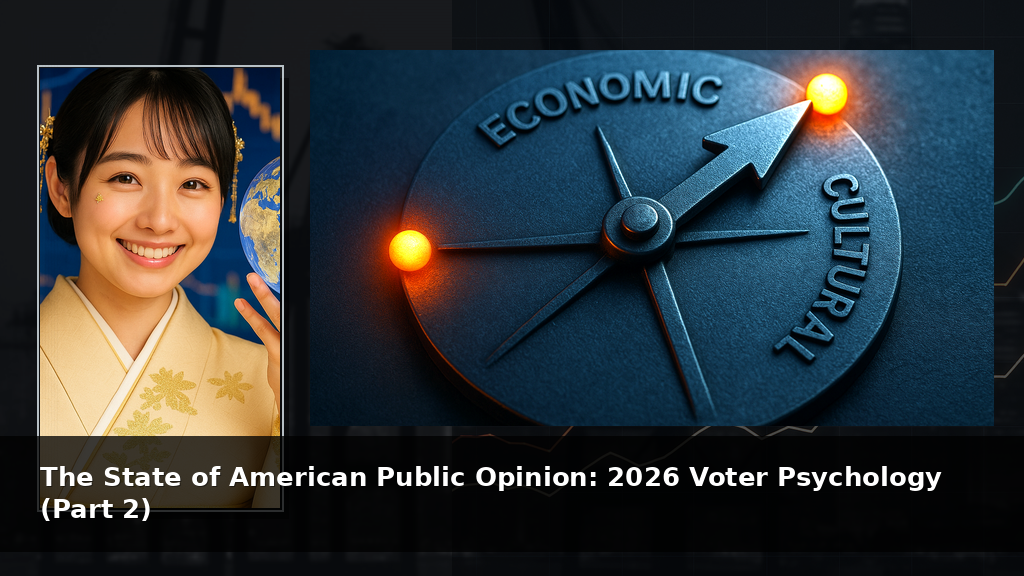
The key to this misalignment is to separate conflict into an economic axis and a cultural axis. NIRA analyzes party politics across countries by distinguishing economic issues from sociocultural issues (NIRA). What is taking place is not simply confrontation between right and left. It is a reorganization of the meanings inside those words.
Where Right and Left Came From
The terms “right” and “left” began with the seating of the French Revolution-era assembly. Those who wanted to preserve monarchy and the existing order sat on the right side of the chamber. Those who sought radical reform sat on the left. From this arrangement came the image of the right as valuing order, tradition, and the state, and the left as valuing equality, reform, and redistribution (TBS NEWS DIG).
This original pattern has not disappeared. “Protect tradition” sounds right-wing. “Correct inequality” sounds left-wing. Yet modern politics contains right-wing actors who defend tradition while seeking to restrain market competition. It also contains liberals who speak of individual freedom while calling for corporate regulation and expanded welfare. Right and left remain as etymological categories (in the sense of word origins), but they no longer explain the present configuration by themselves.
This shift is not a simple misuse of words. Political language changed because society’s central issues changed. Earlier conflict centered on tax rates, welfare, labor, capital, and the size of government. Today, immigration, gender, national identity, globalization, distance from China, religion, and speech regulation have also become central. The line between left and right remains, but the issues placed on that line have changed.
The Splitting of the Word Conservative
Contemporary “conservatism” is not one ideology. Several currents coexist under the label. The first is traditional conservatism. It values family, religion, the nation, local community, history, and culture. In Japan, emphasis on the Imperial Household, constitutional revision, and stronger defense often appears in this context. Conservatism here means preserving social continuity.
The second is economic conservatism. It values small government, tax cuts, deregulation, and market competition. This image long dominated interpretations of U.S. conservatism after the Cold War. It rests on the idea that government should remain as small as possible, private competition should be used, and taxes and regulation should be restrained.
In recent years, however, the outline of economic conservatism has weakened. Trump-aligned politics provides the clearest example. These actors are culturally conservative, but they tend to support stronger tariffs, protection for domestic industry, and subsidies. This differs sharply from older free-market conservatism. It leans toward the view that the state should protect borders, industries, and supply chains rather than leave markets free.
The third current is national conservatism, often called NatCon. It emphasizes anti-globalism, border control, immigration restriction, supply-chain security, a hard line toward China, and protection for domestic industry. After the Ukraine war, China risk, and immigration conflicts, this tendency has become conspicuous in Europe as well. Germany’s AfD, France’s National Rally, and U.S. Trumpism are sometimes discussed in this context (National conservatism). Here, conservatism does not mean simply protecting old institutions. It means protecting the boundaries of the nation-state and the community.
The fourth current is the populist right. It foregrounds the opposition between “elites” and “ordinary people.” It is often described through distrust of established media, criticism of bureaucracy, backlash against established parties, and affinity with conspiracy theories. The important point is that this current is not a simple matter of right versus left. It draws energy from distrust of the existing order. The political line now runs not only between right and left, but also between top and bottom, and between established elites and the public. In debates over Japanese party politics as well, distrust of established politics and instability in party alignments have become major issues (Tsushin Chosakai).
These four currents do not always separate cleanly. A single politician or movement often combines traditional conservatism, economic conservatism, national conservatism, and the populist right. For that reason, the label “conservative” requires a follow-up question: what is being conserved? The market, the family, borders, domestic industry, or opposition to existing institutions. Calling all of this merely conservative erases real differences.
Liberal Is Not One Thing Either
“Liberal” is also a word that invites misunderstanding. In its original sense, liberalism emphasized individual freedom. Freedom of speech, freedom of markets, and limits on state power stood at its core. In the classical meaning, liberalism protected free individuals from the state. It did not necessarily mean large government or expanded welfare.
In the United States today, however, liberal often refers to a progressive position that includes diversity, minority protection, environmental protection, welfare expansion, and acceptance of immigration. In U.S. political vocabulary, liberal carries a tone close to progressive. The two are not identical, but in everyday reporting and election narratives, liberal is often treated as a word that combines cultural progressivism with a welfare-state orientation.
In Japan, “liberal” carries a different meaning again. It often refers to defending the postwar Constitution, restraint in military affairs, emphasis on human rights, multicultural coexistence, and caution toward nuclear power, and it is strongly tied to security and constitutional questions (TBS NEWS DIG). The same word therefore foregrounds cultural diversity and welfare in the United States, while in Japan it more often foregrounds constitutional and security positioning.
This creates a translation trap. Replacing the English word liberal directly with the Japanese word “liberal” does not produce the same political image in every country. In the United States, liberals are often described less as classical liberals and more as people who support contemporary progressive values. In Japanese, liberal carries the contexts of the postwar Constitution, security, nuclear power, and human rights. The word is the same, but its coordinates on the political map are not.
The Center of the Left Has Shifted from Labor to Culture
The word “left” has also changed. The older left centered on labor unions, redistribution, anti-capitalist politics, and the interests of the working class. Wages, employment, welfare, and taxation were its main battlefields. The conflict between capital and labor formed the basic line of politics, and the left was understood as the side of labor.
The contemporary left is not limited to that. Gender, diversity, the environment, discrimination, and cultural inclusion now carry greater weight. This does not mean the left has abandoned economic issues. It means that, alongside economic inequality, it has placed cultural recognition and social inclusion at the center of politics.
This shift has intensified criticism in Europe and the United States that the left has become an elite project. The criticism says that a left once expected to represent the working class now represents the cultural values of highly educated urban groups. Here again, the older left-right line is insufficient. A voter can favor redistribution economically while resisting rapid cultural change. Such a voter does not fit neatly into either right or left.
The Cultural Axis Has Separated from the Economic Axis
The central point for understanding current politics is the separation of the economic axis from the cultural axis. On the economic axis, market orientation conflicts with redistribution orientation. Market orientation tends toward tax cuts, deregulation, and small government. Redistribution orientation tends toward welfare, public investment, worker protection, and correction of inequality.
On the cultural axis, one side emphasizes the nation, tradition, and community, while the other emphasizes diversity, the individual, and cultural freedom. The former values borders, family, religion, history, and national continuity. The latter values minority rights, individual choice, cultural inclusion, and correction of discrimination.
Once these two axes are separated, the map of modern politics changes. There is an economic-left and culturally conservative combination: voters who want redistribution or industrial protection while taking conservative positions on immigration or gender. There is also an economic-right and culturally liberal combination: voters who support market competition and small government while accepting individual lifestyles and diversity.
Without this two-axis map, phenomena such as Trump-aligned politics remain hard to understand. It is culturally conservative, but economically it accepts state intervention. It speaks about border control and protection for domestic industry, and it emphasizes defense of the national economy over market principles. This falls outside the older understanding that “right-wing” means market-oriented.
The same shift occurs on the left. The left is no longer seen only as a redistribution movement centered on workers. It is also seen as a bearer of cultural progressivism. As a result, voters who lean left economically and right culturally, or voters who lean right economically and left culturally, spill outside existing party labels. As NIRA indicates, separating economic issues from sociocultural issues has become indispensable for reading present-day party politics (NIRA).
The Misalignment of Words Changes How Elections Are Read
As a result of these changes, political vocabulary has shifted. “Conservative” has come to mean not only preservation of the old order, but also protection of the nation, community, and national identity. “Liberal” increasingly refers not only to individual freedom, but also to support for progressive values. “Right-wing” has expanded beyond market orientation into anti-globalism and emphasis on the nation-state. “Left-wing” has expanded beyond worker-centered politics into cultural progressivism.
In media space, terms such as “far right,” “populist,” “nationalist,” “progressive,” “liberal left,” and “globalist” appear frequently. These are analytical terms, but they also often function as emotional labels. Political explainers for general audiences use categories such as left, right, center, conservative, and liberal because they organize information conveniently. That convenience also hides the complexity of reality (retail-e.com).
For that reason, reading U.S. public opinion in 2026 does not start by deciding immediately whether a person is right or left. It starts by locating that position on the economic axis. It then locates the same position on the cultural axis. After that, it examines how views of the state, attitudes toward globalization, security policy, and immigration policy overlap.
This procedure clarifies differences inside the same label. Among conservatives, those who want to protect free markets differ from those who want to protect domestic industry. Among liberals, those who want to protect individuals from state power differ from those who want to institutionalize protection for social minorities. Among left-wing actors, those who center workers’ wages differ from those who center cultural inclusion.
Conclusion
Right and left, conservative and liberal, have not disappeared. They remain powerful headline terms in election coverage. Yet their contents are no longer monolithic. The economic left-right line and the cultural left-right line have diverged, and older vocabulary now strains to contain newer conflicts.
This divergence is the key to reading voter psychology in 2026. Voters do not vote only on taxes and welfare. They think about borders, industry, tradition, freedom, diversity, and the form of the state in different combinations. The modern political map therefore requires at least two axes, not one line.
The next installment examines the weight carried within this two-axis political map by groups that seek to avoid radicalization.
Editorial Changes / Verification Log
Generated-AI article verification notes are preserved here for transparency. Expand for before/after edits and source checks.
1. (unspecified section) — sentence_split
Before:
In election coverage for 2026, the same word, “conservative,” repeatedly changes shape on the screen. One candidate speaks about tax cuts and deregulation. Another candidate calls for tariffs, border control, and protection for domestic industry.
After:
In election coverage for 2026, the same word, “conservative,” changes shape on the screen. One candidate speaks about tax cuts and deregulation. Another calls for tariffs, border control, and protection for domestic industry.
Reason: Shortened and tightened sentences for flow while keeping content intact.
2. (unspecified section) — connective_trimmed
Before:
The key to understanding this misalignment is to separate political conflict into an economic axis and a cultural axis. NIRA also analyzes party politics across countries by distinguishing economic issues from sociocultural issues.
After:
The key to this misalignment is to separate conflict into an economic axis and a cultural axis. NIRA analyzes party politics across countries by distinguishing economic issues from sociocultural issues.
Reason: Removed redundant phrasing to improve readability.
3. (unspecified section) — gloss_added
Before:
Right and left remain as etymological categories, but they no longer explain the present configuration by themselves.
After:
Right and left remain as etymological categories (in the sense of word origins), but they no longer explain the present configuration by themselves.
Reason: Added a brief parenthetical gloss to aid comprehension.
4. (unspecified section) — sentence_split
Before:
This differs sharply from older free-market conservatism. It is closer to the view that the state should protect borders, industries, and supply chains than to the view that markets should simply be left free.
After:
This differs sharply from older free-market conservatism. It leans toward the view that the state should protect borders, industries, and supply chains rather than leave markets free.
Reason: Streamlined comparison without altering meaning.
5. (unspecified section) — other
Before:
Germany’s AfD, France’s National Rally, and U.S. Trumpism are sometimes discussed in the context of national conservatism (National conservatism).
After:
Germany’s AfD, France’s National Rally, and U.S. Trumpism are sometimes discussed in this context (National conservatism).
Reason: Minor phrasing adjustment to avoid repetition and maintain citation clarity.
6. (unspecified section) — other
Before:
Political explainers for general audiences use categories such as left, right, center, conservative, and liberal because they organize information conveniently.
After:
Political explainers for general audiences use categories such as left, right, center, conservative, and liberal because they organize information conveniently.
Reason: Left unchanged for meaning; retained to preserve the argument’s structure while confirming consistency with the blueprint.