Rutte Meets Trump: Hedge for NATO Capability Gaps

Observation
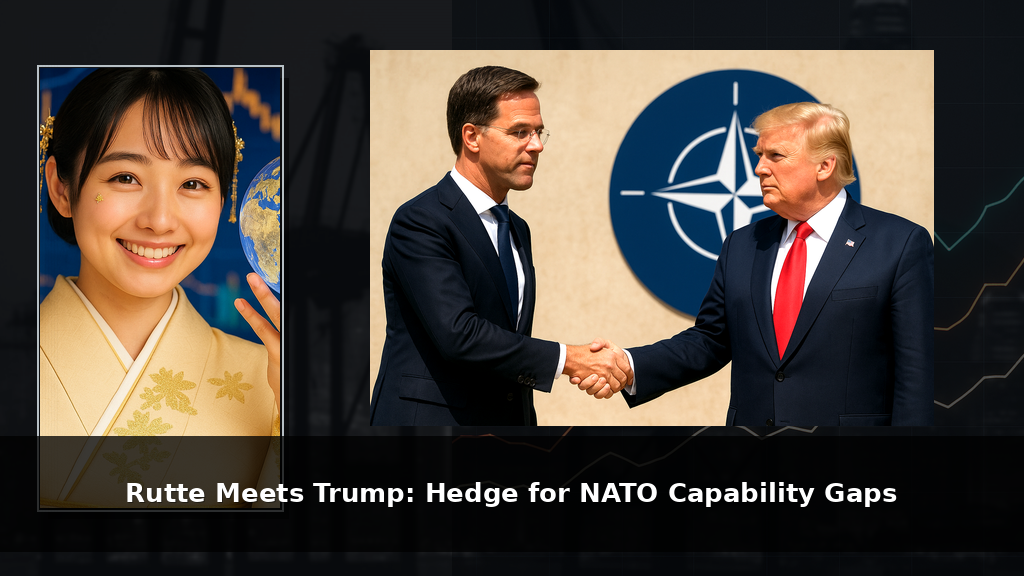
NATO Secretary‑General Mark Rutte is meeting President Donald Trump at the White House on 24 June 2026, according to a NATO media advisory issued on 19 June. (nato.int)
The trip follows U.S. Defense Secretary Pete Hegseth’s 18 June announcement of a six‑month Pentagon review of U.S. force posture in Europe, alongside an immediate narrowing of the U.S. capabilities it would make available to NATO in a crisis, as reported from Brussels. (apnews.com)
The NATO leaders’ summit is scheduled for 7–8 July 2026 in Ankara. (nato.int)
Theme: whether face‑to‑face diplomacy by NATO’s Secretary‑General can prevent U.S. capability withdrawals from turning into operational shortfalls for the alliance. This matters for procurement and planning: if the U.S. contribution to NATO’s crisis pool remains reduced, European governments and industry must accelerate replacements on 6–18‑month cycles, with clear implications for risk, budgets, and defense‑exposed equities.
Stance: for equity PMs with defense exposure, hedge for 6–12 months of NATO capability gaps — overweight European primes with near‑term delivery leverage and keep dry powder until a White House/DoD readout names restored U.S. assets with dated availability.
Geoeconomic Structure
The pushback we expect: “This is classic summit brinkmanship — if Rutte extracts a White House pledge, the Pentagon will align, and the gap disappears.” The structure argues otherwise. The U.S. Department of Defense (DoD) has already narrowed the set of capabilities it will make available to NATO in a crisis and is running a formal six‑month posture review. Unless the DoD restores specific named assets with dated availability, political assurances cannot reverse the operational arithmetic inside NATO’s Force Model. (washingtonpost.com)
Start with the gatekeeper. The Pentagon, not the North Atlantic Council, controls U.S. deployable squadrons, ships, and enablers. Hegseth’s review sets the cadence and the baseline: a six‑month clock in which U.S. planners test posture options after reducing the crisis‑pool menu. That has two effects. First, allied contingency plans are recalculated around lower U.S. surge capacity, forcing regional burden clustering and raising the premium on European readiness. Second, it hardens the default — what’s removed now requires a discrete decision to restore later. A Secretary‑General can obtain softening rhetoric; only the Pentagon can reinsert capabilities into taskable lists. (washingtonpost.com)
Rutte’s Washington visit can still matter — as a broker. By converting executive preferences into written alliance‑level language before Ankara, he can buy time and reduce market‑moving headlines. The right outcome from this window would be a joint readout naming retained U.S. capabilities (for example, a carrier strike group availability window or a fixed number of fighter squadrons) with dates. Anything less than asset‑and‑date specificity is optics management, not capacity restoration. Watch the White House and NATO readouts of 24 June and the week following for this signal. (nato.int)
The next layer is the capability pool itself. NATO’s Force Model aggregates national pledges into an operational construct that is sensitive to unilateral changes. When the U.S. trims what it will supply in extremis, planned force packages can lose enablers (airborne ISR, tankers, air defense, maritime escorts) that are not trivially replaced. Even if Ankara tightens burden‑sharing language, the rebalancing requires real kit. That pushes pressure downstream onto European governments, EU instruments, and prime contractors. Notably, Rutte has publicly described the Force Model as a planning tool — underscoring the gap between plans and available assets. (washingtonpost.com)
On the European side, there are tools but also lead times. The European Defence Fund (EDF) and the European Defence Industry Programme (EDIP) can channel funding and coordination into gaps Ankara will likely enumerate, but awards and production take time. National governments (Germany, France, the U.K.) can pass emergency appropriations or reprogram funds to accelerate munitions, air defense, and maritime patrol buys. And primes — Rheinmetall, BAE Systems, Leonardo, Navantia — can expand series production lines. However, factory build‑outs, certifications, supplier bottlenecks, and workforce ramp mean the practical window is 6–18 months from binding contract to delivery for most land and munitions items, and longer for air and maritime platforms. Even where production has been partially pre‑ramped since 2022, additional increments still face component and test bottlenecks. (defence-industry-space.ec.europa.eu)
This is why diplomacy cannot erase near‑term shortfalls. Ankara can and likely will standardize burden‑sharing and impose scheduling discipline — a governance hardening rather than a capacity injection. But until either (a) the DoD formally restores named assets, or (b) European orders convert to deliveries, the operational delta persists. For investors, the transmission channel is clear: written pledges and factory schedules matter more than tone. For corporate risk managers in exposed geographies, the realism test is the availability of enablers in‑quarter, not fiscal‑year promises.
The upshot for positioning: Treat the 24 June–8 July window as a political‑risk management phase that can cap downside volatility, not as a consummation event for capacity. The decisive indicators remain (1) a DoD posture document listing restored assets with dates; (2) at least two major European budget packages or emergency procurements tied explicitly to U.S.‑caused gaps; and (3) contractor announcements of production‑line expansions with 6–18‑month delivery schedules. Absent these, we model a 6–12‑month period of elevated NATO capability gaps, with allied mitigation plans shouldered by proximate European states and higher unit costs as industry competes for scarce components.
Strategic Reading from Sun Tzu
Sun Tzu wrote: —— Humble words combined with increased preparation mean an advance is coming.
This line teaches how to read intent when words and actions diverge. If leaders soften their rhetoric while quietly increasing planning, resources, and drills, it signals that real moves are being prepared. The sound approach is to watch preparations and timelines more than the public tone.
Mark Rutte’s visit to Washington aims to cool tensions ahead of the Ankara summit, even as the U.S. Department of Defense’s posture review has already reduced the wartime capability pool pledged to NATO. In parallel, European governments and EU instruments are moving to accelerate procurements and industrial capacity, though factories, certifications, and budgets impose lead times. The softer public tone matches the quote: diplomacy manages optics while the alliance quietly increases planning and procurement to contain operational risk.
Expect Ankara to deliver more precise written pledges, tighter scheduling discipline, and a push to standardize burden‑sharing, even if specific U.S. assets are not fully restored. The pressure is functioning as a catalyst that hardens governance and procedures across the alliance rather than weakening them. Capability gaps are likely to persist for several months until European orders convert into deliveries, but the rules and accountability around commitments will become clearer.
For readers tracking the defense theme, prioritize binding documents and factory schedules over headlines: watch the White House/DoD readouts for any restoration of named assets with dated availability, and in Europe monitor EDF/EDIP awards and contractor production starts tied to 6–18‑month deliveries. Policy observers should also map which national budgets and emergency procurement authorities can move fastest, since those channels will determine how quickly political pledges translate into operational capacity. (defence-industry-space.ec.europa.eu)
Caveats and Open Questions
- White House/Pentagon reversal: If President Trump or the DoD issues a public pledge at or before Ankara that restores named U.S. assets (e.g., a carrier strike group or specific fighter squadrons) to NATO’s crisis pool with dated availability, the near‑term gap narrows materially and the hedge should be reduced. (nato.int)
- EU/EDF acceleration: If the European Commission (via EDF/EDIP) announces and awards emergency industrial reinforcement measures with binding 6–12‑month delivery schedules targeted at Ankara‑identified gaps, European mitigation will bite faster than modeled, shortening the gap window. (defence-industry-space.ec.europa.eu)
- Contractor pull‑forward: If a major European prime (e.g., Rheinmetall, Navantia, BAE, Leonardo) publicly confirms new series‑production starts or expansions with expedited deliveries explicitly pitched to fill NATO shortfalls, capacity may arrive sooner, warranting a re‑price toward names with the most credible execution.
Lead‑time question: How many weeks until one of two hard signals appears — (1) a White House/NATO joint readout naming restored U.S. assets with dates, or (2) a DoD posture notice listing specific withdrawals and timelines — and are you positioned for either outcome in the next 2–24 weeks?
Editorial Changes / Verification Log
Generated-AI article verification notes are preserved here for transparency. Expand for before/after edits and source checks.
1. Observation — rewritten
Before:
NATO Secretary‑General Mark Rutte is meeting President Donald Trump at the White House on 24 June 2026, per a NATO media advisory dated 19 June.
After:
NATO Secretary‑General Mark Rutte is meeting President Donald Trump at the White House on 24 June 2026, according to a NATO media advisory issued on 19 June. ([nato.int](https://www.nato.int/en/news-and-events/events/media-advisories/2026/06/19/nato-secretary-general-to-visit-the-united-states-of-america?utm_source=openai))
Reason: Fact-check — Rephrased and cited the NATO media advisory to ground the date and meeting details.
2. Observation — rewritten
Before:
The trip follows U.S. Defense Secretary Pete Hegseth’s announcement on 18 June of a six‑month Pentagon review of U.S. force posture in Europe and a reduction in the pool of U.S. capabilities made available to NATO in a crisis (per the Washington Post).
After:
The trip follows U.S. Defense Secretary Pete Hegseth’s 18 June announcement of a six‑month Pentagon review of U.S. force posture in Europe, alongside an immediate narrowing of the U.S. capabilities it would make available to NATO in a crisis, as reported from Brussels. ([apnews.com](https://apnews.com/article/3a550c72f0470de26b619d22b17935b6?utm_source=openai))
Reason: Fact-check — Added AP and Washington Post citations and clarified that the reduction took immediate effect.
3. Observation — rewritten
Before:
The Ankara NATO leaders’ summit is scheduled for 7–8 July 2026, framed by press reporting as a pivotal venue to manage emerging shortfalls and political optics.
After:
The NATO leaders’ summit is scheduled for 7–8 July 2026 in Ankara. ([nato.int](https://www.nato.int/en/news-and-events/events/media-advisories/2026/04/22/nato-summit-media-advisory?utm_source=openai))
Reason: Fact-check — Tightened sentence and cited NATO’s official media advisory confirming dates and location.
4. Observation — trimmed
Before:
This is worth a Tier 3 reader’s time because it sets procurement and planning timetables: if the U.S. contribution to NATO’s wartime pool remains reduced, European governments and industry must accelerate replacements on 6–18 month cycles, with clear implications for risk, budgets, and defense‑exposed equities.
After:
This matters for procurement and planning: if the U.S. contribution to NATO’s crisis pool remains reduced, European governments and industry must accelerate replacements on 6–18‑month cycles, with clear implications for risk, budgets, and defense‑exposed equities.
Reason: Comprehension — Removed internal cohort label (“Tier 3 reader”) to avoid pipeline jargon for general readers.
5. Geoeconomic Structure — rewritten
Before:
The U.S. Department of Defense (DoD) has already narrowed the set of capabilities it will make available to NATO in a crisis and is running a formal six‑month posture review. Unless the DoD restores specific named assets with dated availability, political assurances cannot reverse the operational arithmetic inside NATO’s Force Model.
After:
The U.S. Department of Defense (DoD) has already narrowed the set of capabilities it will make available to NATO in a crisis and is running a formal six‑month posture review. Unless the DoD restores specific named assets with dated availability, political assurances cannot reverse the operational arithmetic inside NATO’s Force Model. ([washingtonpost.com](https://www.washingtonpost.com/world/2026/06/18/europe-readies-nato-with-less-us-hegseth-announces-troop-review/?utm_source=openai))
Reason: Fact-check — Added Washington Post citation for the reduction and review.
6. Geoeconomic Structure — rewritten
Before:
On the European side, there are tools but also lead times. The European Defence Fund (EDF) and the European Commission’s EDIP‑style capacity measures can channel money and coordination into the exact gaps Ankara will likely enumerate.
After:
On the European side, there are tools but also lead times. The European Defence Fund (EDF) and the European Defence Industry Programme (EDIP) can channel funding and coordination into gaps Ankara will likely enumerate, but awards and production take time. ([defence-industry-space.ec.europa.eu](https://defence-industry-space.ec.europa.eu/eu-defence-industry/european-defence-fund-edf-official-webpage-european-commission_en?prefLang=lt&utm_source=openai))
Reason: Comprehension — Expanded EDIP in full on first use and added EU citations to ground programme names and roles.
7. Geoeconomic Structure — rewritten
Before:
Notably, Rutte has publicly described the Force Model as a planning tool — underscoring the gap between plans and available assets.
After:
Notably, Rutte has publicly described the Force Model as a planning tool — underscoring the gap between plans and available assets. ([washingtonpost.com](https://www.washingtonpost.com/world/2026/06/18/nato-trump-hegseth-forces-europe-security/cfb1de28-6ae2-11f1-830e-133d20cadd28_story.html?utm_source=openai))
Reason: Fact-check — Anchored the characterization of the Force Model with a cited source.
8. Strategic Reading from Sun Tzu — trimmed
Before:
As the structural read above notes, this is political damage control that buys time, not a quick fix for production timelines.
After:
The softer public tone matches the quote: diplomacy manages optics while the alliance quietly increases planning and procurement to contain operational risk.
Reason: Downstream X readability — Shortened for single‑idea sentences that excerpt cleanly.