The Strait of Malacca and Southeast Asia’s Geopolitics (Part 1)

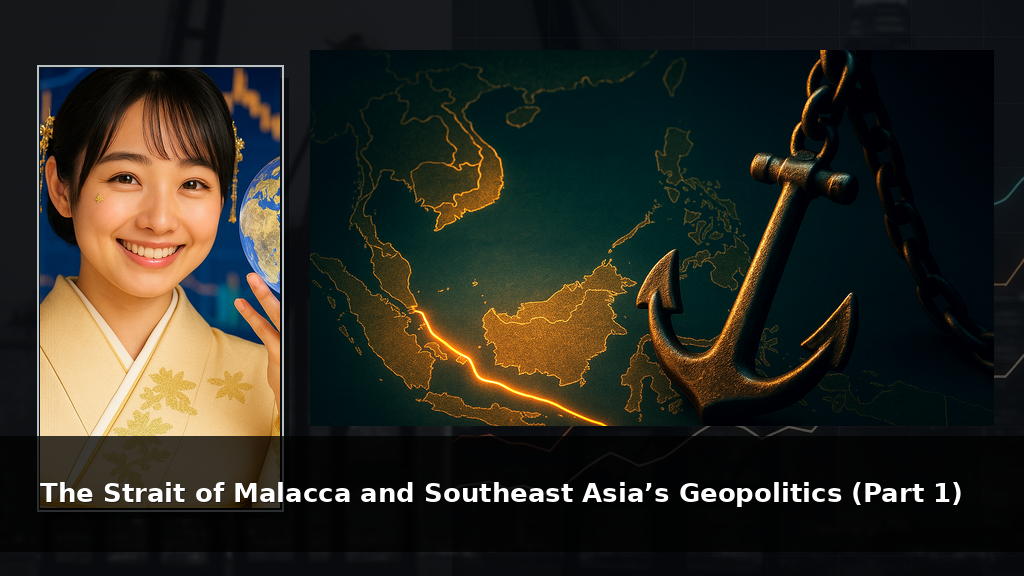
The Weight of a Narrow Sea That Carries 22% of World Trade
In 2026, every news cycle about the Strait of Hormuz crisis pushed attention beyond the exit of the Persian Gulf. Crude oil, LNG, container cargo, and components and finished goods tied to semiconductor supply chains move from the Middle East toward East Asia through one narrow maritime passage, then approach another. That second passage is the Strait of Malacca.
The Strait of Malacca is the shortest route connecting East Asia with the Middle East and Europe. In normal times, its importance becomes almost too routine to notice. Tankers proceed on schedule, container ships move from port to port, and energy and goods disappear into price tables and inventory statistics. Once the risk of a Strait of Hormuz closure entered the foreground, however, the geography behind that routine became visible. The crisis did not illuminate Hormuz alone. It pushed another narrow passage, the Strait of Malacca, to the front of the global economy.
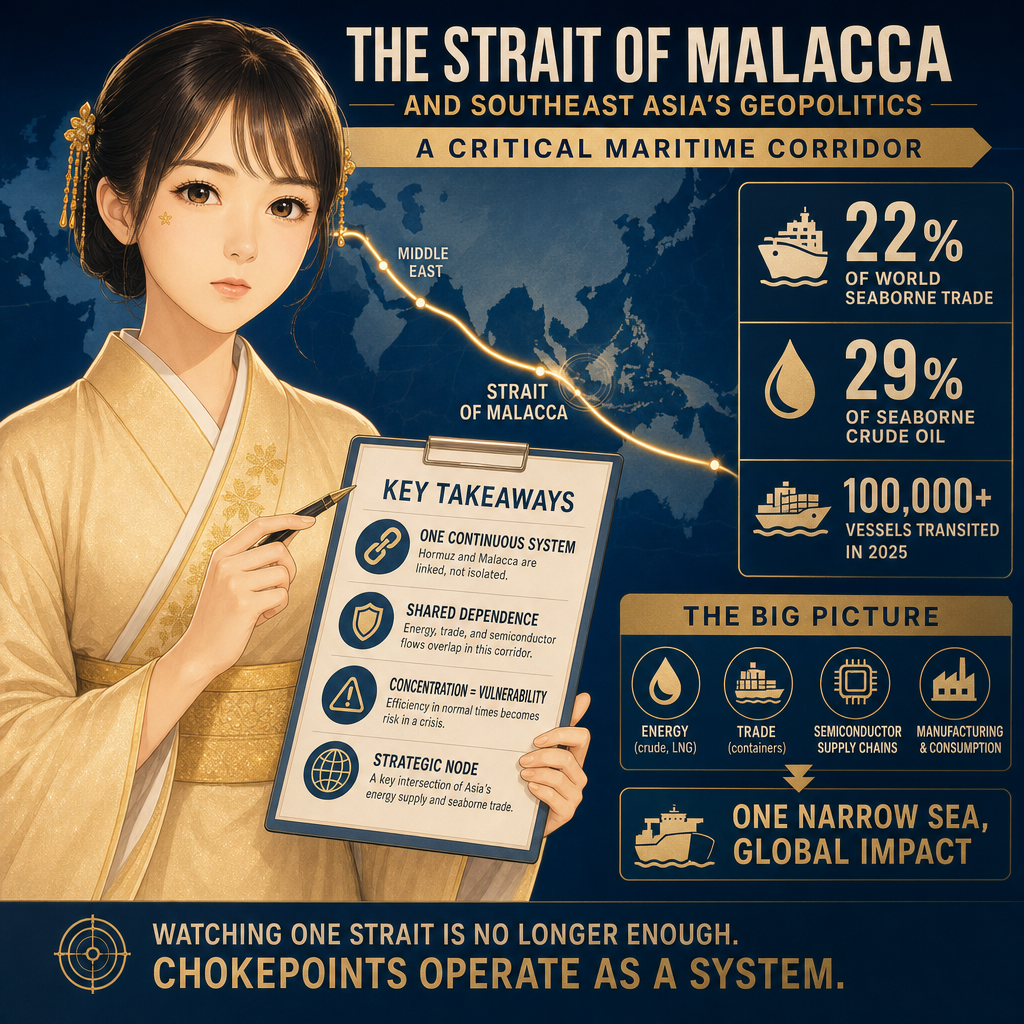
According to Reuters on April 23, 2026, more than 100,000 vessels transited the Strait of Malacca in 2025, carrying about 22% of global seaborne trade and about 29% of seaborne crude oil. These figures do not show traffic volume alone. They show a structure in which global manufacturing, consumption, power generation, and transport depend deeply on the passage capacity of a narrow strait.
Why the Hormuz Crisis Illuminated Malacca
The Strait of Hormuz crisis brought the Strait of Malacca back into focus because energy flows do not move as disconnected lines at sea. They move as continuous routes. Middle Eastern crude oil and LNG do not become secure simply because they leave the production area. Before they reach demand centers in East Asia, they must pass through multiple narrow bodies of water. Instability in the Strait of Hormuz automatically raises the importance of the Strait of Malacca farther along the same route.
The Strait of Malacca has often been described as a “vital sea lane.” That description is accurate, but it no longer captures the full change now taking place. In the 2026 context, the issue is not only the number of vessels passing through. It is the overlap of crude oil, LNG, container shipping, and semiconductor supply chains in the same maritime corridor. When energy security and industrial logistics concentrate in the same geography, tension in one strait affects the risk assessment of another.
A crisis in the Strait of Hormuz does not stop all cargo in the same way. Yet global supply networks do not operate through a simple binary of halted or continuing. Route congestion, caution over delays, limits on alternative routes, and anxiety on the demand side combine to intensify attention on other chokepoints. The Strait of Malacca is not drawing attention because it is an alternative to the Strait of Hormuz. It is drawing attention because it belongs to the same system.
The Weight of the Shortest Route
Malacca’s status as the shortest route linking East Asia with the Middle East and Europe is both its strength and its weakness. Because the route is shortest, ships concentrate there. Because ships concentrate there, logistics and energy planning assume its passage. Over time, that assumption hardens and becomes embedded in the schedules of companies, ports, refineries, power generation, and manufacturing. A crisis exposes this fixed dependence.
Crude oil and LNG are discussed in the language of energy security. Container shipping is discussed as the flow of consumer goods and components. Semiconductor supply chains are discussed as a vulnerability of advanced industry. At sea, however, these are not separate abstractions. They are constrained by concrete conditions: vessel capacity, routes, port connections, and passage through straits. The Strait of Malacca is where these conditions overlap.
The lesson from the Strait of Hormuz crisis is therefore not simply that the Middle East’s exit is dangerous. The deeper reality is that energy and trade routes function only by passing through multiple narrow maritime zones. Once the Strait of Hormuz becomes unstable, the Strait of Malacca no longer remains a distant or separate issue. For flows moving from the Middle East to East Asia, the two straits sit on one continuous line of tension.
From Separate Straits to One System
International reporting and policy debate have often treated the Strait of Hormuz, the Suez Canal, the Bab el-Mandeb Strait, and the Strait of Malacca as separate regional issues. Hormuz belonged to energy, Suez to Eurasian logistics, Bab el-Mandeb to security around the Red Sea, and Malacca to Asian maritime traffic. The categories were divided.
That view is now changing. These are no longer understood only as isolated narrow waterways. They are increasingly recognized as an interconnected group of chokepoints supporting global seaborne trade and energy transport. Tension in one location raises the transit value of another and, at the same time, makes dependence on that other location more visible. Under the Strait of Hormuz crisis, the focus on the Strait of Malacca reflects this shift in perception.
The map itself has not changed. The reading of the map has changed. In the past, the idea of bypassing a dangerous strait appeared to bring shipping closer to safety. Yet when maritime traffic depends on multiple chokepoints, avoiding one place also increases pressure and dependence elsewhere. Rerouting does not erase risk. It moves risk.
The New Reality Shown by the Strait of Malacca
The Strait of Malacca is being reassessed in 2026 not because a new route suddenly appeared there. The opposite is true. A preexisting dependence has become easier to see because of the Strait of Hormuz crisis. In normal times, the global economy prioritizes efficiency and concentrates cargo on the shortest routes. In a crisis, that concentration of efficiency reads as vulnerability.
The central point is that the Strait of Malacca cannot be understood only as a Southeast Asian maritime zone. Middle Eastern energy, trade with Europe, and East Asian manufacturing and consumption connect along the same maritime corridor. In geoeconomic terms, the Strait of Malacca is increasingly treated not as a logistics route alone, but as one of the largest strategic nodes where Asia’s energy supply and seaborne trade intersect.
The most important implication of the Strait of Hormuz crisis is that the era of “watching Hormuz is enough” is ending, as is the era of “watching Malacca alone is enough.” Maritime chokepoints operate not only as individual crisis points, but as a system that reacts across locations. The renewed prominence of the Strait of Malacca marks the moment when that system surfaced in the global economy.
The next installment examines how this structure is changing surrounding strategic calculations.
Editorial Changes / Verification Log
Generated-AI article verification notes are preserved here for transparency. Expand for before/after edits and source checks.
1. (unspecified section) — connective_trimmed
Before:
According to a [Reuters report published on April 23, 2026], more than 100,000 vessels transited the Strait of Malacca in 2025...
After:
According to [Reuters on April 23, 2026], more than 100,000 vessels transited the Strait of Malacca in 2025...
Reason: 冗長な接続表現を削り、読みやすさを高めた。
2. (unspecified section) — sentence_split
Before:
In normal times, its importance becomes almost too routine to notice. Tankers proceed on schedule, container ships move from port to port, and energy and goods disappear into price tables and inventory statistics. Once the risk of a Strait of Hormuz closure entered the foreground, however, the geography behind that routine became visible.
After:
In normal times, its importance becomes almost too routine to notice. Tankers proceed on schedule, container ships move from port to port, and energy and goods disappear into price tables and inventory statistics. Once the risk of a Strait of Hormuz closure entered the foreground, the geography behind that routine became visible.
Reason: 挿入句の位置と句読点を整え、文の切れ目を明確化してリズムを改善。
3. (unspecified section) — other
Before:
The Strait of Malacca is not drawing attention because it is an alternative to the Strait of Hormuz. It is drawing attention because it belongs to the same system.
After:
The Strait of Malacca is not drawing attention because it is an alternative to the Strait of Hormuz. It is drawing attention because it belongs to the same system.
Reason: 原意を維持しつつ、段落内の強調関係を保つため語順と句点を精密化(実質的内容変更なし)。