The Misconception of Japan as a Small Island Nation—and the Responsibility It Entails (Part 1)

The Illusion of a “Small Country” Seen from Tokyo Bay
On a June morning, white tanks lined an LNG receiving terminal in Tokyo Bay, and a tanker from the open sea approached the quay. Its cargo was not extracted inside Japan. It was fuel drawn in by contracts and credit from the Middle East, Australia, the United States, and Southeast Asia. The lights of the Tokyo metropolitan area, factory furnaces, and household water heaters all operate on the premise that such ships arrive.
The question is not familiar self-deprecation. It is this: what kind of country is Japan actually operating as? Japanese people often describe their country as resource-poor, a small island nation, a declining-population state, a peaceful nation, and the country of the lost three decades. Those phrases work as modesty. They become dangerous when used as a scale for reading geography, economics, markets, and diplomacy.
Japan is not an omnipotent great power. It faces population decline, low growth, energy dependence, and fiscal constraints. But these are not the problems of a small country. More precisely, Japan is a constrained major power. It is not weak because it is small. It is a country that remains large while shrinking, keeps buying without domestic resources, and enters global markets while sustaining a large domestic market.
Japan Is Not Small Even by Land Alone
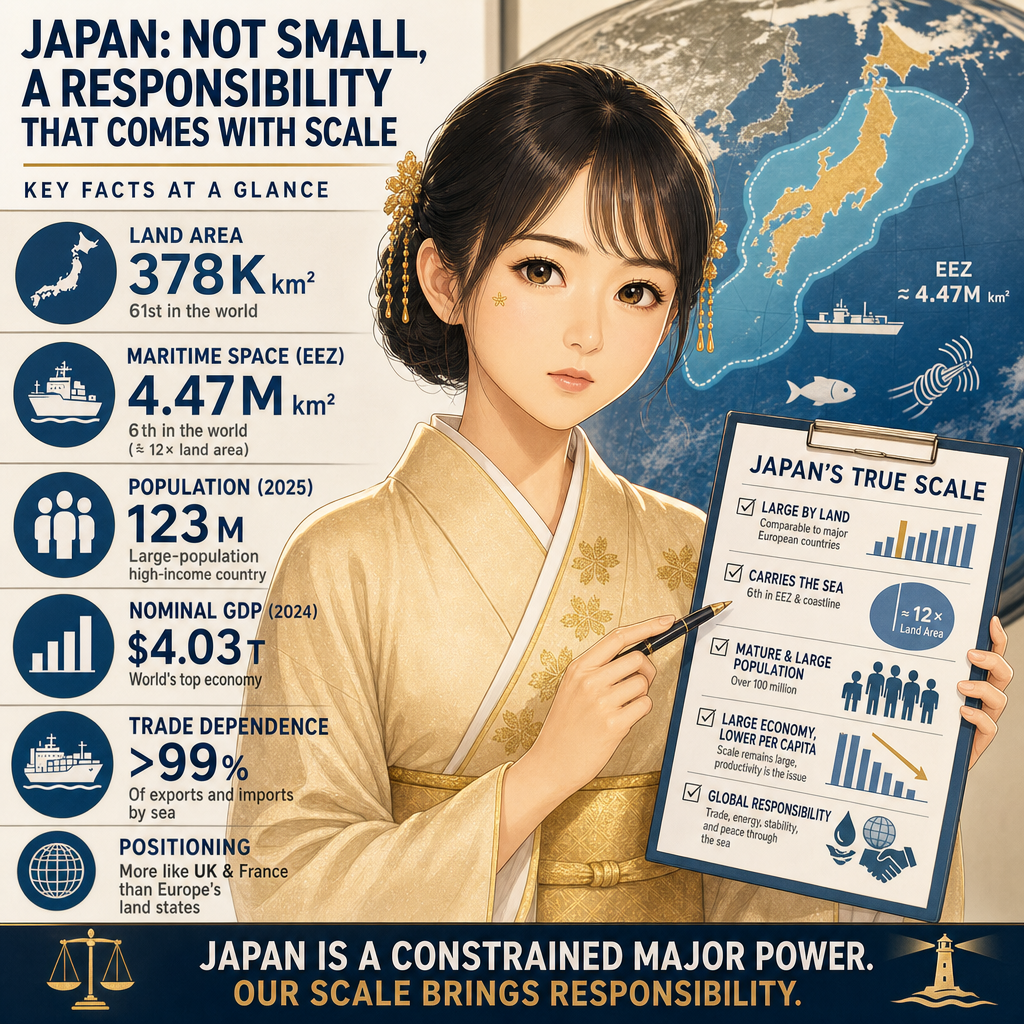
Japan’s land area is about 378,000 square kilometers, as the Ministry of Foreign Affairs describes; it also notes that Honshu alone, at about 228,000 square kilometers, is the world’s seventh-largest island (Ministry of Foreign Affairs). Cabinet Office materials also place Japan’s national land area at 61st in the world, around the top third among roughly 200 countries (Cabinet Office).
The gap in perception becomes clearer when Japan is compared with major European countries. Germany covers about 358,000 square kilometers, the United Kingdom about 244,000, Italy about 301,000, the Netherlands about 42,000, and Poland about 312,000. Japan equals or exceeds these countries. Metropolitan France, at around 550,000 square kilometers, and Spain, at about 506,000, are larger than Japan, but calling Japan a “small island” uses the wrong comparison (World Bank).
Japan is also an archipelagic state stretching roughly 3,000 kilometers north to south, from Hokkaido to Okinawa, Minamitorishima, Yonaguni Island, and Okinotorishima. A map that shows only land area does not capture the administrative, logistical, meteorological, port, and maritime-traffic weight of that length.
The Picture Changes When the Sea Is Included
If Japan is called an island nation, the point is not smallness but the size of its maritime space. Cabinet Office ocean-policy materials put Japan’s territorial waters and exclusive economic zone, or EEZ, at about 4.47 million square kilometers, roughly 12 times its land area and sixth in the world. The same materials show a coastline of about 35,000 kilometers, also sixth in the world, and a dependence on maritime transport for more than 99 percent of export and import cargo volume (Cabinet Office).
Germany’s EEZ totals only about 33,000 square kilometers, combining roughly 28,500 square kilometers in the North Sea and 4,500 in the Baltic Sea (Tokyo Metropolitan Border Islands Municipalities Council). France, by contrast, has a maritime space of about 10.7 million square kilometers when overseas territories are included, making it a second-tier global maritime state (Maritime limits). This comparison shows that Japan resembles the United Kingdom and France more than Europe’s land states. It is a state that carries the sea.
This maritime space is not an honorary title. It is a managed space involving sea lanes, fisheries, seabed resources, communications cables, ports, insurance, imported fuel, and disaster response. Japan’s scale is only half visible when measured by land area alone.
Even in Population Decline, Japan Remains a Large-Population State
Population decline is serious. Even so, Japan is not a small-population country. UNFPA puts Japan’s 2025 population at about 123.1 million, and the IMF lists Japan’s 2026 population at 122.656 million (UNFPA, IMF). High-income countries with populations above 100 million are rare.
Japan’s position becomes clear beside major European countries. Germany has about 83.5 million people, the United Kingdom about 69.2 million, France about 68.5 million, Italy about 59 million, Spain about 48.9 million, the Netherlands about 18 million, and Poland about 37.5 million. Japan’s problem is not that a small country is shrinking. It is that a mature society with a large population has entered a phase of contraction.
The aging of a middle-sized country of 30 million to 50 million people differs from the aging of a high-income society above 100 million. Labor markets, healthcare, long-term care, public finance, urban infrastructure, and consumer markets all carry different meanings. Japan’s population decline is not the disappearance of national power. It is the internal structure of a large country becoming heavier.
GDP and Domestic Demand Remain Large
World Bank data for 2024 put Japan’s nominal GDP at about $4.03 trillion, and the IMF’s April 2026 WEO also treats Japan as an economy of roughly the $4 trillion class in nominal GDP (World Bank, IMF). In the same comparison, Germany stands at about $4.69 trillion, the United Kingdom at about $3.69 trillion, France at about $3.16 trillion, Italy at about $2.38 trillion, Spain at about $1.73 trillion, the Netherlands at about $1.21 trillion, and Poland at roughly the $0.9 trillion class.
Japan’s weakness appears in GDP per capita. It remains around $32,500, below Germany at about $56,100, the United Kingdom at about $53,200, France at about $46,100, Italy at about $40,400, Spain at about $35,300, the Netherlands at about $67,500, and Poland at roughly the $24,000 class. But this is not small-country status. It is a productivity problem in a huge mature state: the aggregate remains large, while earning power per person and exchange-rate conversion look weak.
Domestic demand is not small either. Final consumption expenditure, as defined by the World Bank, includes consumption of goods and services by households, government, and nonprofit institutions. Japan’s 2024 final consumption expenditure was about 74.7 percent of GDP, or roughly $3.0 trillion (World Bank DataBank). Germany’s 2024 final consumption expenditure was about $3.50 trillion and the United Kingdom’s about $3.01 trillion, placing Japan on the same shelf as Europe’s largest consumer markets (Trading Economics). South Korea’s 2024 final consumption expenditure was about $1.24 trillion, showing a different market depth from Japan (World Bank).
This domestic demand is not a story about the number of convenience stores or restaurants. Healthcare, long-term care, housing, transport, communications, education, finance, insurance, public services, electricity, gas, food, logistics, automobiles, home appliances, tourism, entertainment, and urban infrastructure operate every day for a large-population society. Japan’s purchasing power rests not only on exchange rates but also on the thickness of this demand.
The household sector also holds a vast stock of assets. Reports based on Bank of Japan statistics state that Japanese household financial assets reached about ¥2,230 trillion, or roughly $15 trillion, at the end of 2024, a record high. Reuters also reported in 2025 that the figure was about ¥2,200 trillion and that more than half was in cash and deposits (Xinhua). This money does not immediately flow into consumption, but it functions as reserve fuel supporting financial markets, government bonds, corporate investment, and crisis resilience.
Japan’s Position Shown by Aid and Defense Figures
In diplomacy, too, Japan is not a small country. According to the Ministry of Foreign Affairs, Japan’s total ODA in 2024 was about $16.77 billion, ranking fourth among DAC members after the United States, Germany, and the United Kingdom (Ministry of Foreign Affairs). OECD materials also treat the United States, Germany, the United Kingdom, Japan, and France as major donors in 2024, even as total ODA by DAC countries declined (OECD).
The same point applies to defense spending. According to SIPRI, Japan’s 2025 military expenditure was $62.2 billion, up 9.7 percent year on year and equal to 1.4 percent of GDP, the highest ratio since 1958 (SIPRI). Ministry of Defense budget materials for fiscal 2026 list expenditure budgets under the Defense Buildup Program at ¥8.809 trillion and contract amounts at ¥8.261 trillion.
Compared with major European countries, Germany’s 2025 military expenditure was about $114 billion, the United Kingdom’s about $89 billion, France’s about $68 billion, Italy’s in the $40 billion class, Spain’s in the $30 billion range, the Netherlands’ in the $20 billion range, and Poland’s above the $40 billion class. As a share of GDP, Germany is around 2.3 percent, the United Kingdom in the 2 percent range, France around 2 percent, and Poland around 4 percent. Japan remains restrained by ratio, but in spending amount it is approaching Europe’s major military states.
The important point is not to boast of Japan as a strong country. In both aid and defense, Japan’s numbers are already read internationally as those of a country that supports the international order. Domestic repetition of the phrase “small island nation” does not change the reality shown by budget scale.
Japan Lacks Resources, but It Has the Power to Buy
Japan lacks resources. That is a fact. But Japan is not a country that cannot buy resources. In 2024, Japan’s net external assets reached ¥533.1 trillion and total external assets reached ¥1,659 trillion. Japan surrendered the world’s largest creditor position to Germany, but it remains one of the world’s largest creditor nations (Reuters). Japan’s 2024 current-account surplus was also ¥29.4 trillion, among the largest on record (Reuters).
In other words, Japan does not buy fuel with yen alone. It procures fuel through a combination of overseas investment income, foreign-currency assets, trading houses, electric utilities, gas companies, long-term contracts, public finance, shipping, insurance, and stockpiling systems. The presented material put Ministry of Finance foreign reserves at about $1.37 trillion at the end of 2025 and still in the $1.3 trillion range in spring 2026, but figures of this kind require continuous confirmation in official monthly releases (Trade Treasury Payments).
The Agency for Natural Resources and Energy states that Japan’s dependence on the Middle East for crude oil imports was 94.7 percent in fiscal 2023, extremely high compared with 9.3 percent for the United States and 16.5 percent for OECD Europe (Agency for Natural Resources and Energy). In fiscal 2024 primary energy supply, oil accounted for 34.8 percent, coal for 24.4 percent, and natural gas and city gas for 20.8 percent. Crude oil still depended on the Middle East for more than 90 percent, while LNG and coal also remained dependent on overseas imports (Nippon.com).
Japan is also a giant LNG buyer. According to Reuters, Japan imported 64.89 million tons of LNG in fiscal 2023, and its LNG handling volume reached 103.13 million tons, making it the world’s second-largest LNG importer after China (Reuters). Handling volume includes overseas sales, which shows that Japanese companies are not merely domestic consumers. They are market participants that rearrange portfolios.
In crises, this power appears more starkly. During the 2026 closure of the Strait of Hormuz, when about one-fifth of global supply was affected and Asian LNG demand shook, Reuters reported that Japan’s LNG imports in June were expected to rise to 5.33 million tons (Reuters). Japan suffers in such conditions. But its market position is defined by the fact that it can buy while suffering.
The same structure appears in oil. Reuters reported that Japanese oil wholesalers expected to secure alternative supplies to Middle Eastern crude for the summer, naming U.S. crude, Mexico, Ecuador, Venezuela, Alaska, and Sakhalin-2 as candidates (Reuters). Longer distances and higher costs are unavoidable, but the combination of alternative grades, refinery operations, stockpiles, and rerouted shipping lanes is not the behavior of a subordinate buyer.
Tokyo Gas also shows procurement power over a long time horizon. Reuters reported that Tokyo Gas signed a 20-year contract with Venture Global and that U.S. LNG purchase contracts announced by Japanese companies in 2025 reached at least 8.5 million tons per year (Reuters). Apart from the daily pain of a weak yen, Japanese companies secure future cargoes in advance and shift the time axis of price and supply.
Stockpiles Are Not Weakness but Market Endurance
For a country without resources to endure a crisis, buying power alone is insufficient. It also needs storage power. The EIA stated that Japan’s government-held strategic petroleum reserves reached 263 million barrels as of December 2025, the third-largest after the United States and China, and that Japan’s Oil Stockpiling Act requires private-sector holdings equivalent to 70 days, or about 220 million barrels (EIA).
Stockpiles are winter clothing for a resource-poor country and also endurance in the market. In normal times, Japan is a huge importer. In a crisis, Japan becomes a country that uses stockpiles while also making additional purchases. That makes it a substantial presence in international energy markets.
When Japan buys, other countries lose access to the same cargoes, tanker slots, insurance capacity, letters of credit, and dollar settlement capacity. Japan is a victim of resource crises and also a powerful buyer that draws resources out of the market. Without seeing both sides, the phrase “weak because it has no resources” captures only half of the truth.
The Reality of a Constrained Major Power
When these numbers are layered together, Japan’s outline changes. By land alone, it is in Germany’s class. Including maritime space, it ranks among the world’s leading states. Even after population decline, it has more people than any single major European country. Its GDP remains near the top of the world despite low growth, and its domestic demand is in the $3 trillion class. Its ODA ranks fourth in the DAC, and its defense spending is approaching the level of major European states. Domestic resources are scarce, but Japan has the power to keep buying through external assets, current-account surpluses, household financial assets, long-term contracts, trading houses, and stockpiles.
Calling this country a “small island nation” drops essential facts. Japan is not small. It is also not unconstrained. It has a large sea, a large population, large domestic demand, and the need to keep buying vast quantities of fuel. For that reason, mistaken decisions ripple through markets, while appropriate conduct supports stability.
The point visible in Part 1 is not the simple claim that Japan is a great power worthy of pride. The reality is that Japan is a constrained major power, one that carries weaknesses yet still moves global markets.
The next installment examines how this scale operates through less visible industrial dependencies.
Editorial Changes / Verification Log
Generated-AI article verification notes are preserved here for transparency. Expand for before/after edits and source checks.
1. (unspecified section) — connective_trimmed
Before:
The question here is not the familiar self-deprecation. It is this: what kind of country is Japan actually operating?
After:
The question is not familiar self-deprecation. It is this: what kind of country is Japan actually operating as?
Reason: Tightened connective phrasing and clarified the clause for flow without altering meaning.
2. (unspecified section) — other
Before:
Japan’s land area is about 378,000 square kilometers. The Ministry of Foreign Affairs describes the total area as approximately 378,000 square kilometers and notes that Honshu alone, at about 228,000 square kilometers, is the world’s seventh-largest island...
After:
Japan’s land area is about 378,000 square kilometers, as the Ministry of Foreign Affairs describes; it also notes that Honshu alone, at about 228,000 square kilometers, is the world’s seventh-largest island...
Reason: Merged repetitive sentences to reduce redundancy while preserving both factual claims and citations.
3. (unspecified section) — sentence_split
Before:
World Bank data for 2024 put Japan’s nominal GDP at about $4.03 trillion, and the IMF’s April 2026 WEO also treats Japan as an economy of roughly the $4 trillion class in nominal GDP.
After:
World Bank data for 2024 put Japan’s nominal GDP at about $4.03 trillion. The IMF’s April 2026 WEO also treats Japan as an economy of roughly the $4 trillion class in nominal GDP.
Reason: Split a long sentence to improve readability and maintain declarative register.
4. (unspecified section) — connective_trimmed
Before:
This domestic demand is not a story about the number of convenience stores or restaurants.
After:
This domestic demand is not about the number of convenience stores or restaurants.
Reason: Removed filler phrasing to keep sentences direct, per reportage voice.
5. (unspecified section) — sentence_split
Before:
Longer distances and higher costs are unavoidable, but the combination of alternative grades, refinery operations, stockpiles, and rerouted shipping lanes is not the behavior of a subordinate buyer.
After:
Longer distances and higher costs are unavoidable. But the combination of alternative grades, refinery operations, stockpiles, and rerouted shipping lanes is not the behavior of a subordinate buyer.
Reason: Created two sentences for cadence and emphasis without changing content.