India–Italy Summit and the Future of India–Europe Relations (Part 1)

The Upgrade That Took Place in Rome
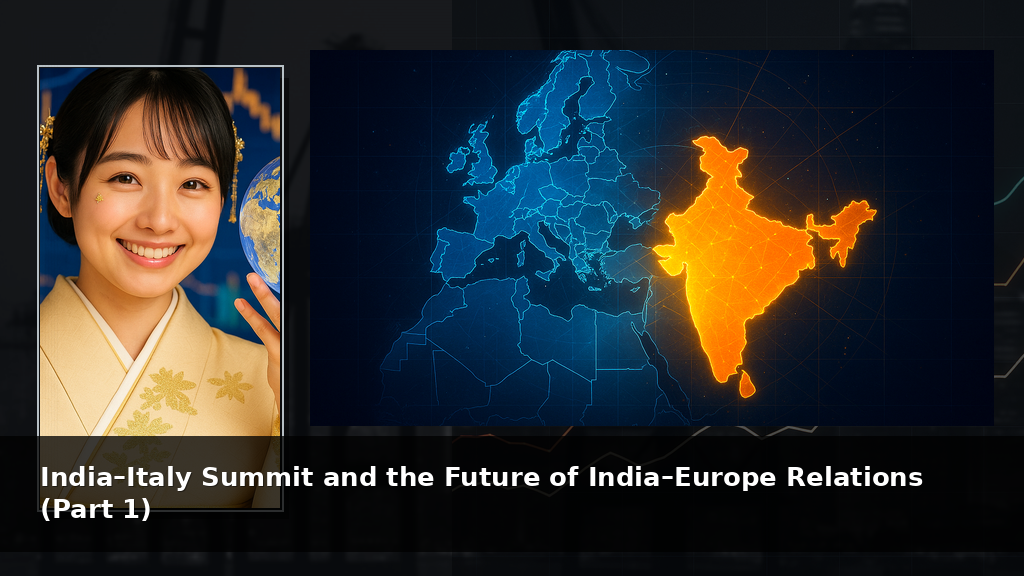
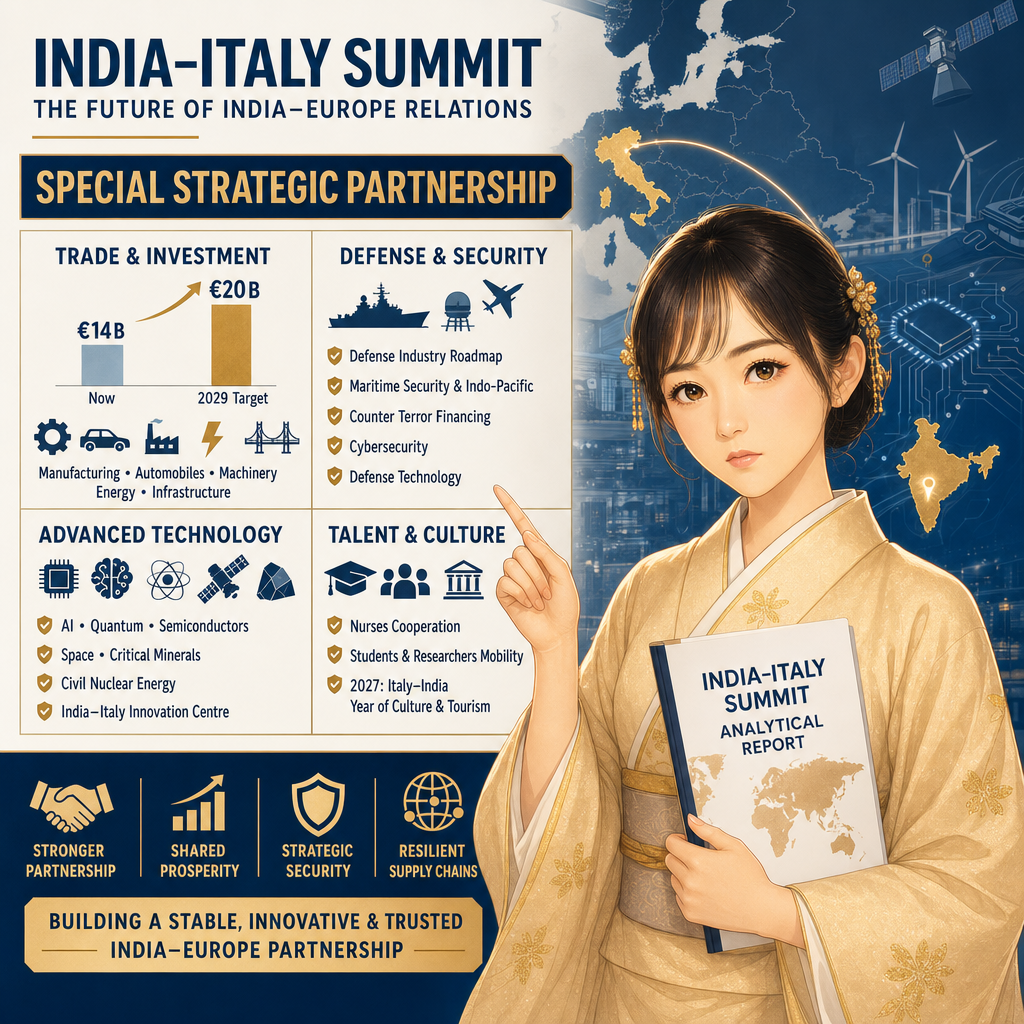
When Prime Minister Giorgia Meloni and Prime Minister Narendra Modi stood side by side in Rome, India–Italy relations shifted from ordinary diplomacy into a deeper institutional relationship. On May 20, 2026, the two leaders agreed to upgrade the existing “Strategic Partnership” to a “Special Strategic Partnership.” Italy’s Decode39 and India’s The Indian Express treated this upgrade as the central outcome of the summit.
The important point is that the agreement did not remain a performance of friendship. The Italian government’s joint declaration and the Indian government’s Press Information Bureau release treated trade, investment, defense, advanced technology, talent, and cultural exchange as one package. The Rome summit therefore did more than narrow the distance between India and Italy. It showed which European capital can turn India–Europe relations into concrete policy.
The Trade Target Showed the Weight of Practical Policy
Trade was the most measurable outcome of the summit. The two countries set a target to expand bilateral trade from about €14 billion at present to €20 billion by 2029. The priority sectors included manufacturing, automobiles, machinery, energy, and infrastructure. This structure points beyond a simple increase in exports and imports. It signals an intention to connect industrial bases.
Indian media emphasized a reciprocal frame: Italy as a gateway to the EU market, and India as an entry point into a growth market for Italian companies. This language matters more than the number itself. Italy has depth in European manufacturing, with strengths in machinery, components, automotive supply chains, design, and infrastructure companies. India is expanding production capacity and enlarging its domestic market at the same time. The convergence between the two countries is not a simple story of cheap labor meeting advanced technology. It is the process through which European companies reduce dependence on China while searching for the next manufacturing base, and India absorbs European technology and capital.
This reading matches the direction reported by Reuters immediately before the Rome summit. The meeting did not create a sudden atmosphere of goodwill. It institutionalized a strengthening relationship already in motion. The combination of trade targets and priority industries reveals its practical character more clearly than the language of the leaders’ declaration.
Defense Cooperation Connected to Europe
Defense and security formed another pillar of the Rome summit. The two countries agreed to prepare a defense industry roadmap and placed maritime security, Indo-Pacific cooperation, countering terrorist financing, cybersecurity, and defense technology development on the agenda. The significant point is that Italy emerged not only as a standalone defense partner, but also as a node inside India’s wider security relationship with Europe.
This sequence had a prior stage. The background to India–EU relations has long appeared in public materials, and on January 27, 2026, the EEAS announced that the EU and India had signed a security and defense partnership. Basic reference material also appears in India–European Union relations. The Rome summit’s defense roadmap translated that EU–India movement into bilateral industrial cooperation.
From India’s perspective, defense cooperation with Europe diversifies procurement sources and creates opportunities for technology transfer and joint development. From Italy’s perspective, India is a major security partner with a position in the Indo-Pacific, and also a market for the defense industry. In this context, the phrase “special strategic” is not diplomatic decoration. It indicates a relationship that treats security, industry, and technology as connected fields.
Advanced Technology Overlapped With Reducing Dependence on China
The summit placed AI, quantum technology, semiconductors, space development, critical minerals, and civil nuclear energy among the priority areas for cooperation. The two countries also indicated a plan to advance the establishment of the “India-Italy Innovation Centre.” The joint press statement by Prime Minister Modi, reported by pmindia.gov.in, also placed cooperation in these advanced sectors at the center of the meeting.
This section is especially important for reading India–Italy relations as part of broader India–Europe relations. In recent years, Europe has pursued “de-risking” (reducing exposure to concentrated supply-chain risk) to avoid excessive dependence on China in supply chains and advanced industries. India has continued to strengthen manufacturing under the logic symbolized by “Make in India” and seeks more contact with Europe in semiconductors, critical minerals, space, and digital technology. Their interests align not as a complete alliance, but through the practical purpose of distributing dependence.
As India Briefing notes, this cooperation cannot be measured by trade volume alone. AI, semiconductors, and critical minerals sit at the boundary between industrial policy and security. Italy does not carry the same political weight in Europe as Germany or France, but it has an industrial base in manufacturing, machinery, space, defense, and energy-related companies. For India, Italy is becoming a usable entry point that connects European institutions and industry at the practical level.
Talent and Culture Make the Relationship Durable
The summit outcomes were not limited to hard sectors. The two countries also agreed on cooperation for the reception of nurses, expanded movement of students and researchers, and the designation of 2027 as the “Italy-India Year of Culture and Tourism.” These items can look peripheral, but they affect the durability of the relationship.
Italy faces a shortage of medical personnel alongside population aging, and India sees the overseas deployment of skilled workers as a growth opportunity. Cooperation on nurses answers both needs. The movement of students and researchers creates the foundation for advanced technology cooperation. The culture and tourism year is symbolic, but it places people-to-people exchange inside the political calendar.
The Indian government’s Press Information Bureau release on this point shows that the summit was not merely a set of corporate contracts or defense consultations. India–Europe relations do not last through FTAs and defense cooperation alone. Without human channels involving migration, education, research, medical personnel, and tourism, political agreements struggle to take root in society. The Rome summit built small institutions that address that weakness.
Italy’s Reading Pointed From the Mediterranean to the Indian Ocean
Italian reporting prominently framed India as an important strategic partner for Europe and as part of an economic strategy to reduce dependence on China. Behind that view stands the Meloni government’s idea of building new logistics connections from the Mediterranean to the Indian Ocean and advancing diplomacy that links the G7 with the Global South.
The Meloni government’s Africa policy, the “Mattei Plan,” belongs in this context. As Reuters has reported, the government treats relations with Africa through energy, development, debt, migration, and climate response. Cooperation with India appears within this broader regional strategy as a political line connecting Africa, the Middle East, and Europe.
Seen from Rome, India is not a distant Asian power. It is a partner that connects Mediterranean policy, Africa policy, European industrial policy, and engagement with the Indo-Pacific. This also reflects an Italian diplomatic move to act not only on Europe’s margins, but also as an intermediary with the Global South.
India’s Reading Was a Route Into Europe
On the Indian side, the emphasis fell on accelerating FTA negotiations with the EU, strengthening access to European markets, acquiring defense technology, diversifying supply chains, and deepening European partnerships with competition with China in view. The center of this position is not a containment network against China. It is the expansion of options that help India avoid dependence on China.
Inside India, many assessments view Italy as one of the major European countries most friendly to India at present. The line of argument in The Times of India treats Italy not merely as one EU member state, but as a political foothold for India as it broadens relations with Europe.
This assessment has practical reasons. Relations with France and Germany remain important, but each involves major industrial interests and diplomatic calculations. Italy is relatively flexible and can present a combination of manufacturing, defense, infrastructure, and talent cooperation. For India, it is more rational to increase national entry points for cooperation than to treat Europe as a single unified actor.
The Form of India–Europe Relations Revealed by a Bilateral Summit
The essence of the Rome summit is not simply that India and Italy became closer. Europe has reasons to reduce dependence on China, and India has reasons to avoid dependence on China without entering full confrontation with it. What the two countries share is a judgment that new connectivity through the Middle East needs political support, and that industrial foundations including AI, semiconductors, and critical minerals need multiple lines of supply and cooperation.
This relationship, however, is not a military alliance. It is not a bloc held together by values alone. It is a practical rapprochement that reduces mutual vulnerabilities step by step by bundling trade targets, a defense industry roadmap, advanced technology, talent mobility, and cultural exchange. The future of India–Europe relations will not be decided by declarations from Brussels alone. Capitals such as Rome, Paris, Berlin, and Athens will use their own industries and geographies to give concrete form to relations with India.
In that sense, the May 20, 2026 Rome summit was a miniature version of India–Europe relations. Italy sought to become a European window, and India sought to secure multiple entrances into Europe. Their convergence showed that the next phase of India–Europe relations will advance less through ideals than through supply chains, technology, talent, and the defense industry.
The next installment examines the aims and constraints of the EU external investment strategy that supports this India–Europe rapprochement.
Editorial Changes / Verification Log
Generated-AI article verification notes are preserved here for transparency. Expand for before/after edits and source checks.
1. (unspecified section) — sentence_split
Before:
When Prime Minister Giorgia Meloni and Prime Minister Narendra Modi stood side by side in Rome, India–Italy relations moved from ordinary bilateral diplomacy into a deeper institutional relationship. On May 20, 2026, the two leaders agreed to upgrade the existing “Strategic Partnership” to a “Special Strategic Partnership.”
After:
When Prime Minister Giorgia Meloni and Prime Minister Narendra Modi stood side by side in Rome, India–Italy relations shifted from ordinary diplomacy into a deeper institutional relationship. On May 20, 2026, the two leaders agreed to upgrade the existing “Strategic Partnership” to a “Special Strategic Partnership.”
Reason: Tightened phrasing and separated actions to improve clarity at the scene-setting opening.
2. (unspecified section) — connective_trimmed
Before:
This structure points beyond a simple increase in exports and imports. It signals an intention to connect industrial bases.
After:
This structure goes beyond a simple increase in exports and imports. It signals an intention to connect industrial bases.
Reason: Removed redundant connective phrasing for smoother flow.
3. (unspecified section) — gloss_added
Before:
In recent years, Europe has pursued “de-risking” to avoid excessive dependence on China in supply chains and advanced industries.
After:
In recent years, Europe has pursued “de-risking” (reducing exposure to concentrated supply-chain risk) to avoid excessive dependence on China in supply chains and advanced industries.
Reason: Added a brief parenthetical gloss to aid comprehension of a policy term.
4. (unspecified section) — other
Before:
Basic reference material has also appeared in India–European Union relations.
After:
Basic reference material also appears in India–European Union relations.
Reason: Minor rephrase to reduce awkwardness while preserving the same factual point and citation.