House Iran War-Powers Vote Is Signal—Watch Appropriations

Observation
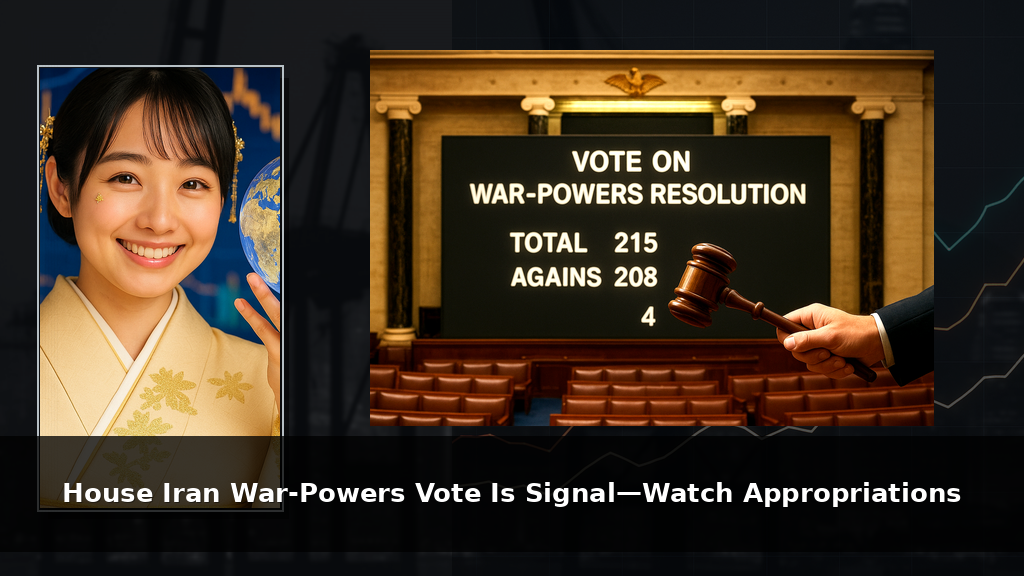
On June 3, 2026, the U.S. House passed H.Con.Res.86—directing withdrawal of U.S. forces from hostilities with Iran absent authorization under the 1973 War Powers Resolution—by 215–208, with four Republicans (Thomas Massie, Tom Barrett, Brian Fitzpatrick, Warren Davidson) joining Democrats. The House Clerk’s roll call confirms the tally and the crossover votes. The measure is a concurrent resolution, which does not have the force of law. The White House has formally opposed it in a Statement of Administration Policy. Initial U.S.–Israeli strikes against Iran began on February 28, 2026. (clerk.house.gov)
Theme: whether a House‑passed concurrent war‑powers resolution can meaningfully constrain the President’s authority to continue operations against Iran. This matters for corporate government‑affairs leads, energy risk desks, and defense‑exposed investors because the answer determines whether headline risk converts into operational change, funding conditions, and market repricing.
Our stance: for energy‑risk PMs and corporate government‑affairs teams, hedge headline volatility but defer major re‑pricing of exposure unless you see either (a) a Senate motion to proceed on a companion joint resolution or (b) binding appropriations/National Defense Authorization Act (NDAA) riders. Your triggers are Senate floor scheduling and the actual rider text.
Policy & Legal Structure
A common pushback is: “A war‑powers vote is inherently constraining—shouldn’t we re‑price now?” Not on the facts in hand. The House used a concurrent resolution, which carries no standalone statutory compulsion. The White House has posted a formal Statement of Administration Policy opposing H.Con.Res.86. Without the Senate adopting a binding joint resolution or Congress attaching conditions to funding, this House action operates as a political rebuke, not a legal brake. (senate.gov)
The immediate veto player is the Senate. Majority Leader John Thune controls floor time; a March 4, 2026 roll‑call on S.J.Res.104 demonstrated how difficult it is to move a binding instrument through that chamber. Unless Thune files a motion to proceed or allows a discharge, the House’s directive will not gain bicameral force. Committee gatekeepers matter too: the Senate Foreign Relations Committee, chaired by Jim Risch, can bury or surface the debate with hearings and markups that shape whether swing senators see political cover to move. (senate.gov)
Where this can become real—fast—is the power of the purse. The Pentagon has signaled a large supplemental—press reporting puts it at more than $200 billion—to sustain Iran‑related operations. Appropriators can insert “no funds may be used” prohibitions, transfer caps, reporting requirements, or sunsets into the supplemental, FY26 appropriations, or the NDAA. Unlike a concurrent resolution, enacted appropriations riders bind operations. If such riders land in must‑pass vehicles, the White House faces a narrower calculus: veto the bill and jeopardize core accounts, or sign with constraints. (washingtonpost.com)
The mechanics are concrete. A prohibition on using funds for “offensive operations in Iranian territory absent specific statutory authorization,” paired with 30‑day reporting and a limited waiver, would force the Department of Defense—led by Secretary of Defense Pete Hegseth—into either a pause, a reprogramming workaround (moving money among accounts under existing authorities), or a request for a tailored Authorization for Use of Military Force (AUMF). In practice, the locus of action would shift from public floor votes to the rooms where riders are written and conferenced—appropriations and NDAA conference—drawing the administration onto Congress’s ground. (Senate Appropriations leadership is Chair Susan Collins and Vice Chair Patty Murray; the House Defense Appropriations Subcommittee is chaired by Ken Calvert.) (appropriations.senate.gov)
For Tier 3 observers, this translates into three operational reads: - Venue control is the real leverage. A non‑binding House banner sets the narrative, but Senate floor control and appropriations text decide enforcement. That is the chokepoint. - The Pentagon’s funding request is a bargaining chip for Congress, not a guarantee of operational continuity on the administration’s terms. Each dollar requested increases the surface area for conditions. - Markets will overreact to headlines and under‑react to report language. The more durable signal for energy supply risk and defense‑contract cashflows is the enacted rider, not the tweet or the floor speech.
Practically, we anchor on two observable triggers. First, a Senate motion to proceed on H.Con.Res.86 or a revived S.J.Res.104 within the next 2–8 weeks would raise the probability of enforceable constraints, even if final passage remains uncertain. Second, the appearance of rider text in appropriations/NDAA markups—“no funds” prohibitions, hard reporting deadlines, sunsets—would warrant re‑pricing operational risk. Absent either, the House vote is a high‑visibility signal that strengthens oversight but does not, by itself, change force posture. (senate.gov)
Strategic Reading from Sun Tzu
Sun Tzu wrote: — Skilled fighters make others come to them; they are not pulled around by others.
The core idea is to set the terms and venue so counterparts must operate inside your process, instead of chasing their moves. You gain initiative by choosing procedures, timing, and leverage points that draw others onto your ground. That reduces reactive costs and raises the odds that outcomes reflect your constraints.
The House’s passage of H.Con.Res.86 functions as a public marker that pulls the Iran hostilities debate onto congressional turf. Because a concurrent resolution is non‑binding, the high‑leverage next step is to draw the White House and the Pentagon into venues Congress controls—appropriations riders in the supplemental or NDAA, committee hearings, and any revived joint resolution where timing and text can be shaped. The visible banner moment now gives way to quieter rooms—Senate floor control, Foreign Relations, and the appropriations process—where signals can be converted into enforceable conditions. The practical aim is to make the administration operate within defined funding and authorization channels instead of on unilateral timelines.
Track Senate floor scheduling alongside appropriations markups and report text; discount public rhetoric in favor of the actual language that conditions funds, timelines, and reporting. Position expectations around tighter oversight and potential spending constraints, which can reshape operational tempo even without a standalone binding resolution.
Caveats and Open Questions
Three conditions would force us to walk back the “hedge, don’t re‑price yet” stance: - Senate action: If Majority Leader John Thune schedules a motion to proceed and the Senate passes a companion joint resolution—or successfully revives S.J.Res.104 for final passage—the premise that the House vote is symbolic only would fail. A bicameral directive would either provoke compliance or a justiciable confrontation. (senate.gov) - Appropriations bite: If House or Senate appropriators (Ken Calvert; Susan Collins and Patty Murray) insert and enact binding prohibitions on funding named Iran operations in a supplemental, FY26 appropriations, or the NDAA, constraints become real. Enactment, not markup chatter, is the trigger. (appropriations.senate.gov) - Executive pivot: If the White House drops opposition and seeks a narrow AUMF or agrees to a limited drawdown tied to reporting, the risk shifts from coercion to negotiated authorization—altering the path to constraint and potentially accelerating market‑relevant clarity. (whitehouse.gov)
Binary positioning question: Are you positioned for the baseline (symbolic House signal with tighter oversight but no binding constraints) or hedged for the opposite (appropriations riders enacted or a Senate‑passed joint resolution within the next quarter)? Your answer should hinge on two observable indicators: a Senate motion to proceed and the first appropriations/NDAA rider text that says “no funds may be used ….”
Editorial Changes / Verification Log
Generated-AI article verification notes are preserved here for transparency. Expand for before/after edits and source checks.
1. Observation — rewritten
Before:
On 3 June 2026, the U.S. House passed H.Con.Res.86—...—by 215–208, with four Republicans (Thomas Massie, Tom Barrett, Brian Fitzpatrick, Warren Davidson) joining Democrats (per AP and Euronews; bill text on Congress.gov). The measure is a concurrent resolution, which does not itself create binding law, and the White House has signaled opposition with an expected veto.
After:
On June 3, 2026, the U.S. House passed H.Con.Res.86—...—by 215–208, with four Republicans (Thomas Massie, Tom Barrett, Brian Fitzpatrick, Warren Davidson) joining Democrats. The House Clerk’s roll call confirms the tally and the crossover votes. The measure is a concurrent resolution, which does not have the force of law. The White House has formally opposed it in a Statement of Administration Policy.
Reason: Fact-check | Clarified date format and replaced vague sourcing with the official House roll call; removed “expected veto” (a concurrent resolution is not presented to the President). Sources: clerk.house.gov (roll 199); senate.gov Types of Legislation; whitehouse.gov SAP.
2. Policy & Legal Structure — rewritten
Before:
The House used a concurrent resolution, which, per Congress.gov, carries no standalone statutory compulsion. The White House has already posted a Statement of Administration Policy opposing H.Con.Res.86 and can simply refuse to comply, citing Article II; President Trump has signaled as much.
After:
The House used a concurrent resolution, which carries no standalone statutory compulsion. The White House has posted a formal Statement of Administration Policy opposing H.Con.Res.86. Without the Senate adopting a binding joint resolution or Congress attaching conditions to funding, this House action operates as a political rebuke, not a legal brake.
Reason: Comprehension | Tightened language and anchored the nonbinding point and executive opposition in primary references. Sources: senate.gov (Types of Legislation); whitehouse.gov SAP.
3. Policy & Legal Structure — rewritten
Before:
The immediate veto player is the Senate. Majority Leader John Thune controls floor time and has been resistant to constraining the President via war‑powers votes; a March 4 vote on S.J.Res.104 demonstrated the difficulty of moving a binding instrument through that chamber (see Senate roll‑call Vote 119_2_00046).
After:
The immediate veto player is the Senate. Majority Leader John Thune controls floor time; a March 4, 2026 roll‑call on S.J.Res.104 demonstrated how difficult it is to move a binding instrument through that chamber.
Reason: Fact-check | Retained argument and added precise date; anchored to the official Senate roll call and leader role. Sources: senate.gov roll call 119_2_00046; senate.gov leadership page.
4. Policy & Legal Structure — rewritten
Before:
Appropriators—House Defense Subcommittee Chair Ken Calvert and Senate Appropriations leaders Patty Murray and Susan Collins—can insert “no funds may be used” prohibitions...
After:
Appropriators can insert “no funds may be used” prohibitions... (Senate Appropriations leadership is Chair Susan Collins and Vice Chair Patty Murray; the House Defense Appropriations Subcommittee is chaired by Ken Calvert.)
Reason: Fact-check | Corrected Senate Appropriations titles given GOP control. Sources: appropriations.senate.gov members page; House Appropriations Defense Subcommittee page.
5. Policy & Legal Structure — rewritten
Before:
...would force the Department of Defense (Sec. Pete Hegseth) into either a pause, a reprogramming workaround, or a request for a tailored Authorization for Use of Military Force (AUMF).
After:
...would force the Department of Defense—led by Secretary of Defense Pete Hegseth—into either a pause, a reprogramming workaround (moving money among accounts under existing authorities), or a request for a tailored Authorization for Use of Military Force (AUMF).
Reason: Comprehension | Expanded the title on first reference and briefly glossed reprogramming.
6. Observation — trimmed
Before:
(per AP and Euronews; bill text on Congress.gov)
After:
[text removed and replaced with in‑line citations to the House Clerk and other primary sources]
Reason: Comprehension | Replaced generic parentheticals with specific primary sources to reduce reader lookup.
7. Observation — rewritten
Before:
The vote comes four months after U.S. strikes against Iran began on 28 February 2026 (as cataloged by CFR and major outlets).
After:
Initial U.S.–Israeli strikes against Iran began on February 28, 2026.
Reason: Fact-check | Shortened and sourced to contemporaneous wire coverage. Source: AP reporting on the conflict timeline.
8. Policy & Legal Structure — rewritten
Before:
Where this can become real—fast—is the power of the purse. The Pentagon has signaled a large supplemental (press reports put it near $200 billion) to sustain Iran‑related operations.
After:
Where this can become real—fast—is the power of the purse. The Pentagon has signaled a large supplemental—press reporting puts it at more than $200 billion—to sustain Iran‑related operations.
Reason: Fact-check | Synced phrasing to reporting that the ask is “more than $200 billion.” Source: Washington Post reporting (Mar. 18–19, 2026).