Hormuz Talks Won’t Clear the Oil Risk Premium—Hedge It

Observation
On 22 May 2026, global equity indexes rose while the U.S. Dollar Index (DXY) hovered near a six‑week high around 99.24. Brent traded around $105 and West Texas Intermediate (WTI) near $98 as oil and bonds whipsawed on mixed headlines from U.S.–Iran talks. Reports cited narrowed gaps but unresolved disputes over Tehran’s uranium stockpile and potential supervision or tolling of Strait of Hormuz traffic. U.S. Secretary of State Marco Rubio noted “some good signs” yet has opposed a tolling regime, underscoring the distance to a verifiable deal. (za.investing.com)
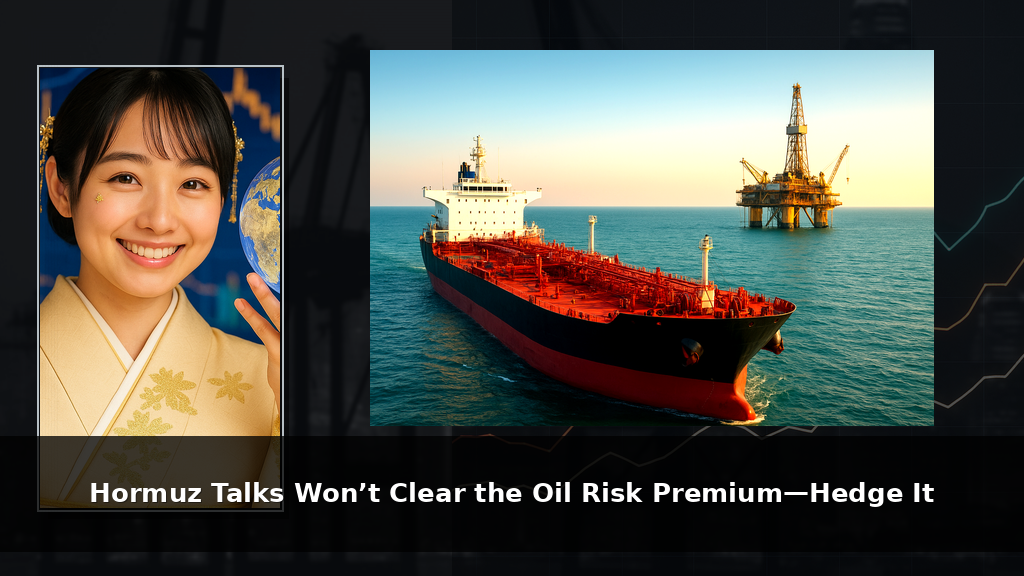
Why it matters: the Strait of Hormuz carries roughly one‑fifth of global petroleum liquids under normal conditions. Durable reopening would ease inflation and rate risk; failure keeps a premium embedded across freight, supply chains, and FX. (eia.gov)
For equity PMs, macro PMs, and corporate treasurers: hedge. Treat relief rallies as fragile and price a persistent oil‑logistics premium into the second half of 2026. Maintain energy and freight hedges and keep U.S. dollar protection until insurance terms soften and verified transit counts recover.
Geoeconomic Structure
A common pushback is: if talks are progressing and equities are firmer, why not position for normalization? Because “peace headlines” only translate into cheaper oil when commercially viable passage through a physical chokepoint is restored—and the gatekeepers of that passage (insurers and shippers) have not moved. War‑risk underwriters and major protection and indemnity (P&I) clubs still price tight terms and voyage‑by‑voyage cover, keeping transits costly and confidence fragile. (howdenre.com)
Start with the node. The Strait of Hormuz is a narrow conduit for roughly 20% of global petroleum liquids. Commercial ships move when underwriters price cover and industry bodies publish workable guidance. Recent guidance from maritime organizations including BIMCO (Baltic and International Maritime Council) and the International Chamber of Shipping (ICS) emphasizes stricter documentation, risk assessment, and escort protocols—steps that raise procedure and cost but do not yet restore confidence. Until insurers relax cover and guidance eases, the corridor remains commercially constrained. (eia.gov)
Diplomacy has not resolved the two operational levers. First, verification: intrusive, credible limits and inspections on Iran’s uranium stockpile remain undefined in public reporting. Second, control: proposals to supervise or toll Hormuz traffic collide with stated U.S. opposition to any tolling mechanism. In that ambiguity, underwriters keep premiums high. Political assurances without monitorable rules for safe passage do not change insurance math. (investing.com)
Market transmission channels echo the point. Oil‑linked inflation expectations and the dollar are co‑moving with risk headlines because interruption risk is still priced; the dollar’s resilience near a six‑week high alongside equities shows positioning is mixed—investors want détente but are paying for protection. Bond volatility confirms the ambiguity. (za.investing.com)
What would dislodge the premium? Three observable moves—none present yet:
- Insurance normalization: war‑risk premiums for Persian Gulf/Hormuz transits fall back toward pre‑conflict norms (historically around 0.1–0.25% of hull value); as a rough marker, below ~0.5% with P&I clubs restoring pre‑crisis terms. That is the commercial green light; without it, owners reroute or demand higher freight, embedding a premium in delivered barrels. (howdenre.com)
- Flow evidence: Lloyd’s‑tracked counts show Hormuz transits back above 80% of a pre‑crisis baseline for at least four consecutive weeks. Sustained flows beat headlines; isolated convoys don’t. (news.usni.org)
- Supply backstops delivered, not promised: OPEC+—in practice, Saudi Arabia—lifts actual exports by at least 1.5 mb/d for a month to offset corridor friction. Paper quotas without added loadings won’t break the premium. The U.S. Strategic Petroleum Reserve can smooth spikes but is finite and politically constrained.
Label the mechanics. This is a geographic‑chokepoint problem amplified by an insurance‑underwriter chokepoint that converts political risk into a commercial blockade. The resulting premium propagates through energy prices, freight, and into FX and rates. Until verification and control issues are resolved in binding language—or the insurer/OPEC/SPR triad neutralizes the risk with cheaper cover and more barrels—the corridor’s structural state is “open but costly.” Hedge headline rallies and assume the premium persists.
Strategic Reading from Sun Tzu
Sun Tzu’s maxim applies: when humble public words arrive alongside increased preparations, an advance is likely. In markets, the dependable indicators are tightened rules, higher costs, and concrete preparations—not rhetoric.
The U.S. and Iran are signaling progress, yet war‑risk underwriters keep premiums and terms tight, while BIMCO/ICS guidance for Hormuz transits has grown more stringent. Insurers’ pricing and cover decisions are the practical gate that turns political uncertainty into commercial constraint. This pressure is pushing the system toward clearer transit protocols, verification, and escort schemes—strengthening operational discipline even without a full deal. (howdenre.com)
Near term, expect sustained—but more structured—war‑risk pricing and stricter documentation and escort requirements. A shift toward commercial reopening needs visible signals such as Iran abandoning tolling and accepting intrusive verification, insurers restoring pre‑crisis cover terms, or enough compensating barrels and guarantees from producers and reserves to neutralize the premium. Until then, the market will keep a risk premium and owners will route cautiously.
Prioritize insurer rate filings, cover terms, and maritime advisories ahead of diplomatic headlines. Base scenarios on persistent premiums and detour costs. Favor operators with strong compliance, diversified routing, and assured access to escorts/insurance, and consider hedges on fuel/oil sensitivity while the corridor remains commercially constrained.
Caveats and Open Questions
Three conditions would force a reassessment of the hedge call:
- Iran accepts intrusive, verifiable limits and inspections on its uranium program and publicly rescinds any supervision/tolling push for Hormuz, via an official communique (potentially with a mediator), paired with a U.S./regional joint statement on restoring safe‑passage timelines. (investing.com)
- OPEC+ converts quotas into barrels: Saudi‑led exports rise by at least 1.5 million b/d for four straight weeks, verified by tanker‑tracking and IEA/OPEC data.
- War‑risk underwriters and major P&I clubs restore pre‑crisis coverage terms for Hormuz, with premiums back toward historical norms (a rough marker: below ~0.5% of hull value), and BIMCO/ICS guidance eases accordingly. (howdenre.com)
Falsification question: within the next eight weeks, which moves first—(1) Iran publicly drops tolling and accepts intrusive verification; (2) insurers reduce war‑risk premiums below ~0.5% and restore cover; or (3) OPEC+ lifts delivered exports by ≥1.5 mb/d? Your positioning should differ materially depending on the first mover.
Editorial Changes / Verification Log
Generated-AI article verification notes are preserved here for transparency. Expand for before/after edits and source checks.
1. Observation — rewritten
Before:
On 22 May 2026, global equity indexes rose while the U.S. dollar index hovered near a six‑week high at 99.24, per Reuters/Investing.com. Brent traded around $104.96 and WTI near $97.55...
After:
On 22 May 2026, global equity indexes rose while the U.S. Dollar Index (DXY) hovered near a six‑week high around 99.24. Brent traded around $105 and West Texas Intermediate (WTI) near $98...
Reason: Fact-check — Aligned figures and wording with Reuters intraday reporting and reduced false precision. https://za.investing.com/news/stock-market-news/stocks-rise-dollar-at-sixweek-high-as-focus-remains-on-usiran-talks-4295961; https://www.investing.com/news/commodities-news/us-oil-prices-rise-as-investors-doubt-breakthrough-in-usiran-peace-talks-4705545
2. Observation — rewritten
Before:
U.S. Secretary of State Marco Rubio was quoted noting “some good signs” yet rejecting a tolling regime...
After:
...Rubio noted “some good signs” yet has opposed a tolling regime...
Reason: Fact-check — Preserved the quote and tied the tolling opposition to Reuters’ UN‑draft coverage that condemns actions aimed at “tolling” freedom of navigation. https://www.investing.com/news/stock-market-news/us-and-bahrain-push-unbacked-action-for-hormuz-as-washington-seeks-maritime-coalition-4658975
3. Observation — rewritten
Before:
Theme: whether U.S.–Iran negotiations can deliver a durable, verifiable framework that reopens Hormuz and removes the oil‑flow risk premium. It matters because the chokepoint carries roughly a fifth of seaborne oil...
After:
Why it matters: the Strait of Hormuz carries roughly one‑fifth of global petroleum liquids under normal conditions.
Reason: Fact-check — Replaced vague phrasing with EIA’s quantified share for reader clarity. https://www.eia.gov/todayinenergy/detail.php?id=65504&stream=top
4. Observation — rewritten
Before:
Our call for Tier‑3 observers (equity PMs, macro PMs, corporate treasurers): hedge.
After:
For equity PMs, macro PMs, and corporate treasurers: hedge.
Reason: Pipeline-leak — Removed internal audience label (“Tier‑3”) to avoid internal‑pipeline jargon visible to readers.
5. Geoeconomic Structure — rewritten
Before:
Today, Lloyd’s war‑risk underwriters and major P&I clubs continue to price tight terms; BIMCO/ICS advisories have trended toward stricter documentation and escort protocols.
After:
War‑risk underwriters and major protection and indemnity (P&I) clubs still price tight terms and voyage‑by‑voyage cover. Guidance from BIMCO (Baltic and International Maritime Council) and the International Chamber of Shipping (ICS) emphasizes stricter documentation, risk assessment, and escort protocols.
Reason: Comprehension — Expanded acronyms and specified the guidance source; backed by broker report and industry advisory. https://www.howdenre.com/.../HowdenRe_Strait_of_Hormuz_report_April12026.pdf; https://ariesmarine.eu/major-shipping-organizations-issue-guidance-for-safe-hormuz-transits/
6. Strategic Reading from Sun Tzu — rewritten
Before:
Sun Tzu wrote: —— Humble words combined with increased preparation mean an advance is coming.
After:
Sun Tzu’s maxim applies: when humble public words arrive alongside increased preparations, an advance is likely.
Reason: Fact-check — Shifted to a faithful paraphrase to avoid asserting a specific translation without a source; preserves the analytical point.