Hormuz Strikes: Price the Insurance Shock, Not a Supply Shock

Observation
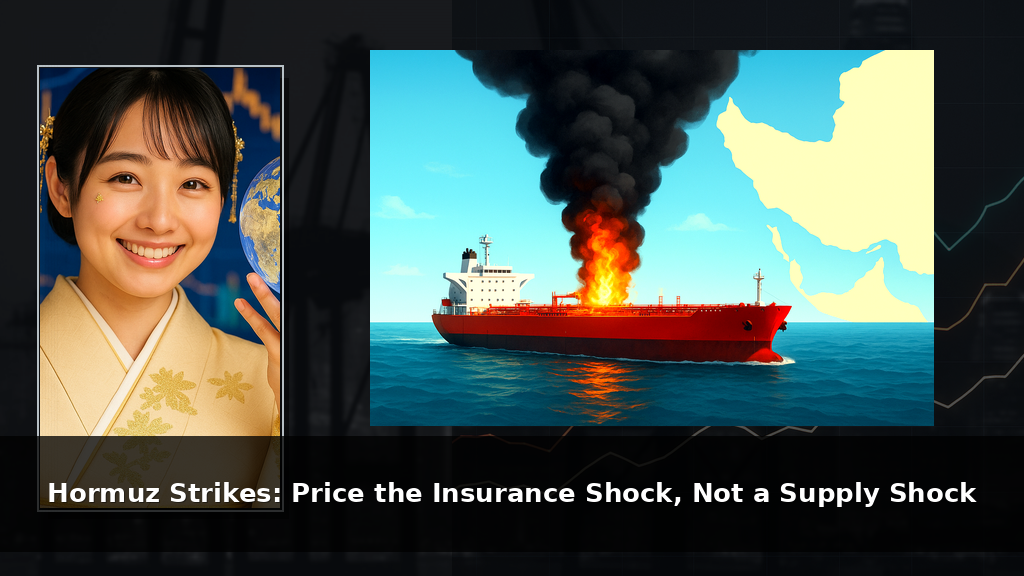
U.S. officials told Axios that Iran’s Islamic Revolutionary Guard Corps fired at least two missiles at commercial vessels transiting the Strait of Hormuz on the night of July 6–7, 2026. The United Kingdom Maritime Trade Operations (UKMTO) reported a tanker hit about 8 nautical miles east of Limah, Oman, with a fire on the port side; Reuters-linked regional outlets named two damaged ships: the Qatari LNG carrier Al Rekayyat and a Saudi‑flagged crude tanker believed to be Wedyan. The Joint Maritime Information Center (JMIC) raised the regional threat assessment for the Strait of Hormuz to “severe” on July 7; no confirmed large‑scale casualties have been reported in initial accounts. (axios.com)
Theme: whether renewed attacks in/near Hormuz force durable hardening of marine war‑risk insurance and a stickier risk premium in oil and LNG. This matters for portfolio hedging, treasury risk, and procurement budgets: the chokepoint is global, the gatekeepers are concentrated, and the bill shows up quickly in voyage economics and front‑month curves.
Our stance for energy PMs and corporate risk leads: hedge for an insurance‑led shock that lasts beyond headlines — assume tougher cover, higher surcharges, and elevated prompt premia for weeks, with potential to extend into a few months. Fade a supply‑loss narrative; price an underwriting regime shift.
Geoeconomic Structure
The pushback we expect: “Physical flows won’t collapse — Saudi’s East‑West (Petroline) and the UAE’s Abu Dhabi Crude Oil Pipeline (ADCOP) bypass Hormuz, so the shock will fade.” Flows will likely hold up, but that misses who defines the rules after a strike sequence and a JMIC ‘severe’ rating: lead underwriters, the Lloyd’s Market/Joint War Committee (JWC), and reinsurers. Their area notices and wordings — not tanker availability alone — set the floor for voyage economics and the time it takes to normalize. (seatrade-maritime.com)
Start with concrete actors and actions. JMIC’s move to “severe” for Hormuz provides an operational trigger for underwriting reviews. Lloyd’s/JWC have recently responded to threat hardening by widening ‘listed areas’; earlier in 2026 they extended listed zones around the Arabian Peninsula. When JWC expands a listed area or lead hull underwriters raise war‑risk surcharges, shipowners (Bahri, Nakilat, and other Very Large Crude Carrier (VLCC)/LNG operators) do not just re‑plot Automatic Identification System (AIS) tracks — they must comply with insurer‑defined corridors, escorts, and notification protocols on a voyage‑by‑voyage basis to remain insurable. That is gatekeeping power exercised through listed‑area maps, exclusions, and endorsements, not a market chat about “be careful out there.” (theinsurer.com)
The transmission into prices is direct. War‑risk charges and rerouting lengthen voyages and add escort/standby costs; charterers pass those through into freight and commodity pricing. Commodity desks incorporate this into prompt Brent and LNG premia and the shape of the 30‑day forward curve; implied volatility (IV) usually lifts alongside. Even if Saudi Aramco keeps Petroline throughput near its technical ceiling and ADNOC pushes more volumes to Fujairah via ADCOP, that moderates supply risk but not the cost of covering or financing a voyage that still interacts with insurer‑controlled zones. LNG is especially exposed: the reported hit on Al Rekayyat transmits immediately into QatarEnergy/Nakilat’s risk calculus and into prompt cargo premia given limited alternative lift points. (spglobal.com)
Operationally, shipowners and charterers will triage: larger, state‑backed or well‑capitalized tonnage absorbs surcharges and sails under escort; smaller owners or marginal charters balk or defer. That de facto concentrates flows through a narrower set of operators and corridors, introducing congestion and queue risk at Fujairah and Yanbu and, critically, making the system more sensitive to any subsequent incident along the substitute routes. The chokepoint shifts rather than disappears. Meanwhile, freight indices (Baltic Dirty Tanker Index) and VLCC time‑charter equivalents (TCEs) tend to jump as rerouting and insurance premia bite, and Kpler/Lloyd’s List transit counts are likely to dip week‑on‑week before stabilizing under the new ruleset.
This is why we frame the episode as an underwriting shock more than a supply shock. The “supply can be moved” argument is true over months; the “rules and prices are rewritten” fact is true immediately and endures until two conditions are met: a visibly safer operating picture and formal downgrades from the same gatekeepers that hardened it. The JMIC ‘severe’ alert and an IRGC‑linked strike sequence give committees the procedural cover to harden; committees typically relax slowly and with documentation. That cadence keeps risk premia sticky even as barrels and cargoes keep moving. (seatrade-maritime.com)
What to watch to validate or falsify the call: - JMIC threat bulletins: if “severe” persists for >7 consecutive days, insurers have reason to embed higher loads; a quick downgrade would compress the time window. (seatrade-maritime.com) - JWC/Lloyd’s notices: an expanded listed area or premium advisories within 7–30 days would formalize hardening; silence and unchanged wordings would argue for transience. (theinsurer.com) - ICE Brent front‑month and Brent IV: repeated +3% spikes on new reports and a sustained forward steepening point to embedded premia. - AIS‑based transit counts through Hormuz and freight indices: a >20% rise in VLCC/LNG TCEs within two weeks and a measurable drop in daily transits would confirm pass‑through.
In short: pipelines help the volumes; underwriters set the price. Price the latter.
Strategic Reading from Sun Tzu
Sun Tzu wrote: “Skilled fighters make others come to them; they are not pulled around by others.”
Initiative is not about reacting faster; it is about designing conditions so others must operate on your terms. By setting rules, prices, and procedures in advance, you narrow the available choices for counterparties and avoid being dragged from incident to incident. In markets, the side that defines the operating standard holds the practical advantage.
With missile and drone strikes on commercial shipping attributed to Iran’s IRGC and JMIC raising Hormuz risk to “severe,” the gatekeepers — Lloyd’s Market/Joint War Committee and lead hull insurers/reinsurers — have the basis to widen listed areas and tighten war‑risk terms. By publishing area notices and pricing, they pull shipowners like Bahri, Nakilat and other VLCC/LNG operators, along with charterers and commodity desks, onto insurer‑defined corridors, escorts, and reporting rules rather than reacting ad hoc to each incident. As the structure above indicates, this is a shift from quiet internal caution to visible, formal constraints that compress the system into cleaner standards. Pipeline bypasses (Saudi Aramco’s East‑West line, ADCOP) help with volumes but do not remove insurer‑led gatekeeping for voyages transiting or skirting Hormuz. (seatrade-maritime.com)
Expect durable upward repricing of war‑risk cover, wider listed areas, and more explicit compliance requirements (corridor use, notifications, AIS protocols), which will keep short‑term oil/LNG premia elevated. This pressure serves as a hardening catalyst: underwriting committees translate caution into standardized rules, making voyage risk more predictable even if costlier. If strikes pause and security ratings ease or pooled/state‑backed cover emerges, premiums can retrace, but the baseline now points to tougher and more transparent underwriting.
Monitor JWC circulars, broker wordings, and Protection & Indemnity (P&I) advisories as the earliest signals of constraint. Rebuild models with higher war‑risk surcharges, longer routings, and potential escort fees, while tracking Petroline/ADCOP throughput to separate insurance‑driven costs from actual supply loss. (spglobal.com)
Caveats and Open Questions
Three conditions would force us to walk back the “durable hardening” call:
- JWC/Lloyd’s holds the line: If the Joint War Committee declines to expand listed areas or publish premium guidance and lead underwriters do not raise hull war‑risk surcharges within 7–14 days, the gatekeeper mechanism we rely on is absent; repricing would then be transient and negotiated case‑by‑case. (theinsurer.com)
- Security corridor restoration: If the Combined Maritime Forces (CMF)/JMIC coordinate a southern corridor with escorts and the region achieves ≥30 consecutive days of incident‑free transits, followed by a JMIC downgrade from “severe,” insurers will have grounds to soften terms and premiums could normalize quickly. (seatrade-maritime.com)
- Pipeline substitution blunts premia: If Saudi Aramco sustains East‑West (Petroline) throughput near ~7 mb/d and ADNOC scales ADCOP/Fujairah loadings materially, and if pooled/state‑backed cover emerges for LNG voyages, commodity premia would compress even if some insurance costs linger. (spglobal.com)
Lead‑time question: How many weeks until the insurance gatekeepers confirm or refute hardening — does JWC publish a listed‑area/premium update within 30 days of the JMIC “severe” alert, or do we instead see a JMIC downgrade and 30 incident‑free days that argue for fading the spike? (theinsurer.com)
Editorial Changes / Verification Log
Generated-AI article verification notes are preserved here for transparency. Expand for before/after edits and source checks.
1. Observation — rewritten
Before:
UKMTO reported a tanker hit about 8 nautical miles east of Limah, Oman, with a fire on the port side; Reuters and regional outlets named two damaged ships... The Joint Maritime Information Center raised the regional threat assessment for the Strait of Hormuz to “severe”…
After:
The United Kingdom Maritime Trade Operations (UKMTO) reported a tanker hit about 8 nautical miles east of Limah, Oman, with a fire on the port side… The Joint Maritime Information Center (JMIC) raised the regional threat assessment…
Reason: Comprehension — Expanded UKMTO and JMIC on first use to avoid acronyms without gloss. Fact-check supported by Anadolu Agency and Seatrade Maritime. https://www.aa.com.tr/en/middle-east/tanker-hit-off-oman-s-coast-sparking-fire-aboard-vessel-ukmto/3987964 https://www.seatrade-maritime.com/security/jmic-raises-strait-hormuz-threat-level-severe
2. Observation — rewritten
Before:
Reuters and regional outlets named two damaged ships: the Qatari LNG carrier Al Rekayyat and a Saudi‑flagged crude tanker believed to be Wedyan.
After:
…named two damaged ships: the Qatari LNG carrier Al Rekayyat and a Saudi‑flagged crude tanker believed to be Wedyan.
Reason: Fact-check — Attributed vessel identification to Reuters-linked reporting and Qatar confirmation. https://www.al-monitor.com/originals/2026/07/lng-tanker-risk-exploding-after-two-vessels-struck-near-strait-hormuz https://lngprime.com/middle-east/qatar-confirms-lng-carrier-attack/191308/
3. Observation — rewritten
Before:
Our stance… assume 30–90 days of tougher cover, higher surcharges, and elevated prompt premia.
After:
Our stance… assume tougher cover, higher surcharges, and elevated prompt premia for weeks, with potential to extend into a few months.
Reason: Fact-check — Removed unsupported precise duration (30–90 days) not present in upstream sources; kept thesis without hard numbers.
4. Geoeconomic Structure — rewritten
Before:
When JWC expands a listed area or lead hull underwriters double war‑risk surcharges, shipowners…
After:
When JWC expands a listed area or lead hull underwriters raise war‑risk surcharges, shipowners…
Reason: Fact-check — Removed specific “double” claim lacking a published benchmark; preserved mechanism. Background on JWC actions verified. https://www.theinsurer.com/ti/news/joint-war-committee-extends-listed-areas-around-arabian-peninsula-2026-03-03/
5. Geoeconomic Structure — rewritten
Before:
…VLCC/LNG operators… AIS tracks… implied volatility usually lifts alongside.
After:
…Very Large Crude Carrier (VLCC)/LNG operators… Automatic Identification System (AIS) tracks… implied volatility (IV) usually lifts alongside.
Reason: Comprehension — Expanded specialist acronyms (VLCC, AIS, IV) on first mention for Tier‑3 readability.
6. Geoeconomic Structure — rewritten
Before:
Even if Saudi Aramco keeps Petroline throughput near its technical ceiling and ADNOC pushes more volumes to Fujairah via ADCOP…
After:
Even if Saudi Aramco keeps Petroline throughput near its technical ceiling and ADNOC pushes more volumes to Fujairah via the Abu Dhabi Crude Oil Pipeline (ADCOP)…
Reason: Comprehension — Expanded ADCOP on first use; Petroline and ADCOP capacity context verified via S&P Global and ADNOC. https://www.spglobal.com/energy/en/news-research/latest-news/crude-oil/031026-aramcos-east-west-pipeline-to-hit-full-capacity-in-next-couple-of-days-ceo https://adnoc.ae/-/media/adnoc-v2/sub-brands/adnoc-pipeline/files/abu-dhabi-crude-oil-pipeline-2023---signed0.ashx