Hormuz Under Fire: Tilt Toward Escorted Normalization, Hedge the Tail

Observation
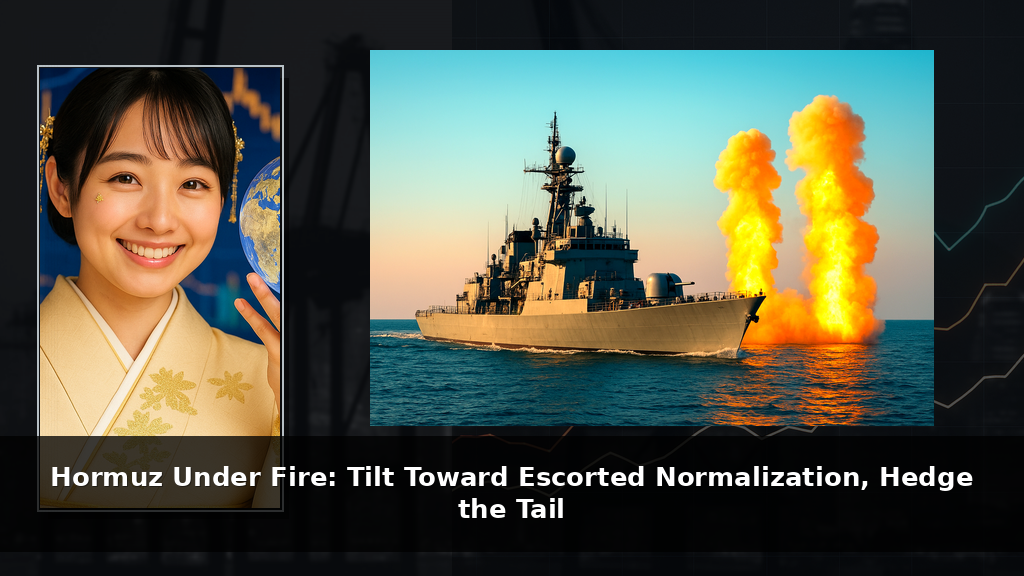
U.S. Central Command said it completed the ninth consecutive night of strikes on Iran on July 19, 2026, targeting command centers, air defenses, maritime capabilities, and launch sites to reduce threats to commercial shipping in the Strait of Hormuz. Iranian state media reported explosions in southern port cities including Bushehr and Bandar Mahshahr, and at least one death near Tabriz; on July 20, the UK Maritime Trade Operations (UKMTO) reported a commercial vessel on fire in the strait with crew abandoning ship. Benchmark Brent crude traded above $90 as the strikes and Iranian threats to block Hormuz raised supply‑security concerns, while the UK and other allies signaled contributions to a multinational mission and continued maritime advisories to reassure commercial shipping.
Theme: whether sustained U.S. strikes and coalition measures can restore safe commercial transits through Hormuz without provoking wider regional escalation. It matters because the strait carries about 21 million barrels per day of petroleum liquids—roughly one‑fifth of global oil—per the U.S. Energy Information Administration (EIA), so shipping, insurance, and energy pricing will pivot on the corridor’s usability in the next 2–6 weeks.
Stance: for corporate energy buyers, treasury risk managers, and logistics leads, tilt toward escorted normalization while hedging the tail. Budget a persistent $5–$10/bbl risk premium for Q3–Q4 and plan to re‑enter escorted Hormuz routings as insurance capacity becomes available; avoid locking into costly long reroutes unless UKMTO incidents stay elevated.
Geoeconomic Structure
A reasonable objection is that Iran’s asymmetric interdiction capacity—missiles, mines, fast boats, and coastal surveillance—can’t be “bombed away,” so nightly strikes risk escalation without restoring commercial confidence. The counter is structural: what unlocks the corridor is not eliminating all threat vectors, but degrading cue‑to‑shoot timelines (the time from detection to launch) and the “kill chain” (the find‑track‑target‑fire sequence), then hardening passage with visible, repeatable procedures that insurers can price.
Three elements are converging. First, the kinetic. CENTCOM’s cadence—nine consecutive nights by July 19—has targeted coastal surveillance, air defenses, and missile/drone launch sites that enable rapid interdiction. That sequencing aims to widen reaction timelines and reduce the density of credible, surprise “no‑go” windows. Second, the maritime assurance layer. UKMTO coordination, coalition naval presence/escorts, and mine‑countermeasure (MCM) units convert a volatile battlespace into a managed lane. Owners and charterers don’t need a risk‑free strait; they need clear convoy schedules, MCM milestones, and predictable comms. Third, the financial gatekeepers: private insurers and, if needed, a U.S. International Development Finance Corporation (DFC)‑backed reinsurance facility to crowd in war‑risk cover. If Chubb, AIG, Berkshire, Travelers, and peers can place escorted transits at known premiums—or the DFC facility absorbs the first layer of losses—owners will resume passage.
Label the mechanism after the fact: CENTCOM is pushing on the denial actor’s kill chain to re‑establish a permissive corridor through a geographic chokepoint, while UKMTO plus coalition escorts provide a maritime‑assurance coordination node that insurers can underwrite. The chokepoint (Hormuz) remains a single point of failure for roughly 21 mb/d, but it becomes an escorted corridor with rules.
Alternative bypass capacity helps blunt the shock but won’t replace Hormuz. Saudi east‑west and UAE routes to Fujairah can add meaningful volumes, but even optimistic declarations of ≥2–3 mb/d of added throughput merely reduce pressure; they don’t obviate the need for a usable strait. That’s why the decisive hinge is insurance behavior: if the DFC facility writes more than $5 billion of cover and major reinsurers resume placements, owners will accept escorted transits despite a higher premium. If insurers balk, even effective naval assurance will underdeliver because hull/war cover is the binding constraint.
For positioning, watch the operational and market thresholds that translate into go/no‑go signals: - UKMTO incident rate: a sustained decline to ≤1 report/week for two consecutive weeks signals improved permissiveness; >3/week for two straight weeks flags enduring interdiction pressure. - Automatic Identification System (AIS) transit counts: recovery to ≥70% of Jan‑2025 weekly baseline within 30 days indicates commercial re‑entry; <40% signals persistent avoidance. - Brent: >$100 for 14 straight trading days implies markets are pricing a prolonged disruption; sub‑$85 with stabilizing transits points to normalization with a premium. - Insurance uptake: tangible DFC usage or private placements at scale within 30–60 days confirms the financial backstop is in place.
The supplier‑leverage argument—that Iran can always sustain interdictions—only wins if Tehran or aligned groups credibly enforce a blockade against escorted convoys or raise the cost of coalition basing. Short of that, a disciplined “detour” of escorts, MCM, and insurance will likely restore passage with a priced premium. That is the balance the market is already sketching: a spike toward $90 on headlines, followed by reassessment as military assurance and risk transfer harden into procedures.
Strategic Reading from Sun Tzu
Sun Tzu wrote: — Make the indirect route direct, and turn difficulty into advantage.
In complex situations, the straightest line through an obstacle often creates the most friction and delay. By taking seemingly indirect steps—preparing logistics, sequencing moves, and using alternate routes—you reduce resistance and actually arrive faster and safer. Turning a problem into advantage means letting constraints force cleaner coordination, better standards, and more reliable execution.
CENTCOM is using sustained precision strikes and organizing naval escorts and mine‑countermeasure units to cut Iran’s interdiction leverage at the Strait of Hormuz. The structural analysis above reads this as a consolidation move—disciplined protection over theatrics—which matches the idea that escorts, clearance, and sequencing are the “detour” that most quickly restores commercial transits. UKMTO coordination, visible convoy procedures, and scaling Saudi/UAE bypass pipelines turn a chokepoint problem into a managed corridor plus partial relief valves. The remaining hinge is insurance: if private markets and the U.S.‑backed facility write cover for escorted passages, owners can treat the escorted lane as the practical “direct route.”
Expect pressure to crystallize into formal convoy schedules, clearance protocols, and an insurance playbook—a hardening of operations that channels risk into cleaner procedures rather than open‑ended avoidance. If escorts scale and risk cover is priced and available, Hormuz flows should normalize gradually with a higher but predictable premium; if Iran or aligned groups keep interdictions credible or insurers balk, rerouting and price volatility persist. Either way, the system is trending from ambiguity toward explicit passage standards and better‑utilized bypass capacity.
Track three leading signals: escort/convoy capacity (daily counts, mine‑clearance milestones), UKMTO incident rates, and war‑risk premium or uptake of the U.S. reinsurance facility; if the first rises while the latter two improve, lean your logistics and energy pricing models toward staged normalization with elevated but insurable costs. Plan counterparties and exposures for a medium‑term regime of escorted transits and clearer procedures rather than a binary open/closed assumption.
Caveats and Open Questions
- Iran/proxy escalation: If the IRGC Navy or aligned groups such as Yemen’s Houthis enforce a blockade or successfully interdict an escorted convoy at Hormuz or Bab al‑Mandeb, the escorted‑normalization thesis fails. Observable: UKMTO logs >3 incidents/week for two straight weeks and at least one confirmed interdiction of an escorted convoy or a strike on coalition bases that constrains allied posture.
- Insurance refusal: If the U.S. DFC reinsurance scheme records minimal uptake (<$5 billion in 30 days) and leading reinsurers (e.g., Chubb, AIG, Berkshire) continue to exclude Gulf war risk, owners will avoid Hormuz despite escorts. Observable: Protection and Indemnity (P&I) circulars tightening war‑risk terms and no public placements for escorted transits.
- Coalition fragility: If the UK and other contributors do not formalize convoy schedules and MCM timelines, or scale down presence, AIS transits will not recover. Observable: no published convoy cadence by coalition navies within 2–4 weeks and Hormuz transits stuck <40% of baseline at day 30.
Three‑choice trigger: which moves first — (1) UKMTO incident rates fall to ≤1/week for two consecutive weeks, (2) the U.S. DFC facility writes more than $5 billion of war‑risk cover with two major reinsurers resuming placements, or (3) the IRGC/Houthis conduct a confirmed interdiction of an escorted convoy? Your answer should determine whether you lean into escorted normalization now or keep paying for long reroutes.
Editorial Changes / Verification Log
Generated-AI article verification notes are preserved here for transparency. Expand for before/after edits and source checks.
1. Observation — rewritten
Before:
Brent futures briefly traded above $90 as the strikes and Iranian threats to block Hormuz raised supply‑security concerns, while allied navies, including the Royal Navy, moved to reassure and escort shipping.
After:
Benchmark Brent crude traded above $90 as the strikes and Iranian threats to block Hormuz raised supply‑security concerns, while the UK and other allies signaled contributions to a multinational mission and continued maritime advisories to reassure commercial shipping.
Reason: Fact-check | Reuters and Axios reported Brent above $90 on July 19–20; UK role framed to match official UK statements about contributions and advisories. https://ae.marketscreener.com/news/dollar-drifts-as-us-iran-conflict-intensifies-brent-hits-90-ce7f51dad18af621; https://www.axios.com/2026/07/19/oil-prices-90-middle-east-fighting; https://www.gov.uk/government/news/joint-statement-on-the-strait-of-hormuz-3-july-2026
2. Observation — rewritten
Before:
It matters because roughly one‑fifth of global seaborne oil and LNG flows transits Hormuz (about 21 million barrels per day, per the U.S. EIA),
After:
It matters because the strait carries about 21 million barrels per day of petroleum liquids—roughly one‑fifth of global oil—per the U.S. Energy Information Administration (EIA),
Reason: Fact-check | Aligns wording with EIA series on petroleum liquids through Hormuz. https://www.eia.gov/todayinenergy/detail.php?id=61002&os=i
3. Observation — preserved_with_note
Before:
U.S. Central Command said it completed the ninth consecutive night of strikes on Iran on July 19, 2026… UKMTO reported a commercial vessel on fire in the strait with crew abandoning ship.
After:
U.S. Central Command said it completed the ninth consecutive night of strikes on Iran on July 19, 2026… UKMTO reported a commercial vessel on fire in the strait with crew abandoning ship.
Reason: Fact-check | Verified CENTCOM ninth‑night statement on DVIDS and UKMTO‑reported vessel fire on July 20. https://www.dvidshub.net/news/570270/us-completes-8th-consecutive-night-strikes-against-iran; https://www.iranwatch.org/node/14159; https://www.dawn.com/news/2016999
4. Geoeconomic Structure — rewritten
Before:
Third, the financial gatekeepers: private insurers and, if needed, a U.S. DFC‑backed reinsurance facility to crowd in war‑risk cover. If Chubb, AIG, Berkshire, Travelers, and peers can place escorted transits at known premiums — or the DFC facility takes first loss — owners will resume passage.
After:
Third, the financial gatekeepers: private insurers and, if needed, a U.S. International Development Finance Corporation (DFC)‑backed reinsurance facility to crowd in war‑risk cover. If Chubb, AIG, Berkshire, Travelers, and peers can place escorted transits at known premiums—or the DFC facility absorbs the first layer of losses—owners will resume passage.
Reason: Comprehension | Expanded DFC on first use and clarified “first loss.” Verified facility details. https://www.dfc.gov/media/press-releases/dfc-announces-chubb-lead-insurance-partner-maritime-reinsurance-plan
5. Geoeconomic Structure — rewritten
Before:
The counter is structural: what unlocks the corridor is not eliminating all threat vectors, but degrading cue‑to‑shoot networks and then hardening passage…
After:
The counter is structural: what unlocks the corridor is not eliminating all threat vectors, but degrading cue‑to‑shoot timelines (the time from detection to launch) and the “kill chain” (the find‑track‑target‑fire sequence), then hardening passage…
Reason: Comprehension | Added brief glosses for specialist terms to avoid reader lookup.
6. Geoeconomic Structure — rewritten
Before:
- AIS transit counts: recovery to ≥70% of Jan‑2025 weekly baseline within 30 days indicates commercial re‑entry;
After:
- Automatic Identification System (AIS) transit counts: recovery to ≥70% of Jan‑2025 weekly baseline within 30 days indicates commercial re‑entry;
Reason: Comprehension | Expanded acronym on first use.
7. Caveats and Open Questions — rewritten
Before:
Observable: P&I circulars tightening war‑risk terms and no public placements for escorted transits.
After:
Observable: Protection and Indemnity (P&I) circulars tightening war‑risk terms and no public placements for escorted transits.
Reason: Comprehension | Expanded acronym on first use.