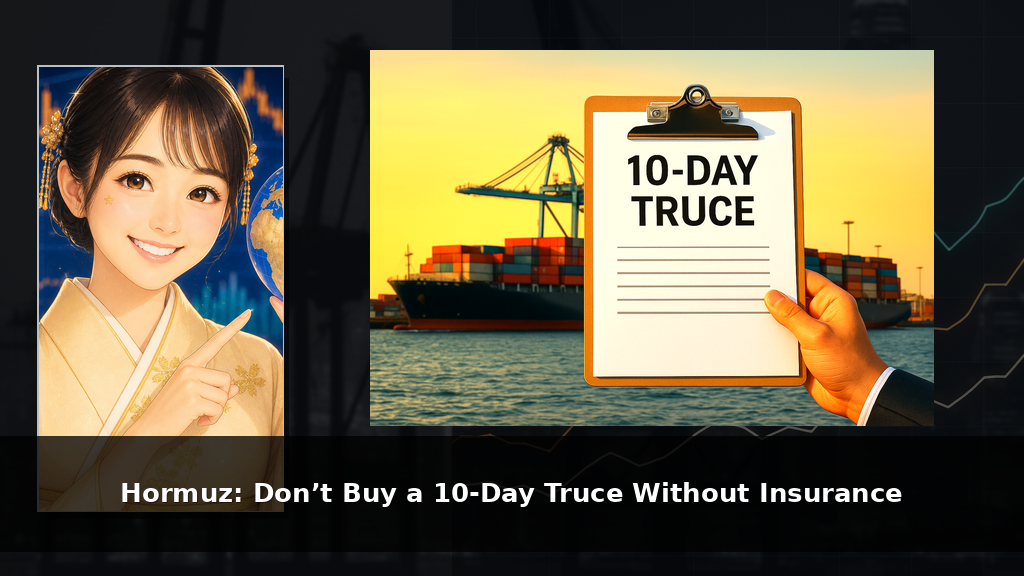
Hormuz: Don’t Buy a 10‑Day Truce Without Insurance

Observation
Qatar, Egypt, Pakistan and other regional mediators have delivered a 10‑day ceasefire proposal to Washington and Tehran aimed at reopening the Strait of Hormuz, Axios reported on July 21, 2026. Reuters reported July 20 that a senior Iranian official acknowledged receipt of a 10‑day plan, and Iran’s Foreign Ministry spokesperson Esmaeil Baghaei confirmed mediators had conveyed proposals without detail. Even as U.S. officials consider the framework, U.S. Central Command (CENTCOM) operations marked a 10th consecutive night of strikes as of July 21, and Axios reports the U.S. has shifted “dozens of fighter jets and refueling aircraft” into the region.
The live question is whether a mediated, time‑limited truce can actually reopen both Hormuz lanes and create momentum to revive June’s interim memorandum of understanding (MOU), or whether continued kinetic pressure and private‑sector risk gating will keep the corridor effectively shut. For energy‑exposed business readers, this chokepoint governs a large share of seaborne crude and LNG flows; operational reopening hinges not on prose but on insurers’ cover and carrier route choices — outcomes that move prices, on‑time‑in‑full (OTIF) delivery, and enterprise risk.
Our stance: hedge. For energy‑exposed portfolio managers (PMs) and corporate risk leads, do not re‑price to a reopening baseline until three public signals arrive in close succession: (1) coordinated acceptance from the White House and State Department and from Iran’s Foreign Ministry, (2) a named neutral verifier with an operational plan, and (3) explicit war‑risk cover reinstatements by leading Protection and Indemnity (P&I) clubs.
Geoeconomic Structure
The pushback we expect is simple: “A truce is a truce; traffic will flow.” That misreads who actually gates the corridor. The Strait of Hormuz is the world’s most consequential oil transit chokepoint — roughly one‑fifth of global petroleum liquids passes through in normal times, per the U.S. EIA — but diplomatic prose does not move tankers unless two private nodes turn green: war‑risk underwriters and the major carriers who must put hulls into the lanes.
Start with the coastal gatekeeper. Iran’s littoral forces — the Islamic Revolutionary Guard Corps (IRGC) and the navy — can interdict or credibly threaten passage. Their consent to a mediator text is necessary but not sufficient, especially when the other combatant continues to apply kinetic pressure. CENTCOM’s nightly strikes and visible U.S. deployments — Axios cites dozens of aircraft repositioned — are designed to raise the cost of Iranian leverage, but they also lower confidence that a 10‑day pause will stick. As long as strikes and counter‑threats remain part of the bargaining, insurers will treat Hormuz as an active‑risk zone rather than a stabilized corridor.
Insurers are the operational chokepoint. Protection and Indemnity (P&I) clubs — Gard, Skuld, NorthStandard, London P&I, American Club — and war‑risk underwriters decide whether a ship can sail with coverage fit for purpose. When risk is opaque, these clubs retreat to capital preservation and cancel pooled cover or push bespoke pricing that most charterers won’t accept. No public reinstatement — via circulars or broker advisories — means no broad‑based return to routine transits. This is why a 10‑day truce that lacks verification and monitoring is, to insurers, still “shadow” ground: too little light to underwrite.
Carriers follow cover. Maersk, Hapag‑Lloyd, CMA CGM and major tanker owners have already demonstrated a willingness to reroute when risk/cover turns. Once fleet plans, bunkering, and crew timetables re‑anchor around Cape routes, it takes more than a short truce to reverse momentum. Public customer notices resuming Hormuz sailings will lag insurer reinstatements and neutral verification — not precede them — because operational leaders must answer to safety committees, lenders, and clients with their own risk covenants.
The missing enabler is a neutral rule‑set. A credible third party — the International Maritime Organization (IMO) or a flag‑state coalition — needs to publish an operational plan for verification, inspections and communications (Automatic Identification System, or AIS, protocols; routing windows; inspection lanes; and escalation pathways). Without that “sunlit” framework, neither insurers nor carriers have the governance cover to move. Mediation by Qatar, Pakistan, and Egypt is diplomatically useful; enforcement and verification by a neutral maritime body is commercially decisive.
Map those pieces and the thesis follows. A 10‑day diplomatic pause without (1) dual‑capital public acceptance, (2) a named, neutral verifier with a visible operational plan, and (3) insurer war‑risk reinstatements, will not restore reliable commercial transit or revive June’s MOU. Watch the concrete indicators: EIA/Vortexa tanker counts back to at least 80% of pre‑crisis baseline for a week, P&I circulars lifting prior cancellations within days, and carrier notices to customers. Until then, Brent crude’s risk premium and freight spreads reflect the true governance state of the corridor.
Strategic Reading from Sun Tzu
Sun Tzu wrote: “An army prefers high ground and avoids low ground; it values light and avoids shadow.”
The line urges leaders to choose positions with visibility, oversight, and clear support, and to avoid operating in opaque conditions where information sinks. In practical terms, transparency and verified procedures reduce surprises and make it easier for partners and insurers to stand behind you. When the environment is murky, risk capital withdraws and movement stalls.
Regional mediators have floated a 10‑day ceasefire to reopen both lanes of the Strait of Hormuz, but the operational gate sits with mutual P&I clubs and major carriers. Without visible, third‑party verification and public reinstatement of war‑risk cover, the corridor remains a “shadow” environment that shippers avoid. The structural read above treats insurers as conservative vaults: absent bright, public assurances, they will keep coverage locked and routing momentum will not reverse. Concurrent U.S. strikes and Iran’s littoral leverage further cloud the picture, making neutral observers, posted rules, and published cover essential for any real reopening.
In the near term, this pressure is more likely to compress the system into clearer, shared procedures than to generate an immediate surge of traffic. If mediators anchor a visible verification regime through a neutral maritime body and insurers publish explicit terms for transits, coverage can thaw and a measured resumption can follow. Without those steps, insurer withholding will harden and Cape reroutes remain the baseline.
For positioning, watch three public signals: joint acceptance by Washington and Tehran, a named neutral verifier with an operational plan, and explicit war‑risk cover reinstatements by leading P&I clubs. Hedge for prolonged diversions and elevated premiums, but be ready to pivot exposure quickly if those signals appear in close succession.
Caveats and Open Questions
Three real‑world developments would force us to walk back the hedge call:
1) Mediators (Qatar/Pakistan/Egypt) publicly transmit an agreed text and both the White House/State Department and Iran’s Foreign Ministry issue formal acceptance within seven days. That joint political signal would raise the probability that private‑sector gates open.
2) Major P&I clubs (Gard, Skuld, NorthStandard, London P&I, American Club) publish circulars reinstating pooled war‑risk cover for Gulf/Hormuz transits. This single‑actor action would directly falsify the insurer‑gating argument and enable carriers to schedule returns.
3) A neutral maritime body (IMO or a named flag‑state coalition) announces, within 10–21 days, an operational verification plan — observers, inspection protocols, communication standards — and publishes it. Visible rules of the road would de‑risk underwriting and catalyze route reversals.
Conversely, our thesis would be reinforced if CENTCOM continues nightly strikes during any notional truce window or if Iran renews harassment of commercial shipping — either would harden insurer withholding and shippers’ aversion, keeping Cape diversions as baseline.
Three‑choice trigger: which moves first — (a) coordinated public acceptance from Washington and Tehran, (b) a war‑risk cover reinstatement circular from a top P&I club, or (c) an IMO/flag‑state verification announcement? Your positioning should tilt to prolonged disruption until at least two of the three appear within days of each other.
Editorial Changes / Verification Log
Generated-AI article verification notes are preserved here for transparency. Expand for before/after edits and source checks.
1. Observation — rewritten
Before:
CENTCOM‑announced operations marked a 10th consecutive night of strikes around July 21, and Axios reports the U.S. has shifted “dozens of fighter jets and refueling aircraft” into the region.
After:
Even as U.S. officials consider the framework, U.S. Central Command (CENTCOM) operations marked a 10th consecutive night of strikes as of July 21, and Axios reports the U.S. has shifted “dozens of fighter jets and refueling aircraft” into the region.
Reason: Comprehension | Fact-check — expanded CENTCOM on first use and added an explicit date. Verified consecutive strikes via AP and deployments via Axios. https://apnews.com/article/8b37952906cbec6351fdcc47a0fa6297; https://www.axios.com/2026/07/21/iran-war-ceasefire-proposal-trump-troops
2. Observation — rewritten
Before:
Tier‑3 readers care because the chokepoint governs a large share of seaborne crude and LNG flows; operational reopening hinges not on prose but on insurers’ cover and carrier route choices — outcomes that move prices, OTIF delivery, and enterprise risk.
After:
For energy‑exposed business readers, this chokepoint governs a large share of seaborne crude and LNG flows; operational reopening hinges not on prose but on insurers’ cover and carrier route choices — outcomes that move prices, on‑time‑in‑full (OTIF) delivery, and enterprise risk.
Reason: Pipeline-leak | Comprehension — removed internal audience label (“Tier‑3 readers”) and expanded OTIF on first use.
3. Observation — rewritten
Before:
Our stance: hedge. For energy‑exposed macro PMs and corporate risk leads, do not re‑price to a reopening baseline until three public signals arrive in close succession: (1) coordinated acceptance from the White House/State and Iran’s Foreign Ministry, (2) a named neutral verifier with an operational plan, and (3) explicit war‑risk cover reinstatements by leading P&I clubs.
After:
Our stance: hedge. For energy‑exposed portfolio managers (PMs) and corporate risk leads, do not re‑price to a reopening baseline until three public signals arrive in close succession: (1) coordinated acceptance from the White House and State Department and from Iran’s Foreign Ministry, (2) a named neutral verifier with an operational plan, and (3) explicit war‑risk cover reinstatements by leading Protection and Indemnity (P&I) clubs.
Reason: Comprehension — expanded PM, clarified U.S. government entities, and spelled out P&I on first use.
4. Geoeconomic Structure — rewritten
Before:
Iran’s littoral forces (IRGC/navy) can interdict or credibly threaten passage.
After:
Iran’s littoral forces — the Islamic Revolutionary Guard Corps (IRGC) and the navy — can interdict or credibly threaten passage.
Reason: Comprehension — expanded IRGC on first use.
5. Geoeconomic Structure — rewritten
Before:
Insurers are the operational chokepoint. Mutual P&I clubs (Gard, Skuld, NorthStandard, London P&I, American Club) and war‑risk underwriters decide whether a ship can sail with coverage fit for purpose.
After:
Insurers are the operational chokepoint. Protection and Indemnity (P&I) clubs — Gard, Skuld, NorthStandard, London P&I, American Club — and war‑risk underwriters decide whether a ship can sail with coverage fit for purpose.
Reason: Comprehension — spelled out P&I on first use.
6. Geoeconomic Structure — rewritten
Before:
A credible third party — IMO or a flag‑state coalition — needs to publish an operational plan for verification, inspections and communications (AIS protocols, routing windows, inspection lanes, and escalation pathways).
After:
A credible third party — the International Maritime Organization (IMO) or a flag‑state coalition — needs to publish an operational plan for verification, inspections and communications (Automatic Identification System, or AIS, protocols; routing windows; inspection lanes; and escalation pathways).
Reason: Comprehension — spelled out IMO and AIS on first use.
7. Geoeconomic Structure — preserved_with_note
Before:
The Strait of Hormuz is the world’s most consequential oil transit chokepoint — roughly one‑fifth of global petroleum liquids passes through in normal times, per the U.S. EIA —
After:
The Strait of Hormuz is the world’s most consequential oil transit chokepoint — roughly one‑fifth of global petroleum liquids passes through in normal times, per the U.S. EIA —
Reason: Fact-check — retained wording after confirming EIA states ~21% of global petroleum liquids in 2018. https://www.eia.gov/todayinenergy/detail.php?id=39932&lang=en
8. Caveats and Open Questions — rewritten
Before:
1) Mediators (Qatar/Pakistan/Egypt) publicly transmit an agreed text and both the White House/State Department and Iran’s Foreign Ministry issue formal acceptance within seven days.
After:
1) Mediators (Qatar/Pakistan/Egypt) publicly transmit an agreed text and both the White House and State Department and Iran’s Foreign Ministry issue formal acceptance within seven days.
Reason: Comprehension — clarified U.S. entities for general readers.