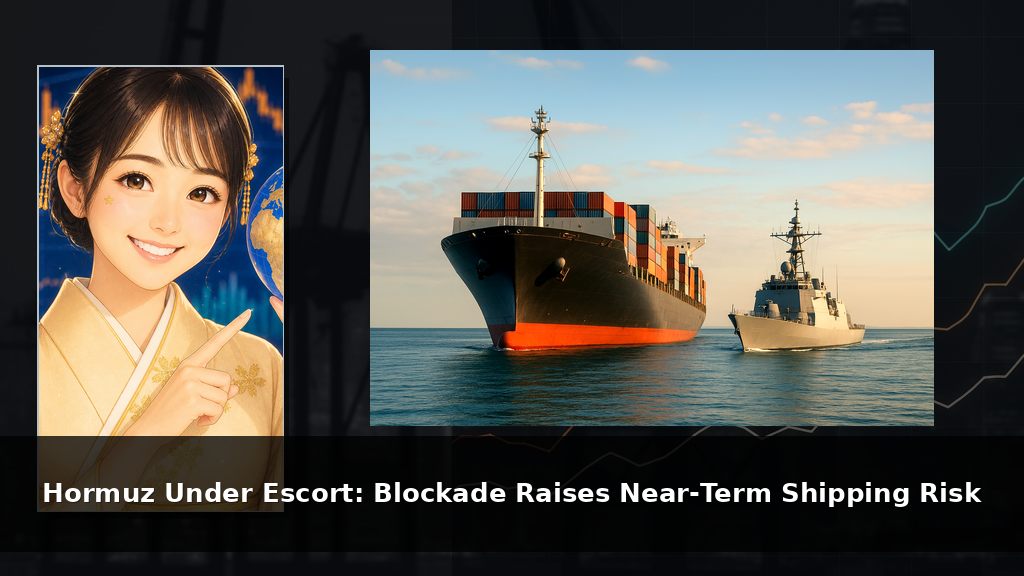
Hormuz Under Escort: Blockade Raises Near‑Term Shipping Risk

Observation
U.S. Central Command said on July 17, 2026 it completed a new wave of strikes against Iranian targets at about 9:30 p.m. ET, marking a seventh consecutive night of operations that hit surveillance sites, logistics infrastructure, underground weapons storage, and maritime capabilities. CENTCOM also reiterated that more than 50,000 U.S. service members are operating across the region. Iranian state media reported seven deaths in strikes on bridges in Bandar Khamir; major outlets noted they could not independently verify those casualty claims. Brent crude settled up 4.6% to $88.10 on July 17 as hostilities escalated, and the UK Maritime Trade Operations agency (UKMTO) had earlier issued advisories on tankers struck by “unknown projectiles” in the Strait of Hormuz. (dvidshub.net)
Iran has also launched renewed attacks on Gulf partner states and Jordan following U.S. strikes, reinforcing near‑term risks to shipping and infrastructure. (ksl.com)
The live question for outside observers: do sustained U.S. strikes plus a naval‑control regime reduce risk to commercial shipping through Hormuz, or do they raise it by provoking asymmetric retaliation and diversion to other chokepoints? This is worth a Tier 3 reader’s time because about a fifth of global petroleum liquids flow through Hormuz; insurers, carriers, and corporates must now re‑price routing, inventory, and exposure decisions in weeks, not quarters. (eia.gov)
Our call: for energy procurement heads, portfolio managers, and global logistics directors, hedge and re‑price. Treat Hormuz transit risk as elevated for the next 60–90 days; budget for higher war‑risk premia, escorts, inspections, and detours. Do not underwrite a quick normalization without hard signals from UKMTO incident counts, Automatic Identification System (AIS) flows, and broker rate sheets. (ukmto.org)
Geoeconomic Structure
Skeptics will argue that a sustained U.S. strike tempo and enforced corridors should reduce risk by degrading Iran’s harassment capacity. The structural problem is that this chokepoint is both narrow and central: the Strait of Hormuz carries flows equivalent to roughly 20% of global petroleum liquids consumption and a large share of seaborne oil; any coercive control regime there reliably alters incentives on all sides. Enforcement can constrain some Iranian capabilities, but it simultaneously induces asymmetric workarounds and commercial caution that raise near‑term hazard and cost. (eia.gov)
Mechanically, a blockade plus strikes turns “normal passage” into “escorted, inspected passage.” In practice, that means convoys, holds, and compliance documentation that slow traffic and make non‑compliant ships (or those mis‑flagged, under‑insured, or operating dark) higher‑risk targets for both enforcement and retaliation. Iran and aligned actors retain a deep menu of deniable tools — anti‑ship missiles fired from shore, one‑way sea drones, uncrewed aerial vehicles (UAVs), fast‑boat boardings, mine‑like objects — that can be flexed at low cost and with ambiguous attribution. When the U.S. Navy shapes routes and rules, Tehran’s rational counter is to probe outside the strongest escort boxes, to shift pressure to alternative chokepoints (Bab el‑Mandeb/Red Sea via aligned groups), or to incentivize AIS darkening that complicates detection. Each of those responses elevates risk to commercial operators in the near term even if Iranian assets take damage. (dvidshub.net)
On the commercial side, the enforcement environment changes the risk calculus for shipowners and their financiers. Marine war‑risk underwriters at Lloyd’s and Protection and Indemnity (P&I) clubs are the immediate gatekeepers to whether voyages happen at all. A recently announced Lloyd’s market consortium anchored by Chubb increases available capacity, but that capacity is rationed via price and conditions; early‑phase underwriting typically moves premia up and tightens exclusions until incident tallies and AIS visibility improve. Higher war‑risk add‑ons and stricter pre‑clearance push owners to either accept escorted corridors on insurer terms or to reroute, delay, or sail dark — each of which fragments behavior and sustains volatility. (lloyds.com)
Observability now disciplines the debate. UKMTO and the Joint Maritime Information Center (JMIC) advisories are clean daily readouts of attacks, boardings, or “unknown projectiles,” while AIS aggregation from Kpler, MarineTraffic and others shows flows, holds, and dark transits in near‑real time. If the control regime were rapidly calming the route, we would expect — within a few weeks — UKMTO attack/struck warnings to fade back toward zero and AIS‑visible through‑transits to normalize. Instead, recent signals point to visible incidents, diversions, and compliance friction consistent with an elevated‑risk, reallocation‑of‑hazard phase. (ukmto.org)
Finally, third‑country naval hedges and host‑state politics shape the ceiling on how quickly risk can fall. EU and UK escorts, and EU–Djibouti cooperation in the Red Sea, can dampen displacement risk but require sustained political will and port access. Gulf partners like Oman, UAE, Bahrain, and Kuwait must align practical cooperation with public positioning; partial cooperation still yields an uneven corridor map that invites probing. Meanwhile, Brent futures have added a visible risk premium; curve shape will respond less to speeches than to whether incident counts subside and Gulf crude loadings avoid a >10% month‑on‑month drop. Until those data improve, the structural mechanism supports a hedged posture. (eeas.europa.eu)
Strategic Reading from Sun Tzu / 孫子の戦略視点
Sun Tzu wrote: —— Skilled fighters make others come to them; they are not pulled around by others.
Initiative comes from drawing others onto your terms instead of reacting to theirs. You do this by shaping routes, rules, and incentives so that the practical choice is to operate where you have control. If you let the other side set the time and place, even strong capabilities get dragged into costly, unpredictable engagements.
U.S. Central Command is trying to pull commercial traffic onto escorted, inspected corridors while degrading Iran’s capacity to harass ships; insurers and P&I clubs reinforce this by pricing risk so that compliance becomes the least‑cost option. As the structural read above notes, that very enforcement also raises incentives for Iran and proxies to shift to deniable attacks, alternative chokepoints, or AIS‑dark tactics, turning this into a contest over whose terms prevail. Signals like diversions, convoying, and higher war‑risk surcharges show initiative is contested and commercial behavior is adapting to tighter controls. The practical center of gravity is moving toward clearer procedures set by navies, underwriters, and data providers, even as near‑term hazard increases. (lloyds.com)
Expect a near‑term phase of more visible incidents and detours as asymmetric actors probe around enforced corridors, with higher war‑risk premia and tighter documentation checks. At the same time, this pressure is likely to harden operations: standardized transit lanes, coalition escort schedules, insurance pre‑clearance, and stricter AIS compliance will become more explicit and routine. As incident tallies and AIS visibility improve or worsen, underwriters will reprice risk and either normalize passage under these standards or tighten them further. (lloyds.com)
For portfolio and supply‑chain decisions, track UKMTO/Maritime Administration (MARAD) incident counts, AIS darkening and diversion patterns, and broker circulars on war‑risk surcharges to see whether initiative is consolidating under escorted standards or bleeding into wider disruption. Favor routings and counterparties that can demonstrate compliance with escorts, inspections, and insurance pre‑clearance, and budget for a few months of elevated detour and security costs. (maritime.dot.gov)
Caveats and Open Questions
Three conditions would force us to walk back a “risk rises before it falls” stance:
- CENTCOM plus coalition briefings, corroborated by UKMTO, show a sustained drop in successful attacks on merchant ships within 30 days, and Oman/other Gulf partners visibly cooperate in regular U.S.‑led escort and clearance operations. That combination would indicate enforcement is restoring safer navigation faster than retaliation can scale. (dvidshub.net)
- Lloyd’s market (including the Chubb‑led consortium) and major P&I clubs deploy capacity and brokers report a >30% contraction in war‑risk surcharges for Hormuz transits within a month. Underwriter behavior is the tightest proxy for real‑world risk normalization. (lloyds.com)
- EU/UK/Djibouti coalition actions materially suppress displacement to the Red Sea/Bab el‑Mandeb theater, evidenced by MARAD/UKMTO incident tallies falling toward pre‑crisis levels. If attacks don’t migrate, the reallocation channel weakens. (maritime.dot.gov)
Lead‑time question: over the next 4–6 weeks (through mid‑August 2026), do UKMTO attack/struck warnings fall to ≤1 per week and AIS‑identified Hormuz transits rebound to >90% of their Jan–Feb 2026 baseline? If yes, shift from hedge to normalize; if not, maintain the hedge and budget for prolonged detours. (ukmto.org)
Editorial Changes / Verification Log
Generated-AI article verification notes are preserved here for transparency. Expand for before/after edits and source checks.
1. Observation — rewritten
Before:
Brent crude rose roughly 4% around the escalation (Reuters), and UKMTO advisories reported tankers struck by projectiles in the Strait.
After:
Brent crude settled up 4.6% to $88.10 on July 17 as hostilities escalated, and the UK Maritime Trade Operations agency (UKMTO) had earlier issued advisories on tankers struck by “unknown projectiles” in the Strait of Hormuz.
Reason: Fact-check — Specify date and settlement (Reuters) and expand UKMTO on first use; support with primary advisories. ([au.investing.com](https://au.investing.com/news/commodities-news/oil-rises-on-intensifying-usiran-hostilities-and-threat-of-red-sea-closure-4538044?utm_source=openai))
2. Observation — rewritten
Before:
CENTCOM reiterated it has more than 50,000 U.S. service members operating regionally. Iran responded with attacks on Gulf partner states and renewed threats to commercial shipping...
After:
CENTCOM also reiterated that more than 50,000 U.S. service members are operating across the region. Iran has also launched renewed attacks on Gulf partner states and Jordan following U.S. strikes, reinforcing near‑term risks to shipping and infrastructure.
Reason: Fact-check — Keep CENTCOM figure and add verified geographic detail (Gulf allies and Jordan) per Reuters/AP updates. ([dvidshub.net](https://www.dvidshub.net/news/570254/centcom-finishes-latest-wave-strikes-against-iran))
3. Observation — rewritten
Before:
about a fifth of seaborne oil transits Hormuz
After:
about a fifth of global petroleum liquids flow through Hormuz
Reason: Comprehension — Align wording with EIA’s framing for non‑specialists; cite an authoritative source. ([eia.gov](https://www.eia.gov/todayinenergy/detail.php?id=65504+&utm_source=openai))
4. Geoeconomic Structure — rewritten
Before:
UKMTO/JMIC advisories are the cleanest daily readout of attacks... AIS aggregation from Kpler, MarineTraffic and others shows flows...
After:
UKMTO and the Joint Maritime Information Center (JMIC) advisories are clean daily readouts... while AIS aggregation from Kpler, MarineTraffic and others shows flows...
Reason: Comprehension — Expand acronyms on first use to avoid lookup for Tier 3 readers. ([ukmto.org](https://www.ukmto.org/-/media/ukmto/products/20260707-ukmto_warning_81-26.pdf?rev=269465a0c17541009686e186ab5d9a4b&utm_source=openai))
5. Geoeconomic Structure — rewritten
Before:
Marine war‑risk underwriters at Lloyd’s and P&I clubs... A recently announced Lloyd’s market consortium anchored by Chubb increases available capacity...
After:
Marine war‑risk underwriters at Lloyd’s and Protection and Indemnity (P&I) clubs... A recently announced Lloyd’s market consortium anchored by Chubb increases available capacity...
Reason: Comprehension — Expand P&I on first use; verify the consortium. ([lloyds.com](https://www.lloyds.com/insights/media-centre/press-releases/press-release-19062026?utm_source=openai))
6. Geoeconomic Structure — trimmed
Before:
Skeptics will argue that a sustained U.S. strike tempo and enforced corridors should reduce risk by degrading Iran’s harassment capacity.
After:
Skeptics argue that sustained strikes and enforced corridors should reduce risk by degrading Iran’s harassment capacity.
Reason: Downstream X readability — Shorten a heavy setup sentence without changing meaning.
7. Strategic Reading from Sun Tzu / 孫子の戦略視点 — trimmed
Before:
Signals like diversions, convoying, and higher war‑risk surcharges show initiative is contested and commercial behavior is adapting to tighter controls. The practical center of gravity is moving toward clearer procedures set by navies, underwriters, and data providers, even as near‑term hazard increases.
After:
Signals like diversions, convoying, and higher war‑risk surcharges show initiative is contested and behavior is adapting to tighter controls, even as near‑term hazard rises.
Reason: Downstream X readability — Consolidate to one idea per paragraph.
8. Caveats and Open Questions — rewritten
Before:
Lead‑time question: over the next 4–6 weeks, do UKMTO attack/struck warnings fall to ≤1 per week and AIS‑identified Hormuz transits rebound to >90% of their Jan–Feb 2026 baseline?
After:
Lead‑time question: over the next 4–6 weeks (through mid‑August 2026), do UKMTO attack/struck warnings fall to ≤1 per week and AIS‑identified Hormuz transits rebound to >90% of their Jan–Feb 2026 baseline?
Reason: Comprehension — Add absolute dates per instruction to avoid confusion about timing.