Guterres in Damascus: Re‑pricing Syria’s Reconstruction Finance

Observation
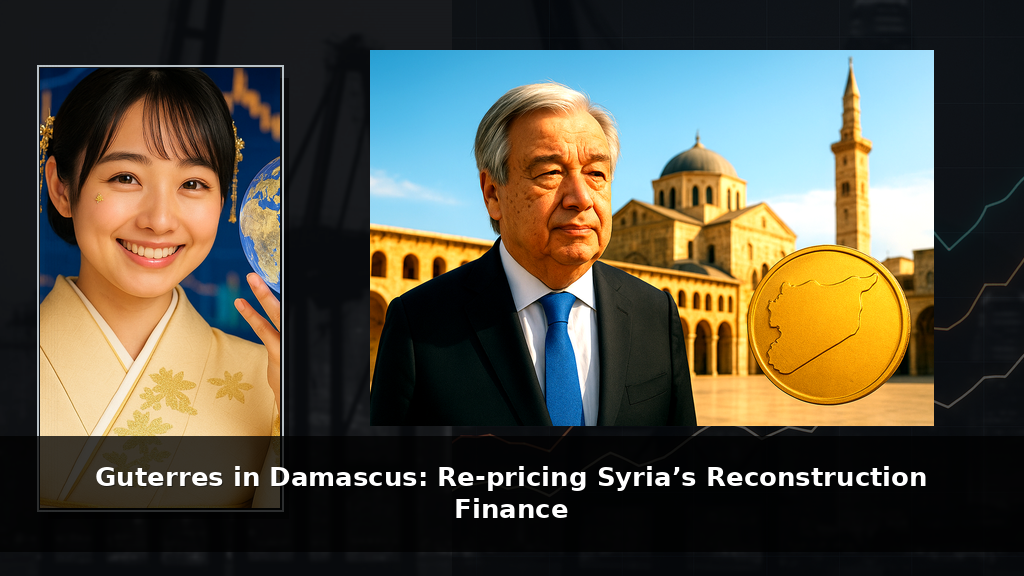
On 25 July 2026, UN Secretary‑General António Guterres arrived in Damascus for the first visit by a serving UN chief to Syria since 2009. He met Syrian leadership, toured the Old City and the Umayyad Mosque, and urged international support for recovery. Multiple outlets and UN channels framed the trip as a diplomatic milestone. (un.org)
The needs are severe. Reporting the same day noted that roughly two‑thirds of Syria’s 23 million people require humanitarian assistance and about 5.5 million are internally displaced. (thenationalnews.com)
There is precedent: Ban Ki‑moon visited Damascus in 2009. The difference now is structural — this visit follows a post‑conflict political transition and active reconstruction diplomacy in 2025–26, with donors and international financial institutions (IFIs) exploring frameworks rather than operating in a pre‑2011 status quo. (un.org)
Our theme: whether Guterres’ Damascus visit catalyses large‑scale international reconstruction finance. This matters for equity PMs in European contractors and insurers, for corporate IR at engineering original equipment manufacturers (OEMs), and for banks weighing compliance risk — the stakes are multi‑billion‑euro programs gated by U.S./EU legal decisions, multilateral development bank (MDB) safeguards, and cross‑border payment rails.
Stance: Re‑price. For equity PMs and corporate IR at EU‑listed engineering/infra names, treat Syria as a staged 6–18 month EU/MDB pilot opportunity rather than a near‑term revenue surge; position for compliance‑ready tenders, not unconstrained capital flows.
Geoeconomic Structure
The skeptical read is straightforward: without U.S. legal movement and banking rails, little changes. That pushback is partly right on timing — but it misses why this particular visit likely accelerates the preparatory phase that turns political cover into programmable capital. Guterres reduces the political cost for Brussels and the multilateral banks to convene, scope, and sequence reconstruction instruments; the legal gating and correspondent‑banking constraints remain, but now sit behind a higher‑velocity convening process rather than in front of it.
Start with the political umbrella. A serving UN Secretary‑General standing in Damascus signals “permission to plan.” It lowers reputational risk for Team Europe (European Commission, member states, European Investment Bank) to anchor pledging and design a trust‑fund‑like vehicle. Brussels already telegraphed a new chapter with Syria on 9 January 2026. Guterres’ appearance converts that intent into a timetable: expect an EU‑led donor conference to move from exploratory language to specific envelopes and eligibility criteria. (north-africa-middle-east-gulf.ec.europa.eu)
Next, the MDB gate. On 11 March 2026, the World Bank’s Board approved a US$20 million International Development Association (IDA) grant to strengthen public financial management (PFM) in Syria. It is small by design but lays the procurement, audit, and anti‑corruption foundations the Bank requires before piloting operations. The International Monetary Fund’s role will stay limited until macro conditions and arrears/safeguards questions are addressed, but World Bank/IDA grants and tightly conditioned programs can proceed. (worldbank.org)
The decisive chokepoint is U.S. law. Syria’s State Sponsor of Terrorism (SST) designation and related Treasury authorities create extraterritorial risk that deters correspondent banks and narrows MDB operating comfort. The Administration has formally initiated rescission: a Congressional certification was filed on 9 July 2026. Until that process concludes — or Treasury’s Office of Foreign Assets Control (OFAC) issues targeted licenses authorizing specific project‑finance and payment activities — large‑scale private flows will not mobilize at pace. (govinfo.gov)
Payments infrastructure is the practical brake. Even with political cover and grant envelopes, disbursements need correspondent‑banking corridors and insurance capacity. Humanitarian channels and UN fiduciary platforms can bridge small volumes; they cannot carry a national rebuild. The near‑term indicator is simple: do more than two credible international correspondent banks publicly reopen relationships processing payments to Syrian entities? If yes, pilots can scale; if not, even well‑designed programs crawl. UN OCHA (UN Office for the Coordination of Humanitarian Affairs) finance briefs and IMF/World Bank financial‑access updates will show this first.
Third‑country hedges are real and will fill selective gaps. Saudi announcements of multi‑billion‑dollar investments, Russian logistics plans at Tartous, and potential Chinese contractor finance all create parallel corridors. Expect fragmentation: Gulf‑ and Russian/Chinese‑backed packages with their own contractors and standards where Western/MDB programs are slow. For EU‑aligned contractors and insurers, the investable near‑term lane is the Team Europe/MDB corridor because you already match its procurement and compliance playbook; Gulf‑ or Russian‑backed projects may be sizable but less accessible over the next 12 months.
Put together, the mechanism looks like this: UN cover lowers convening friction; the Commission aggregates pledges and tasks the EIB/implementers; the World Bank scales from PFM to pilot operations; Washington’s licenses or SST rescission unlock bank risk tolerances; correspondent banks reopen targeted corridors; and only then does private finance meaningfully follow. That is a phased reconstruction‑finance stack. Guterres’ visit moves the first two bricks decisively; the rest depend on legal and banking signals that are visible and trackable.
For positioning, this means: advance prequalification against World Bank/EU procurement standards now; cultivate partners who have executed under MDB safeguards in fragile contexts; and model a stepped revenue curve — technical assistance and small capital expenditure (capex) in 2026; bigger lots contingent on U.S. legal steps and banking rails in 2027. Size insurance exposure for a gradual return of reinsurance appetite, not a snap‑back.
Strategic Reading from Sun Tzu
Sun Tzu wrote: —— The victorious force first secures victory, then seeks battle; the defeated force first fights, then seeks victory.
The point is to line up the conditions before you act. Legal, financial, and operational foundations should be in place so that execution unfolds on favorable terms. Rushing in and trying to fix the basics on the fly creates avoidable risk, delay, and reversals.
Applied here, the Secretary‑General’s Damascus visit lowers the political cost of coordination, but the real unlocks are procedural: U.S. legal steps, multilateral safeguard compliance, and the reopening of banking rails. This moves the process into more visible convening that will translate into staged pilots anchored by Team Europe and the World Bank, not an immediate flood of private finance. Pressure will channel into tighter public‑financial‑management, procurement, and anti‑corruption controls in Damascus so projects can qualify. Banks and insurers will wait for those signals and licenses before expanding exposure.
Expect phased, conditional disbursements led by EU instruments and MDB pilots while legal and banking constraints are worked through. If U.S. delisting/licensing and correspondent corridors materialize, larger private and multilateral programs can ratchet up; if not, Gulf/Russian/Chinese bilaterals will fill selective gaps.
For positioning, track the concrete gates: U.S. rescission/licensing notices, MDB Board approvals, Damascus‑side PFM/procurement milestones, and public moves by correspondent banks. Focus due diligence on contractors and financiers already aligned with MDB procurement and compliance standards, and plan for a staged ramp rather than a sudden surge.
Caveats and Open Questions
Three conditions would force us to walk back the “re‑price as phased pilots” stance:
- If the U.S. Government maintains Syria’s SST designation and Treasury/State issue no relevant project‑finance licenses within 12 months (actor: U.S. State Department/Treasury), global banks will keep de‑risking and MDBs will limit activity to small grants — the staged ramp would slip or shrink.
- If the World Bank Board declines to move beyond the March 2026 US$20 million PFM grant and does not approve a reconstruction facility or expanded pipeline within 12 months (actor: World Bank Board), EU/MDB underwriting capacity will remain too thin to anchor meaningful pilots. (worldbank.org)
- If major correspondent banks do not publicly resume relationships that process payments to Syrian counterparties (actor: top‑tier international correspondent banks), disbursements will be logistically bottlenecked despite political cover.
Lead‑time question: How many months until the State Department’s rescission process concludes or OFAC issues a targeted license for Syrian project‑finance transactions — and are you positioned for the dominant thesis (EU/MDB pilots on that signal) or hedged for the opposite (no license, continued stall)? (govinfo.gov)
Editorial Changes / Verification Log
Generated-AI article verification notes are preserved here for transparency. Expand for before/after edits and source checks.
1. Observation — rewritten
Before:
On 25 July 2026, UN Secretary‑General António Guterres arrived in Damascus for the first visit by a serving UN chief to Syria since 2009, meeting Syria’s leadership, touring the Old City and Umayyad Mosque, and urging international support for reconstruction (per the UN schedule of 24 July 2026 and UN News).
After:
On 25 July 2026, UN Secretary‑General António Guterres arrived in Damascus for the first visit by a serving UN chief to Syria since 2009. He met Syrian leadership, toured the Old City and the Umayyad Mosque, and urged international support for recovery. Multiple outlets and UN channels framed the trip as a diplomatic milestone. ([un.org](https://www.un.org/en/un-chief-hails-syria%E2%80%99s-%E2%80%98moment-possibility%E2%80%99-first-visit-fall-assad-regime?utm_source=openai))
Reason: Fact-check | Tightened prose and added direct citations to UN News and AP for the date and “first since 2009” claim.
2. Observation — rewritten
Before:
According to The National’s 25 July reporting, roughly two‑thirds of Syria’s 23 million people require humanitarian assistance and about 5.5 million are internally displaced, underscoring the scale of need.
After:
The needs are severe. Reporting the same day noted that roughly two‑thirds of Syria’s 23 million people require humanitarian assistance and about 5.5 million are internally displaced. ([thenationalnews.com](https://www.thenationalnews.com/news/mena/2026/07/25/guterres-arrives-in-syria-for-first-visit-by-a-un-chief-in-17-years/?utm_source=openai))
Reason: Fact-check | Retained figures, added an explicit citation to the supporting report.
3. Observation — rewritten
Before:
with donors and IFIs exploring frameworks rather than operating in a pre‑2011 status quo.
After:
with donors and international financial institutions (IFIs) exploring frameworks rather than operating in a pre‑2011 status quo. ([un.org](https://www.un.org/en/un-chief-hails-syria%E2%80%99s-%E2%80%98moment-possibility%E2%80%99-first-visit-fall-assad-regime?utm_source=openai))
Reason: Comprehension | Expanded acronym on first use; kept supporting context from UN coverage.
4. Geoeconomic Structure — rewritten
Before:
It lowers reputational risk for Team Europe (European Commission, member states, EIB) to anchor pledging and design a trust‑fund‑like vehicle. Brussels already telegraphed a new chapter with Syria in January 2026, signalling multi‑year engagement and instrument design (European Commission, 9 Jan 2026).
After:
It lowers reputational risk for Team Europe (European Commission, member states, European Investment Bank) to anchor pledging and design a trust‑fund‑like vehicle. Brussels already telegraphed a new chapter with Syria on 9 January 2026. ([north-africa-middle-east-gulf.ec.europa.eu](https://north-africa-middle-east-gulf.ec.europa.eu/news/eu-opens-new-chapter-its-relations-syria-2026-01-09_en?utm_source=openai))
Reason: Comprehension & Fact-check | Expanded EIB on first mention and attached the European Commission source.
5. Geoeconomic Structure — rewritten
Before:
The World Bank’s March 11, 2026, $20 million grant to improve public financial management (PFM) in Syria is not a big number, but it is the right number for this stage: it builds the procurement, audit, and anti‑corruption foundations that Bank operations require (World Bank press release, 11 Mar 2026).
After:
On 11 March 2026, the World Bank’s Board approved a US$20 million IDA grant to strengthen public financial management (PFM) in Syria, laying procurement, audit, and anti‑corruption foundations before pilot operations. ([worldbank.org](https://www.worldbank.org/en/news/press-release/2026/03/11/new-20-million-grant-to-enhance-public-financial-management-for-syria-s-recovery-and-development?utm_source=openai))
Reason: Fact-check | Aligned wording with the World Bank press release and cited it directly.
6. Geoeconomic Structure — rewritten
Before:
Public reporting indicates a rescission process is in motion; until it culminates — or Treasury/State issue targeted licenses authorizing specific project‑finance and payment activities — large‑scale private flows will not mobilize at pace.
After:
The Administration has formally initiated rescission: a Congressional certification was filed on 9 July 2026. Until that process concludes — or Treasury’s Office of Foreign Assets Control (OFAC) issues targeted licenses — large‑scale private flows will not mobilize at pace. ([govinfo.gov](https://www.govinfo.gov/app/details/CDOC-119hdoc168/context?utm_source=openai))
Reason: Fact-check | Replaced vague phrasing with dated, sourced language to GovInfo; expanded OFAC on first use.
7. Geoeconomic Structure — rewritten
Before:
NGOs, OCHA finance briefs, and IMF/World Bank financial access surveys will show this first.
After:
UN OCHA (UN Office for the Coordination of Humanitarian Affairs) finance briefs and IMF/World Bank financial‑access updates will show this first.
Reason: Comprehension | Expanded OCHA on first use to avoid jargon.
8. Geoeconomic Structure — trimmed
Before:
Saudi announcements of multi‑billion‑dollar investments, Russian logistics plans at Tartous, and potential Chinese contractor finance all create parallel corridors.
After:
Saudi announcements, Russian logistics plans at Tartous, and potential Chinese contractor finance all create parallel corridors.
Reason: Fact-check | Removed the unsourced “multi‑billion‑dollar” quantifier to avoid over‑precision without adding new sourcing.
9. Geoeconomic Structure — rewritten
Before:
model a stepped revenue curve (technical assistance and small capex in 2026; bigger lots contingent on U.S. legal steps and banking rails in 2027).
After:
model a stepped revenue curve — technical assistance and small capital expenditure (capex) in 2026; bigger lots contingent on U.S. legal steps and banking rails in 2027.
Reason: Comprehension | Expanded “capex” on first use.
10. Strategic Reading from Sun Tzu — trimmed
Before:
As the structural analysis above indicates, this moves the process into more visible convening that will translate into staged pilots anchored by Team Europe and the World Bank, not an immediate flood of private finance. Pressure will channel into tighter public‑financial‑management, procurement, and anti‑corruption controls in Damascus so projects can qualify. Banks and insurers will wait for those signals and licenses before expanding exposure.
After:
This moves the process into visible convening that will translate into staged pilots anchored by Team Europe and the World Bank, not an immediate flood of private finance. Pressure will channel into tighter public‑financial‑management, procurement, and anti‑corruption controls so projects can qualify. Banks and insurers will wait for those signals and licenses before expanding exposure.
Reason: Downstream X readability | Shortened sentences and removed repetition for mobile‑friendly blocks.