France’s wildfires expose a civil‑protection capacity gap

Observation
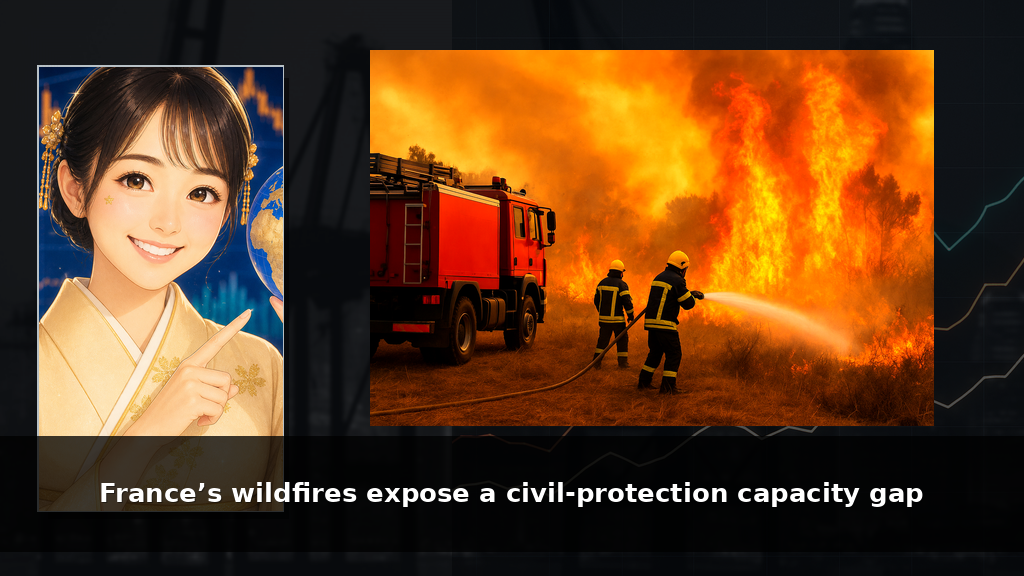
On 25 July 2026, Tour de France organiser ASO, the Paris Préfecture de Police, and France’s Interior Ministry shortened and rerouted Stage 21, cutting it from about 133 km to 89 km and starting on the Champs‑Élysées in Paris rather than in Thoiry. Organisers cited the Interior Ministry’s redeployment of internal security forces to support wildfire response in southwest France (Gironde/Landes). Reporting also noted roughly 1,400 firefighters on the Gironde front and the use of an A400M military aircraft, while evacuee counts across France and Spain ranged from “more than 250,000” to “more than 267,000” over 25–26 July. (aljazeera.com)
Earlier in July, organisers and prefectures had already intervened: conditions were altered for Stage 3 because of a Pyrénées‑Orientales wildfire (6 July), and Stage 9 was shortened amid a red heat alert in Corrèze (12 July). (letour.fr)
Theme: the redeployment of police, gendarmes and other internal‑security resources away from a flagship public event to wildfire response signals a structural capacity shortfall in France’s civil‑protection/security architecture. Reasonable people will argue this is an “exceptional year,” but the stake for sponsors, venues, travel/leisure investors and compliance teams exposed to summer operations in France is immediate.
Call: for European travel & leisure equity PMs, re‑price Q3 France‑exposed names for recurring state redeployments and prefer operators that publish clear summer contingency playbooks and hold state‑backed indemnities. Underweight assets dependent on itinerant host‑town event revenues without such protections.
Policy & Legal Structure
The pushback is predictable: “This is a freak summer — not structure.” The administrative pathway says otherwise. The Ministry of the Interior (Place Beauvau) exercised authority to redeploy internal security forces — police and gendarmerie — and coordinated military aerial support. That upstream decision created a manpower constraint the Paris police prefecture and ASO could not solve by logistics alone; the curtailed Stage 21 was an administrative resource triage more than a race‑safety call. (lemonde.fr)
Three features make this structural rather than episodic.
First, repetition within a single month matters. Stage 3 saw wildfire‑driven access controls; Stage 9 was shortened on a red heat alert; then the finale was cut to free police for wildfire response. One ad‑hoc alteration can be a weather story; three separate interventions across different departments in July read as system strain. In France’s model, prefects — the state’s local representatives — are the field commanders of internal security. When successive prefectural assessments converge on redeployments or route cuts, the binding constraint is capacity, not imagination. (letour.fr)
Second, reliance on national reinforcements is a tell. The AP detailed A400M aircraft sorties and large‑scale mobilisation — a sign the civil‑protection core (departmental fire and rescue services, SDIS) and local policing were stretched to their operating envelope. Firefighter unions (e.g., CFDT‑SDIS, SNSPP) have, in similar episodes, flagged exhaustion and staffing gaps. When the Ministry must tap military lift and reassign gendarmerie units while host municipalities lose pre‑authorised event footprints, the state is compensating for a thin standing reserve. That is the classic “surge without surge capacity” problem. (apnews.com)
Third, legal and fiscal spillovers will outlast the weather. Host municipalities like Thoiry lost expected footfall and spend; Yvelines communes absorbed planning costs without the visibility dividend. Under French administrative law, there is a venue (tribunaux administratifs) to seek redress if state measures impose disproportionate harm on reliance interests shaped by prior authorisations, via doctrines such as imprévision (hardship/change‑of‑circumstances) or faute de l’administration (administrative fault). Even if most claims settle politically, the prospect of compensation creates a durable budget conversation in Paris and a risk‑pricing conversation in markets.
Mechanically, the chokepoint is event‑security staffing during the summer peak. It draws from the same pools — police, gendarmerie, and SDIS — that must answer wildfire or heat emergencies. When red alerts or fire fronts activate, the prefect’s duty to protect public safety drives reassignment to the emergency front, and private‑public partnerships (ASO, stadium operators, festivals) are told to shrink, reroute, or postpone. Until Parliament funds a standing reserve or the Ministry codifies ring‑fenced event‑security staffing with backfill rules, redeployment remains the doctrine.
For portfolios and counterparties, the watch indicators are concrete:
- Interior Ministry after‑action notes: if Place Beauvau publishes a quantified tally of police/gendarmerie units redeployed and signals permanent increases or a national reserve, the structural diagnosis is confirmed; if it calls 2026 “exceptional” and points to one‑off EU Civil Protection assists, the exceptional‑year camp gains ground.
- Firefighter‑union mobilisation: a national press conference, strike call, or formal demand list to the DGSCGC (Direction générale de la sécurité civile et de la gestion des crises) within weeks would signal persistent staffing strain at the first‑responder layer. Quiet unions argue for episodic pressure, not chronic shortfall.
- Parliamentary calendars: an ad hoc hearing or a budget amendment for SDIS/civil‑protection reserves ahead of Q4 2026 elevates this from operational friction to policy change. No docket movement implies reliance on improvisation will continue into next season.
- ASO/organiser doctrine: a formal “summer contingency” playbook — triggers, time windows, indemnity language — would reduce idiosyncratic risk for listed counterparties and municipalities but standardise the expectation that private events will yield manpower to civil‑protection surges.
The market implication is straightforward. If the state’s default is redeployment under prefectural duty‑of‑care, then sponsors, venues, and travel operators are residual claimants on summer uncertainty unless and until indemnity lines and standing reserves are legislated. Equity PMs should assign a non‑trivial probability to repeated July/August disruptions in 2027–2028, haircutting earnings for names that monetise transient host‑town events without contractual backstops, and paying a premium for operators with (a) state‑backed coverage for sudden redeployments, (b) diversified venue footprints, and (c) published, testable contingency playbooks.
Strategic Reading from Sun Tzu
“Do not rely on the enemy not coming; rely on having the means to meet them.”
The principle is to build capacity for shocks instead of hoping they won’t arrive. Fund reserves, set clear protocols, and prepare people and equipment so operations continue without improvisation. Resilience is designed ahead of time.
France’s Interior Ministry redeployed police and coordinated military aerial support to fight wildfires, which in turn pushed the Paris police prefecture and ASO to shorten the Tour’s final stage. That dependence on ad hoc reallocation rather than a standing surge reserve is the risk this principle warns about. Signals from firefighter unions and multiple stage adjustments through July indicate recurring capacity strain rather than a one‑off anomaly.
In the near term, expect codified contingency triggers (e.g., heat or wildfire red alerts) and predefined route‑change protocols, while redeployments continue as a stopgap. As scrutiny from municipalities, unions, and budget committees rises, the ministry is likely pushed toward clearer funding lines and standards that separate civil‑protection reserves from event‑security staffing. The pressure that disrupted Stage 21 can become a catalyst for tighter procedures and cleaner inter‑agency playbooks.
Monitor the Interior Ministry’s after‑action report, firefighter‑union demands, and budget‑committee notes for signals of permanent reserve creation, indemnity rules for event disruptions, and standardised contingency triggers. For exposure management, favour partners and venues that publish clear summer‑season playbooks and have state‑backed coverage for sudden redeployments.
Caveats and Open Questions
- Interior Ministry reversal: if Place Beauvau publishes an after‑action communiqué within 90 days that frames 2026 as exceptional, credits one‑off EU/military assists for closing gaps, and states there is no need for permanent force increases or a standing reserve, the structural‑gap thesis weakens and the re‑pricing premium should compress.
- Union quietude: if CFDT‑SDIS and peer firefighter unions avoid national mobilisation and forgo formal funding/reform demands in the next month, that reduces evidence of chronic strain and supports the “exceptional year” view.
- Organiser routinisation: if ASO publishes a repeatable operational playbook and secures explicit state indemnity for short‑notice route changes, risk shifts from capacity failure toward managed coordination; the earnings haircut for exposed names should be smaller.
Lead‑time question: within 12 weeks, does the Interior Ministry publish a quantified redeployment report that requests permanent reserve capacity or ring‑fenced event‑security staffing? Portfolios should be positioned before that document lands.
Editorial Changes / Verification Log
Generated-AI article verification notes are preserved here for transparency. Expand for before/after edits and source checks.
1. Observation — rewritten
Before:
On 25 July 2026, Tour de France organiser ASO, the Paris Préfecture de Police, and France’s Interior Ministry shortened and rerouted Stage 21 from roughly 133 km to 89 km, starting and finishing in Paris, citing the redeployment of internal security forces to fight major wildfires in southwest France (Gironde/Landes). Associated Press reporting counted roughly 1,400 firefighters on the Gironde front, with national reinforcements and A400M aircraft support, while aggregated coverage estimated more than 250,000–267,000 people forced from their homes across France and Spain in the same late‑July window.
After:
On 25 July 2026, ASO, the Paris Préfecture de Police, and France’s Interior Ministry cut Stage 21 from about 133 km to 89 km and moved the start to the Champs‑Élysées, citing redeployment of internal security forces to wildfires. AP also noted about 1,400 firefighters in Gironde and A400M support; evacuee counts across France and Spain ran from 250,000+ to 267,000+ over 25–26 July.
Reason: Fact-check | Clarified route change (start in Paris) and added multi-source support. Sources: Al Jazeera 26 Jul 2026; Le Monde 25 Jul 2026; AP 25 Jul 2026. https://www.aljazeera.com/sports/2026/7/26/tour-de-france-final-stage-shortened-as-emergency-teams-tackle-wildfires; https://www.lemonde.fr/sport/article/2026/07/25/tour-de-france-2026-en-raison-des-incendies-en-gironde-le-trace-de-la-derniere-etape-reduit-a-89-km_6732379_3242.html; https://apnews.com/article/93678a31ff53fc46564b6dfd9934eae1
2. Observation — rewritten
Before:
The decision followed earlier July adjustments: Stage 3 spectator/access restrictions tied to a Pyrénées‑Orientales wildfire and a Stage 9 shortening amid a red heat alert.
After:
Earlier in July, conditions were altered for Stage 3 because of a Pyrénées‑Orientales wildfire (6 July), and Stage 9 was shortened amid a red heat alert in Corrèze (12 July).
Reason: Fact-check | Added dates and anchored to official race notices for a Tier‑3 reader. Sources: letour.fr Stage 3 and Stage 9 notices. https://www.letour.fr/de/aktuelles/2026/changes-to-the-conditions-for-stage-3-due-to-the-major-wildfires-affecting-the-departement-des-pyrenees-orientales/1334924; https://www.letour.fr/en/news/2026/change-to-the-route-of-stage-9-as-the-department-of-correze-passes-on-red-alert-for-a-heatwave/1341492
3. Policy & Legal Structure — rewritten
Before:
Place Beauvau (the Interior Ministry) exercised its authority to redeploy internal security forces — police and gendarmerie — and to coordinate military aerial assets.
After:
The Ministry of the Interior (Place Beauvau) exercised authority to redeploy internal security forces — police and gendarmerie — and coordinated military aerial support.
Reason: Comprehension | Glossed “Place Beauvau” on first use so a non‑specialist reader does not need to look it up.
4. Policy & Legal Structure — rewritten
Before:
The reliance on military and national reinforcements is a tell. AP noted A400M aircraft sorties and large‑scale mobilization — a sign the civil‑protection core (departmental SDIS fire/rescue and local policing) was stretched to its operating envelope.
After:
Second, reliance on national reinforcements is a tell. The AP detailed A400M aircraft sorties and large‑scale mobilisation — a sign the civil‑protection core (departmental fire and rescue services, SDIS) and local policing were stretched to their operating envelope.
Reason: Comprehension | Expanded SDIS on first use; preserved AP support. Source: AP 25 Jul 2026. https://apnews.com/article/93678a31ff53fc46564b6dfd9934eae1
5. Policy & Legal Structure — rewritten
Before:
Under French administrative law, they have venues (tribunaux administratifs) to seek redress under doctrines like imprévision or faute de l’administration…
After:
Under French administrative law, there is a venue (tribunaux administratifs) to seek redress via doctrines such as imprévision (hardship/change‑of‑circumstances) or faute de l’administration (administrative fault).
Reason: Comprehension | Added brief glosses for legal terms to avoid lookup.
6. Policy & Legal Structure — rewritten
Before:
Mechanically, this is a chokepoint in the internal‑security/civil‑protection stack. The GVC‑like node is “event‑security staffing”…
After:
Mechanically, the chokepoint is event‑security staffing during the summer peak. It draws from the same pools — police, gendarmerie, and SDIS — that must answer wildfire or heat emergencies.
Reason: Comprehension | Removed “GVC‑like” jargon and restated in plain English.
7. Policy & Legal Structure — rewritten
Before:
Firefighter‑union mobilisation: a national press conference, strike call, or formal demand list to DGSCGC within weeks…
After:
Firefighter‑union mobilisation: a national press conference, strike call, or formal demand list to the DGSCGC (Direction générale de la sécurité civile et de la gestion des crises) within weeks…
Reason: Comprehension | Expanded DGSCGC on first use.
8. Strategic Reading from Sun Tzu — trimmed
Before:
Sun Tzu wrote: —— Do not rely on the enemy not coming; rely on having the means to meet them.
After:
“Do not rely on the enemy not coming; rely on having the means to meet them.”
Reason: Downstream X readability | Removed stylised dashes for a clean, quotable line.
9. Meta — trimmed
Before:
On 25 July 2026, the Tour’s final stage was cut 133→89 km as police were redeployed to wildfires. We argue this signals a structural capacity gap—re‑price Q3 event risk.
After:
On July 25, 2026, the Tour’s final stage was cut from 133 to 89 km as police were redeployed to fight wildfires. That points to a structural civil‑protection capacity gap.
Reason: Comprehension | Brought within 120–160 characters; clarified wording for general readers.