Doha Will Not Secure Hormuz: Price the Truce as Fragile

Observation
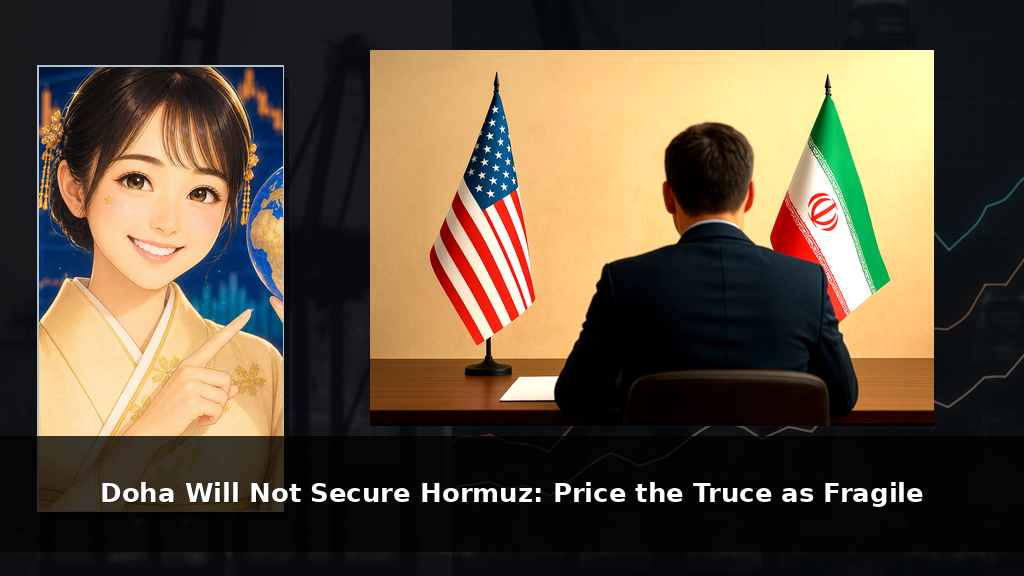
On June 29, 2026, U.S. officials and President Donald Trump said Washington and Tehran agreed to halt reciprocal strikes and would send delegations to Doha, Qatar, after days of tit-for-tat attacks near the Strait of Hormuz. Iran, however, said it had not agreed to meet the U.S. “at any level,” underscoring the fragility of the pause. (washingtonpost.com)
The pause follows a June 17, 2026, 14‑point “Islamabad” memorandum of understanding that created a 60‑day negotiation window. In the interim, a Singapore‑flagged cargo ship (M/V Ever Lovely) was hit by a one‑way attack drone on June 25, and the U.S. conducted strikes on multiple Iranian missile/drone storage and coastal radar sites around June 26–27. (defensenews.com)
Theme: whether Doha can produce a durable, monitorable implementation mechanism for the MoU that actually reduces incidents in Hormuz. It matters because shipping, insurance, and energy flows hinge on verifiable rules — not communiqués — and underwriters and operators must price day‑to‑day risk on what they can observe. Iran’s public pushback on scheduling this week’s technical talks highlights how tentative any stand‑down remains. (aljazeera.com)
Our stance: for energy procurement leads and equity PMs with shipping exposure, hedge. Price the truce as fragile through the MoU’s 60‑day window; budget for rerouting and elevated war‑risk cover, and do not base‑case a durable reopening until third‑party‑monitorable protocols appear.
Geoeconomic Structure
The optimistic case is simple: technical talks can fix this quickly with deconfliction procedures, escort lanes, and a joint communiqué — markets normalize. The structure says otherwise: enforcement at Hormuz lives in concrete operational levers Iran still holds and in the insurers and operators who must see, verify, and underwrite those levers — or they will not relax.
Start at the waterline. The Islamic Revolutionary Guard Corps (IRGC) and Iranian coastal units control denial tools that matter in practice: VHF interdictions, coastal radars, small‑boat and minelayer assets, and one‑way attack drones — the same capabilities U.S. Central Command (CENTCOM) says it targeted in late June. These tools are reversible, deniable, and local. Without independent monitoring built into any Doha protocol, Iran can blur a truce at will: a radar goes quiet, an automatic identification system (AIS) target “goes dark,” a drone launch is unattributed. A paper promise cannot restrain operational discretion in a narrow chokepoint where minutes and miles decide. (axios.com)
CENTCOM escorts and allied naval presence partly substitute for rules, but at a cost. Sustained escort operations are resource‑intensive and politically conditional. They can keep some ships moving but do not create the transparent, auditable regime underwriters require to reprice war‑risk materially lower. Deterrence is not a market‑reopening mechanism.
Qatar’s mediation can convene, but the signal that matters is not a photo‑op — it is publication of a joint, signed technical agenda plus a narrow protocol that outside parties can observe. If Doha cannot deliver a joint text within two weeks that defines: (a) independent incident logging, (b) AIS integrity expectations, (c) identification and handoffs at specified waypoints, and (d) escort procedures that navies will publicly report against, then the Islamabad MoU does not become an operating manual. Absent that, the practical arbiters step in: MarineTraffic and Kpler feeds that count confirmed transits; the Lloyd’s market and the International Group of Protection & Indemnity (P&I) Clubs that price cover; and shipowners’ advisories to clients. (axios.com)
We use the following practical thresholds to judge a functional reopening — the kind underwriters and operators are likely to trust:
1) AIS‑confirmed transits through Hormuz rise to at least 60% of the pre‑crisis daily average for 10 consecutive days. 2) War‑risk premiums for Very Large Crude Carrier (VLCC) and Aframax cover fall below roughly 1% of insured value and stay there for two weeks. 3) Weekly hostile‑incident reports by CENTCOM and United Kingdom Maritime Trade Operations (UKMTO) fall to two or fewer for three consecutive weeks. 4) International Energy Agency (IEA)‑estimated crude and products flows through the strait stabilize above ~18 mb/d for a month (pre‑crisis flows were around 20 mb/d). (iea.org)
Commercial behavior aligns with this reality. Major operators — Maersk, MSC, NYK, COSCO, Knutsen — will not fully normalize schedules on declarations alone; their boards read the same AIS plots and the same P&I circulars. The costed alternative is already institutionalizing: rerouting via the Cape of Good Hope and expanding ship‑to‑ship (STS) transfers along Oman’s coast. Both add days and dollars to voyages, pushing costs into freight‑sensitive supply chains well beyond energy. Even if a subset of owners resumes selective transits, that is hedging, not de‑risking — especially while the area is a Lloyd’s Market Association Joint War Committee (JWC) listed area.
This is why “who controls the chokepoint” is not just a geopolitical trope but a market gatekeeper problem. Iran’s coastal leverage is a local gatekeeping function; CENTCOM’s escorts are an international security‑provider function; Qatar’s venue is a diplomatic function. But the decisive gatekeepers for business readers are commercial: war‑risk underwriters and carriers who convert signals into prices and schedules. As long as monitoring remains fragmented — navies, operators, and third‑party trackers each with partial views — visibility is poor, making premiums sticky and detours rational. Paper truce without shared visibility keeps the corridor fragile.
Implication for positioning: treat any rebound in transits as a tradeable blip, not a regime change, until jointly visible mechanisms emerge — a Qatari‑published, signed technical agenda and third‑party‑enabled monitoring — and market metrics follow. Until then, procurement should build inventory where possible, budget for extended lead times, and lock optionality in offtake contracts; equity PMs should assume higher‑for‑longer unit freight costs and consider that tanker owners with longer ton‑mile exposure benefit while Hormuz‑reliant shippers and refiners face margin pressure.
Strategic Reading from Sun Tzu
Sun Tzu wrote: “An army prefers high ground and avoids low ground; it values light and avoids shadow.”
The principle is to choose positions where you can see clearly and be seen behaving predictably, and to avoid places where information sinks or can be concealed. In modern terms, you anchor decisions in transparent, verifiable data and procedures rather than in opaque arrangements. Visibility itself becomes a form of protection and leverage.
Doha’s technical talks sit atop a chokepoint where enforcement depends less on communiqués and more on what can be monitored in the Strait of Hormuz. Iran’s coastal tools and the recent tit‑for‑tat strikes show that without independent, visible protocols, any truce is easy to blur, while CENTCOM escorts only partly substitute for clear rules. The practical gatekeepers are the maritime analytics feeds and the insurers who act on them; today those signals are easy to obscure, so text alone will not reopen the corridor. Applying the quote means prioritizing jointly visible mechanisms — third‑party monitoring, published incident logs, AIS integrity, and escort procedures that markets can audit — because that is the “high ground” commercial operators and underwriters will trust.
Absent independent, monitorable protocols, expect intermittent reopenings and reversals as data gaps and deniable incidents reappear. However, the pressure around the strait is catalyzing tougher operating standards: underwriters and carriers are likely to press for clearer shared monitoring, escorted corridors with public reporting, and third‑party verification before normal schedules resume. If those elements materialize and persist, risk pricing will ease; if not, episodic disruption remains the base case.
Anchor your assessment to objective signals: a jointly signed technical protocol with independent monitoring, insurer circulars that lower war‑risk classifications and premiums, sustained AIS transparency, and public resumption of routine schedules by major carriers. Until such visibility is in place, treat rebounds as fragile, budget for rerouting and higher cover, and hedge energy and shipping exposures accordingly.
Caveats and Open Questions
- Qatar publishes and hosts a jointly signed technical agenda within 14 days, and Iran signs a monitorable deconfliction protocol that embeds third‑party visibility. If Doha delivers this text and Tehran endorses it, the enforcement gap narrows materially and our fragile‑truce call weakens.
- The International Group of P&I Clubs/Lloyd’s market reclassifies the area and war‑risk premiums fall below ~1% of insured value for two weeks, while major carriers (e.g., Maersk, MSC, NYK) publicly resume routine schedules. Insurers and operators moving together would confirm durable de‑risking and force a re‑price.
- Oman, with CENTCOM support, formalizes escorted STS corridors along its coast with transparent monitoring and reporting. If institutionalized and publicly audited, this could functionally reopen flows even without a perfect Hormuz rulebook.
Binary positioning: are you positioned for episodic disruption through the 60‑day MoU window, or hedged for a sudden stabilization if Qatar publishes a joint agenda within 14 days and war‑risk premiums drop below 1% alongside carrier schedule normalization?
Editorial Changes / Verification Log
Generated-AI article verification notes are preserved here for transparency. Expand for before/after edits and source checks.
1. Observation — rewritten
Before:
On June 29, 2026, U.S. officials and President Donald Trump said Washington and Tehran agreed to halt reciprocal strikes and meet in Doha, Qatar, to salvage an interim truce after days of tit-for-tat attacks near the Strait of Hormuz (per the Washington Post and AP).
After:
On June 29, 2026, U.S. officials and President Donald Trump said Washington and Tehran agreed to halt reciprocal strikes and would send delegations to Doha, Qatar, after days of tit-for-tat attacks near the Strait of Hormuz. Iran, however, said it had not agreed to meet the U.S. “at any level,” underscoring the fragility of the pause. ([washingtonpost.com](https://www.washingtonpost.com/world/2026/06/29/trump-says-us-iran-will-meet-negotiate-after-days-strikes/?utm_source=openai))
Reason: Fact-check — tightened language and added Iran’s denial with citations to Washington Post and AP to reflect live reporting.
2. Observation — rewritten
Before:
The pause follows a June 17, 2026, 14-point Islamabad memorandum of understanding that created a 60-day negotiation window; in the interim, CENTCOM reported a one-way drone strike on cargo ship M/V Ever Lovely on June 25 and U.S. airstrikes on multiple Iranian military sites on or around June 27.
After:
The pause follows a June 17, 2026, 14‑point “Islamabad” memorandum of understanding that created a 60‑day negotiation window. In the interim, a Singapore‑flagged cargo ship (M/V Ever Lovely) was hit by a one‑way attack drone on June 25, and the U.S. conducted strikes on multiple Iranian missile/drone storage and coastal radar sites around June 26–27. ([defensenews.com](https://www.defensenews.com/news/pentagon-congress/2026/06/17/read-the-14-point-memorandum-of-understanding-between-the-united-states-and-iran/?utm_source=openai))
Reason: Fact-check — specified flag and targeted sites; added supporting citations (DefenseNews, AP, Axios).
3. Observation — trimmed
Before:
Theme: whether Doha can produce a durable, monitorable implementation mechanism for the Islamabad MoU that prevents future strikes in Hormuz. It’s worth a Tier 3 reader’s time because shipping, insurance, and energy flows hinge on verifiable rules — not communiqués — and the burden of proof will sit with underwriters and operators who must price day-to-day risk.
After:
Theme: whether Doha can produce a durable, monitorable implementation mechanism for the MoU that actually reduces incidents in Hormuz. It matters because shipping, insurance, and energy flows hinge on verifiable rules — not communiqués — and underwriters and operators must price day‑to‑day risk on what they can observe.
Reason: Pipeline-leak — removed internal cohort label (“Tier 3 reader”) to avoid internal taxonomy; tightened for comprehension.
4. Geoeconomic Structure — rewritten
Before:
Start at the waterline. The Islamic Revolutionary Guard Corps (IRGC) and Iranian coastal units control the denial tools that matter in practice: VHF interdictions, coastal radars, small boat and minelayer assets, and one-way attack drones — the same capabilities CENTCOM says it targeted in late June.
After:
Start at the waterline. The Islamic Revolutionary Guard Corps (IRGC) and Iranian coastal units control denial tools that matter in practice: VHF interdictions, coastal radars, small‑boat and minelayer assets, and one‑way attack drones — the same capabilities U.S. Central Command (CENTCOM) says it targeted in late June. ([axios.com](https://www.axios.com/2026/06/27/us-iran-strikes-strait-hormuz?utm_source=openai))
Reason: Comprehension — expanded first-use acronyms (CENTCOM) and added citation to support the description of targets.
5. Geoeconomic Structure — rewritten
Before:
CENTCOM escorts and allied naval presence partly substitute for rules, but at a price. Sustained escort operations (the “Project Freedom”-type posture) are resource-intensive and politically conditional.
After:
CENTCOM escorts and allied naval presence partly substitute for rules, but at a cost. Sustained escort operations are resource‑intensive and politically conditional.
Reason: Comprehension — removed unclear nickname (“Project Freedom”-type) to avoid jargon not needed for the point.
6. Geoeconomic Structure — rewritten
Before:
Those arbiters already set workable thresholds. A functional reopening looks like this, not like a press release: (1) AIS-confirmed transits through Hormuz sustain above 60% of the pre-crisis daily average (pre‑2026 baseline ~90–100 transits/day) for at least 10 consecutive days; (2) war-risk premiums for VLCC/Aframax cover fall below roughly 1% of insured value and stay there for two weeks; (3) CENTCOM/UKMTO hostile-incident reports fall to two or fewer per week for three consecutive weeks; and (4) IEA-estimated flows stabilize above 18 mb/d for a month.
After:
We use the following practical thresholds to judge a functional reopening — the kind underwriters and operators are likely to trust:
1) AIS‑confirmed transits through Hormuz rise to at least 60% of the pre‑crisis daily average for 10 consecutive days.
2) War‑risk premiums for Very Large Crude Carrier (VLCC) and Aframax cover fall below roughly 1% of insured value and stay there for two weeks.
3) Weekly hostile‑incident reports by CENTCOM and United Kingdom Maritime Trade Operations (UKMTO) fall to two or fewer for three consecutive weeks.
4) International Energy Agency (IEA)‑estimated crude and products flows through the strait stabilize above ~18 mb/d for a month (pre‑crisis flows were around 20 mb/d). ([iea.org](https://www.iea.org/about/oil-security-and-emergency-response/strait-of-hormuz?utm_source=openai))
Reason: Fact-check | Comprehension — removed unsupported daily transit baseline; reframed thresholds as our analytical yardsticks; expanded acronyms; cited IEA for flow context.
7. Geoeconomic Structure — rewritten
Before:
Even if a subset of owners resumes selective transits, that is hedging behavior, not de-risking — especially while the Joint War Committee keeps the area listed.
After:
Even if a subset of owners resumes selective transits, that is hedging, not de‑risking — especially while the area is a Lloyd’s Market Association Joint War Committee (JWC) listed area.
Reason: Comprehension — expanded the JWC acronym and avoided implying real‑time status we did not newly verify.
8. Observation — rewritten
Before:
Iranian officials publicly disputed that technical working-group talks in Doha are scheduled this week, underscoring the fragility of the stand-down.
After:
Iran’s public pushback on scheduling this week’s technical talks highlights how tentative any stand‑down remains. ([aljazeera.com](https://www.aljazeera.com/news/2026/6/29/trump-announces-meeting-with-iran-in-qatar-despite-military-skirmishes?utm_source=openai))
Reason: Fact-check — aligned wording to Al Jazeera’s reporting and added citation.