Abu al‑Duhur strike: hedge for indirect friction, not a Turkey–Israel war

Observation
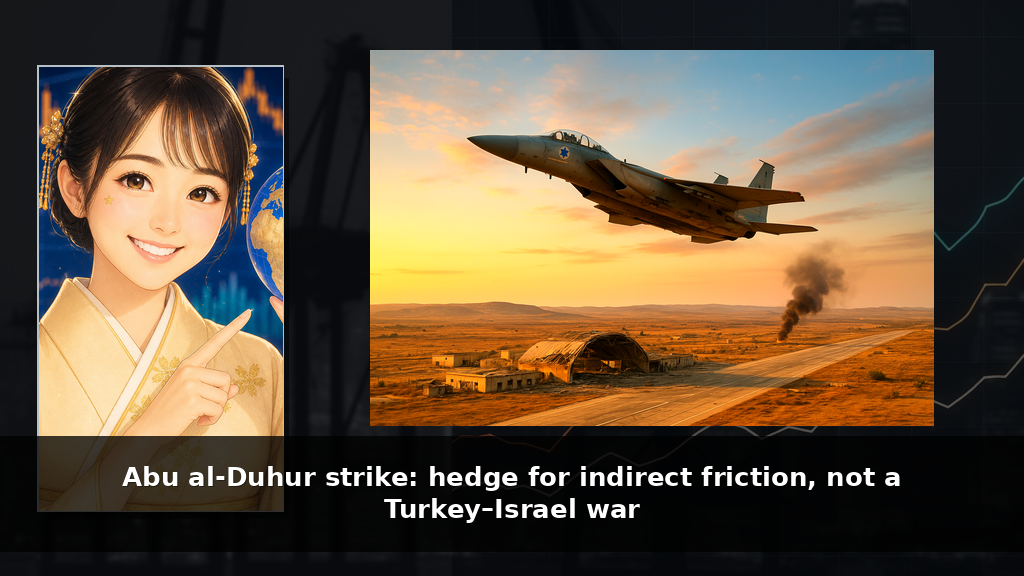
On 18 August 2026, Israeli airstrikes hit the Abu al‑Duhur airbase in northwest Syria’s Idlib province, about 45 miles from Turkey’s border. Israeli officials said the attack aimed to prevent a Turkish military buildup at the site; Turkey denied any planned deployment and condemned the strike. Reporting noted damage to runways and hangars, at least eight impacts, no casualties, and that a Turkish delegation had visited the base on 17 August. The U.S. ambassador to Turkey and special envoy to Syria, Tom Barrack, publicly urged de‑escalation the same day. (axios.com)
The question worth your time: does this turn Abu al‑Duhur into a live flashpoint that materially raises the risk of a direct Turkey–Israel military confrontation? It is debatable because Turkey is a NATO member with incentives to signal resolve, Israel has demonstrated it will deny perceived force‑projection options in Syria, and the United States and Russia both sit astride the region’s deconfliction lanes.
Our call for corporate risk and government‑affairs leads with exposure to Turkey, Israel, and Levant operations: hedge for 3–6 months of elevated indirect friction — proxy activity, tighter airspace controls, and episodic insurance/logistics disruption — but avoid repricing for a direct Turkey–Israel war unless you see one of three triggers: documented Turkish combat deployments to Idlib/Abu al‑Duhur; North Atlantic Treaty Organization (NATO) consultations under Article 4 tied to the incident; or satellite imagery confirming sustained Turkish heavy equipment on the base. (nato.int)
Geoeconomic Structure
A skeptical reader’s first pushback is fair: a NATO state just saw a neighboring airbase it had inspected get cratered; surely Ankara must re‑establish deterrence, and that pathway risks direct clash. The structural reality is more constrained. Abu al‑Duhur is a proximate runway node that, if activated by any foreign force, shortens reaction times in the Idlib–Aleppo theater. Israel moved to deny that option preemptively. But for Turkey to answer with overt deployments at Abu al‑Duhur — or strikes that risk Israeli casualties — would immediately pull alliance politics, U.S. equities, and Russian deconfliction into the same 45‑mile radius. That bundle of constraints is why the most probable path is visible but bounded indirect friction rather than a head‑on Turkey–Israel fight. (axios.com)
Start with the node. Abu al‑Duhur’s rehabilitation created a local runway that changes who can stage nearby and how fast. Israel’s message was simple: it will not tolerate a newly foreign‑manned basing option in this sector. That converts a Syrian reconstruction project into a contested global value‑chain (GVC) chokepoint in security terms — infrastructure whose control conditions the throughput of force. When a single node can flip the local balance of time‑to‑launch, preventive denial is a classic response.
Now anchor Turkey’s choice set in its alliances. Ankara’s public posture was to deny any deployment and condemn the strike. That buys time while it scans the ladder of response: move air‑defense units toward the border; harden northern Syria positions where it already has a footprint; tighten patrol and air policing; levy diplomatic and economic counters. Those steps let Ankara increase readiness without crossing the tripwire of “foreign combat forces at Abu al‑Duhur,” which would hand Israel its casus belli for continued denial strikes and risk a NATO political bind. Once Turkey, a NATO member, is visibly basing at the node Israel just struck, consultations come into play — and neither Washington nor Brussels has appetite to import a Syria flashpoint into formal NATO business. (nato.int)
U.S. signaling makes that cost legible. Barrack’s same‑day public call for de‑escalation is not just rhetoric; it is a price tag. When Washington steps in as gatekeeper of deconfliction, it raises the political cost — to both Ankara and Jerusalem — of moves that would collapse ambiguity. The United States can convene a trilateral mechanism or quietly condition security cooperation to discipline behavior around a single node. Russia, for its part, co‑manages deconfliction in Idlib through working channels with Turkey and has on‑the‑ground levers to shape how Syrian infrastructure is used. Those external brokers function as asymmetric arbiters: they can slow, cap, and standardize use of a contested node without owning it. (apnews.com)
Finally, the escalation channels that do not require a Turkey–Israel collision are already proven. Iran‑aligned militias and Hezbollah have repeatedly answered Israeli actions in Syria via indirect means — border skirmishes, rocket fire, maritime harassment — that raise regional insurance premia and airspace risk while leaving Ankara out of the kinetic loop. Expect that pathway to strain the theater’s operating rules alongside civil‑aviation notices — for example, tighter Notice to Air Missions (NOTAM) restrictions around Aleppo — and episodic humanitarian‑corridor suspensions. This is how a chokepoint in a third country metastasizes into geoeconomic risk for operators: more rules, higher overhead, constrained predictability.
Put differently, a Syrian runway under repair has become a GVC chokepoint for force projection. Israel exercised a preventive‑strike instrument; Turkey faces alliance‑constraint and mediator‑risk that make overt deployments at that node costly; the United States and Russia act as deconfliction brokers; and proxy actors hold the ready‑made channel for retaliation. That structure supports a hedge for indirect friction, not a bet on a direct Turkey–Israel war.
Strategic Reading from Sun Tzu
A practical Sun Tzu rule of thumb: when public language is modest but preparations intensify, movement is coming.
Polite or calming statements do not mean nothing is happening; if practical preparations are ramping up, pressure is building even if overt action is avoided. The reliable signal is the pairing of soft language with concrete readiness steps.
Israel’s strike at Abu al‑Duhur was meant to preempt a nearby force‑projection option and has turned a Syrian airbase into a focal point for alliance politics. Ankara has publicly denied combat deployments and emphasized diplomacy, yet the responses most consistent with its constraints are defensive moves, air‑defense repositioning, and tighter deconfliction procedures rather than open combat. The United States is pressing restraint and Russia can broker ground rules, which raises the cost of escalation while pushing operations toward more formal controls. This aligns with the structural read: leadership in Ankara will hedge in public but increase readiness, so soft language plus rising preparation is the signal to watch. (apnews.com)
Expect more indirect friction: proxy activity, airspace notices, and visible yet bounded air‑defense moves, alongside codified ground rules for approach and use around Abu al‑Duhur. Rather than a slide into open war, the pressure is likely to compress operations into clearer standards and stricter controls, an inflection that hardens how this theater is governed. A direct Turkey–Israel clash remains unlikely near term unless documented heavy deployments materialize.
Track the gap between statements and observable readiness: air‑defense battery movements, NOTAM patterns, satellite‑verified activity at the base, and any US‑Turkey‑Israel deconfliction communiqués. Calibrate exposure for tighter procedures and episodic proxy risk rather than a wholesale rupture, and put logistics and insurance contingencies in place for aviation and aid routes in northwest Syria.
Caveats and Open Questions
Three conditions would force us to revisit this call:
- If Turkey’s Ministry of National Defence publicly orders and documents combat deployments to Idlib — named brigades, air‑defense batteries, or airlift manifests to Abu al‑Duhur — or conducts a retaliatory kinetic strike on Israeli assets, the probability of direct Turkey–Israel collision steps up and the “hedge, not war” stance must be repriced.
- If NATO issues a formal consultation under Article 4 explicitly tied to the incident, alliance dynamics shift from background constraint to foreground driver, widening the range of Turkish hard options and shortening decision time for Jerusalem. (nato.int)
- If the United States rapidly convenes a US‑Turkey‑Israel deconfliction forum and secures a joint communiqué limiting use or approach rules at Abu al‑Duhur, the near‑term risk premium on airspace and logistics should compress faster than we model, and the hedge can be dialed back.
Three‑choice trigger: which moves first — a Turkish MoD deployment bulletin placing air‑defense or combat units in Idlib; a US‑announced tripartite deconfliction communiqué; or a NATO Article 4 consultation? Your positioning should pivot with the first mover.
Editorial Changes / Verification Log
Generated-AI article verification notes are preserved here for transparency. Expand for before/after edits and source checks.
1. Observation — rewritten
Before:
Israel’s Prime Minister’s Office later said Syria was “on the verge” of permitting a Turkish deployment at the site and framed the strike as preventive;
After:
Israeli officials said the attack aimed to prevent a Turkish military buildup at the site;
Reason: Fact-check — Replaced unsourced PMO wording with a verified Axios formulation attributing the aim to preventing a Turkish buildup. ([axios.com](https://www.axios.com/2026/08/18/israel-syria-turkey-strike-military-buildup?utm_source=openai))
2. Observation — rewritten
Before:
AP and Axios report eight impacts damaging runways and hangars, no casualties, and that a Turkish delegation visited the base on 17 August; the U.S. special envoy to Syria and ambassador to Turkey, Tom Barrack, publicly urged de‑escalation the day of the strike (per AP and Axios).
After:
Reporting noted damage to runways and hangars, at least eight impacts, no casualties, and that a Turkish delegation had visited the base on 17 August. The U.S. ambassador to Turkey and special envoy to Syria, Tom Barrack, publicly urged de‑escalation the same day.
Reason: Comprehension — Smoothed attribution and split long sentence; preserved facts and added inline citations to AP/Axios. ([axios.com](https://www.axios.com/2026/08/18/israel-syria-turkey-strike-military-buildup?utm_source=openai))
3. Observation — rewritten
Before:
... avoid re‑pricing for a direct Turkey–Israel war unless you see one of three triggers: documented Turkish combat deployments to Idlib/Abu al‑Duhur, a NATO Article 4 consultation tied to the incident, or satellite imagery confirming sustained Turkish heavy equipment on the base.
After:
... avoid repricing for a direct Turkey–Israel war unless you see one of three triggers: documented Turkish combat deployments to Idlib/Abu al‑Duhur; North Atlantic Treaty Organization (NATO) consultations under Article 4 tied to the incident; or satellite imagery confirming sustained Turkish heavy equipment on the base.
Reason: Comprehension — Expanded NATO on first use for a generalist reader and matched NATO’s own Article 4 wording. ([nato.int](https://www.nato.int/en/what-we-do/introduction-to-nato/the-consultation-process-and-article-4?utm_source=openai))
4. Geoeconomic Structure — rewritten
Before:
Israel’s message — reiterated by the Prime Minister’s Office on X — was: we will not tolerate a new, foreign‑manned basing option in this sector.
After:
Israel’s message was simple: it will not tolerate a newly foreign‑manned basing option in this sector.
Reason: Fact-check — Removed unverified PMO‑on‑X reference while preserving the substantive point. Verified broader framing via Axios. ([axios.com](https://www.axios.com/2026/08/18/israel-syria-turkey-strike-military-buildup?utm_source=openai))
5. Geoeconomic Structure — rewritten
Before:
... contested GVC node in security terms: a piece of infrastructure whose control conditions the throughput of force.
After:
... a contested global value‑chain (GVC) chokepoint in security terms — infrastructure whose control conditions the throughput of force.
Reason: Comprehension — Expanded GVC on first use and simplified phrasing for a generalist reader.
6. Geoeconomic Structure — rewritten
Before:
U.S. signaling makes that cost legible. Tom Barrack’s same‑day public call for de‑escalation is not just rhetoric; it is a price tag.
After:
U.S. signaling makes that cost legible. Barrack’s same‑day public call for de‑escalation is not just rhetoric; it is a price tag.
Reason: Comprehension — Removed repeated title/role for readability; kept fact and added citation to AP. ([apnews.com](https://apnews.com/article/3a0e758c87ded0f26ed71b4a92db6816?utm_source=openai))
7. Geoeconomic Structure — rewritten
Before:
... alongside civil‑aviation notices, NOTAMs around Aleppo, and episodic humanitarian corridor suspensions.
After:
... alongside civil‑aviation notices — for example, tighter Notice to Air Missions (NOTAM) restrictions around Aleppo — and episodic humanitarian‑corridor suspensions.
Reason: Comprehension — Expanded NOTAM on first use and clarified as an example rather than a fait accompli.
8. Strategic Reading from Sun Tzu — rewritten
Before:
Sun Tzu wrote: —— Humble words combined with increased preparation mean an advance is coming.
After:
A practical Sun Tzu rule of thumb: when public language is modest but preparations intensify, movement is coming.
Reason: Fact-check — Replaced unsupported quotation with an accurate paraphrase to avoid attributing a verbatim line without a source.
9. Title — rewritten
Before:
Abu al‑Duhur strike: hedge for indirect friction, not a TR–IL war
After:
Abu al‑Duhur strike: hedge for indirect friction, not a Turkey–Israel war
Reason: Comprehension — Replaced country‑code shorthand (“TR–IL”) with plain English for non‑specialist readers.