2026-05-22 Market Briefing| Nikkei 63,339, Brent $104.55, Nvidia $81.62B


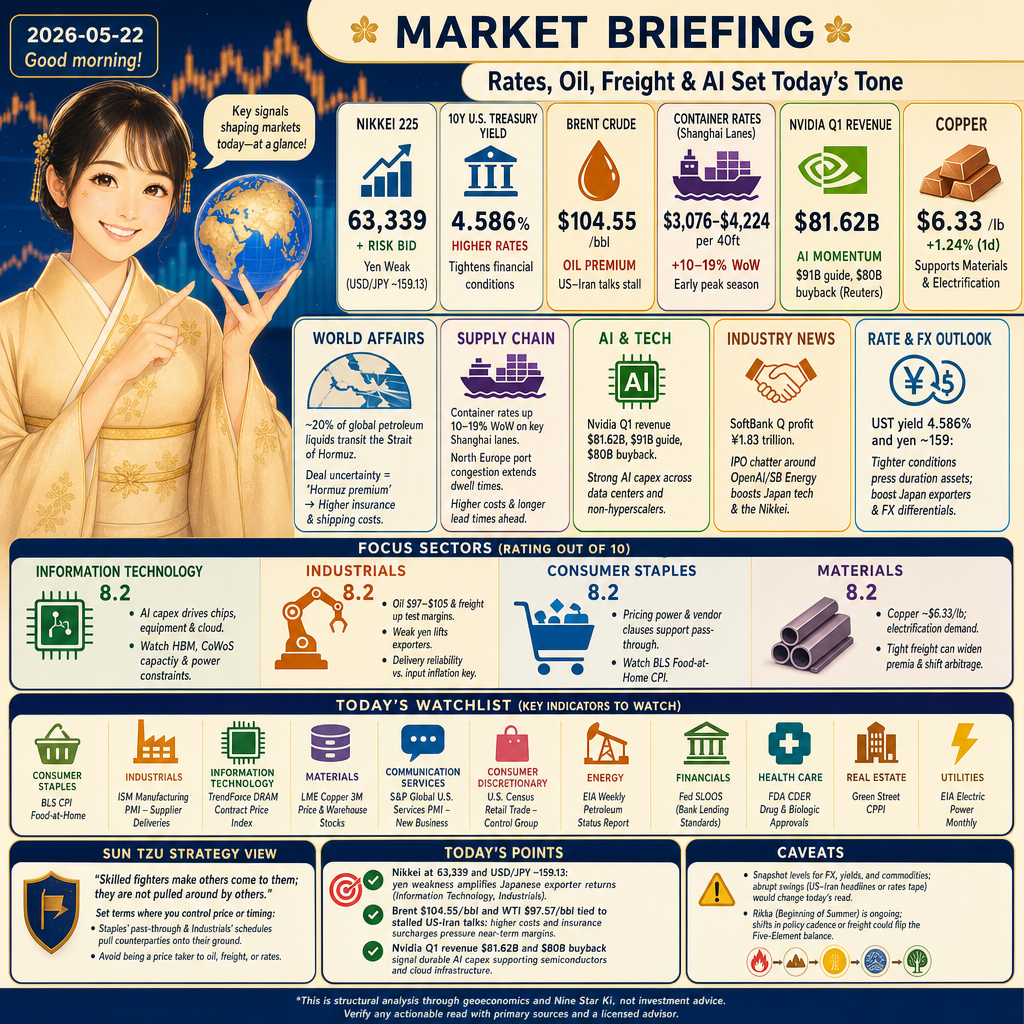
Good morning. Attention and rates are setting the tone: AI-led flows keep tech leadership intact while the 10-year U.S. Treasury (UST) yield at 4.586% tightens financial conditions. Brent near $104 and rising container rates lift cost pressure into summer. The weak yen around 159 per dollar amplifies Japan’s exporter earnings and global FX differentials.
Stocks and FX
63,339 on the Nikkei and USD/JPY near 159.13, with the 10-year U.S. Treasury (UST) yield at 4.586%, framed Friday’s risk bid (Investing.com/Reuters). The stronger dollar and higher USTs tighten global financial conditions, pressuring duration assets while supporting Japanese exporters. That mix helps Information Technology and Industrials tied to Japan, but raises discount rates for long-duration growth in the U.S.
Commodities
$104.55/bbl for Brent and $97.57/bbl for WTI, with intraday Brent swings of ~$1.6–$2.4, reflected doubts over US–Iran talks (Reuters). Copper hovered around $6.33/lb (+1.24% 1d, Reuters). Higher crude and freight lift delivered costs and inflation expectations, squeezing Consumer Discretionary margins while supporting Energy cash flows and Materials pricing power where inventories are tight.
World Affairs
20% of global petroleum liquids historically transit the Strait of Hormuz (EIA), and Reuters reports Iran’s supreme leader ordered enriched uranium to remain in-country, dimming near-term deal hopes. Brent at ~$104.55 and WTI ~$97.57 embed a ‘Hormuz premium’ that raises shipping insurance and routing surcharges, supports the dollar’s safe-haven bid, and tightens real-economy margins.
Supply Chain
$3,076–$4,224 per 40ft on key Shanghai lanes, up 10–19% week-on-week, and extra-loader sailings signal an early peak season (The Loadstar). Port congestion in North Europe is extending dwell times. Rising spot rates and longer lead times lift landed costs and force earlier inventory decisions for Consumer Discretionary and Industrials, while disciplined pass-through supports Consumer Staples.
AI
$81.62B in Nvidia Q1 revenue, a $91B guide, and an $80B buyback (Reuters) confirm durable AI capex across data centers. Lambda’s deal to rent >1,000 Blackwell systems underscores non-hyperscaler demand. The spend cascade benefits chips, advanced packaging, and memory, while pushing power and data-center capacity constraints onto Utilities and select Real Estate.
Industry News
¥1.83 trillion in quarterly profit at SoftBank and IPO chatter around OpenAI/SB Energy lifted Japan tech shares, feeding into the Nikkei’s 63,339 close (Bloomberg/Reuters). Large-cap buybacks and IPO/M&A windows recycle liquidity into AI platforms and suppliers, improving funding conditions for ecosystems tied to Information Technology and Communication Services, with spillovers to Financials’ fee pools.
Industry Forecast
Today's Setup
2026-05-22 is a Nine Purple Fire (Kyushi Kasei, 九紫火星) day during Rikka (Beginning of Summer), with Five Yellow Earth (Goou Dosei, 五黄土星) sitting in the Center (Chūkyū, 中宮) and the One White Water (Ippaku Suisei, 一白水星) year in force. Expect headlines and guidance to price quickly while balance‑sheet gatekeepers and logistics networks decide which stories scale—cost of energy and shipping, financing terms, and throughput constraints drive today’s tape.
Focus Sectors
- Information Technology (8.2/10): Nvidia’s $81.62B Q1, $91B guide, and $80B buyback (Reuters) validate hyperscaler budgets and keep compute the center of gravity. That demand flows into semis, equipment, and cloud while 10Y UST at 4.586% raises rate sensitivity on high-multiple names. Watch HBM (high-bandwidth memory) and CoWoS (chip-on-wafer-on-substrate) capacity, plus power and interconnect bottlenecks that can cap shipments or delay data‑center ramps.
- Industrials (8.2/10): Oil near $97–$105/bbl (Reuters) and container rates up 10–19% WoW (The Loadstar) test fixed‑price contracts, while grid/data‑center build-outs sustain order books in electrical gear and precision machinery. A weak yen (USD/JPY ~159) lifts Japanese exporters’ translated revenue. Delivery reliability versus input inflation will set near‑term spread; ISM Supplier Deliveries will show if bottlenecks are easing enough to convert backlog to revenue.
- Consumer Staples (8.2/10): SCFI (Shanghai Containerised Freight Index) lanes rose 10–19% WoW and Brent/WTI hover near $104/$98 (The Loadstar; Reuters), yet Staples’ list‑price resets and vendor clauses support pass‑through. Tight inventory turns preserve operating leverage even as packaging inputs and freight creep higher. The practical watch is BLS Food‑at‑Home CPI; a stable print implies pricing power is holding without excessive volume loss.
- Materials (8.2/10): Copper near $6.33/lb (+1.24% 1d, Reuters) aligns with electrification and data‑center wiring, while crude near $100 supports upstream cash flow but lifts smelting/chemical energy costs. Tighter ocean freight (The Loadstar) can widen regional premia and shift LME/COMEX arbitrage. Execution hinges on mine/plant uptime and logistics; LME 3‑month copper and warehouse stocks will flag whether tightness is structural or inventory‑driven.
Watchlist
- Consumer Staples: BLS CPI Food-at-Home (monthly U.S. grocery price inflation, a proxy for pass-through effectiveness).
- Industrials: ISM Manufacturing PMI – Supplier Deliveries (monthly U.S. supplier delivery times, a read on bottlenecks and order conversion).
- Information Technology: TrendForce DRAM contract price index (monthly server memory pricing, a leading read on AI compute cost/availability).
- Materials: London Metal Exchange copper 3-month price and warehouse stocks (LME; benchmark pricing and visible inventory).
- Communication Services: S&P Global U.S. Services PMI – New Business (monthly gauge of incoming service demand, proxying ad and communications activity).
- Consumer Discretionary: U.S. Census Advance Monthly Retail Trade – Control Group (monthly core retail sales excluding autos/gas/restaurants).
- Energy: EIA Weekly Petroleum Status Report (weekly U.S. crude/product inventories and refinery utilization that steer spreads).
- Financials: Federal Reserve Senior Loan Officer Opinion Survey (SLOOS) (quarterly U.S. bank lending standards and demand).
- Health Care: FDA CDER Drug and Biologic Approvals (monthly updates on U.S. drug approvals that drive revenue inflections).
- Real Estate: Green Street Commercial Property Price Index (CPPI) (monthly U.S. private‑market CRE pricing).
- Utilities: EIA Electric Power Monthly (U.S. generation mix, retail sales, and implied load growth that inform rate‑base expansion).
Caveats
We use snapshot levels for FX, yields, and commodities; abrupt swings around US–Iran headlines or the U.S. rates tape would change today’s read. The Rikka solar term is ongoing; a shift in policy cadence or a freight inflection could flip the Five‑Element balance between cost pass‑through and demand.
Sun Tzu Strategy View
Sun Tzu wrote: —— Skilled fighters make others come to them; they are not pulled around by others.
With oil premia, freight spikes, and AI headlines tugging the tape, the edge lies in setting terms where you control price or timing. Staples’ pass‑through and Industrials’ delivery schedules pull counterparties onto their ground, while rate‑sensitive segments get dragged by the curve.
Action: Anchor monitoring on price‑setting levers (pass‑through metrics, supplier deliveries) and avoid segments where you’re a price taker to oil, freight, or rates.
Today's Points
- Nikkei at 63,339 and USD/JPY ~159.13: yen weakness is amplifying Japanese exporter returns (Information Technology, Industrials) while boosting FX‑sensitive flows.
- Brent $104.55/bbl and WTI $97.57/bbl tied to stalled US‑Iran talks: energy input costs and insurance surcharges raise short‑term margins pressure for Industrials and Consumer Discretionary.
- Nvidia Q1 revenue $81.62B and an $80B buyback signal durable AI capex that supports semiconductors and cloud infrastructure—offsetting some cyclical headwinds from rising 10Y UST yield at 4.586%.
This is structural analysis through geoeconomics and Nine Star Ki, not investment advice. Verify any actionable read with primary sources and a licensed advisor.