2026-05-20 Market Briefing | Oil Prices, Rising Yields, AI Investment


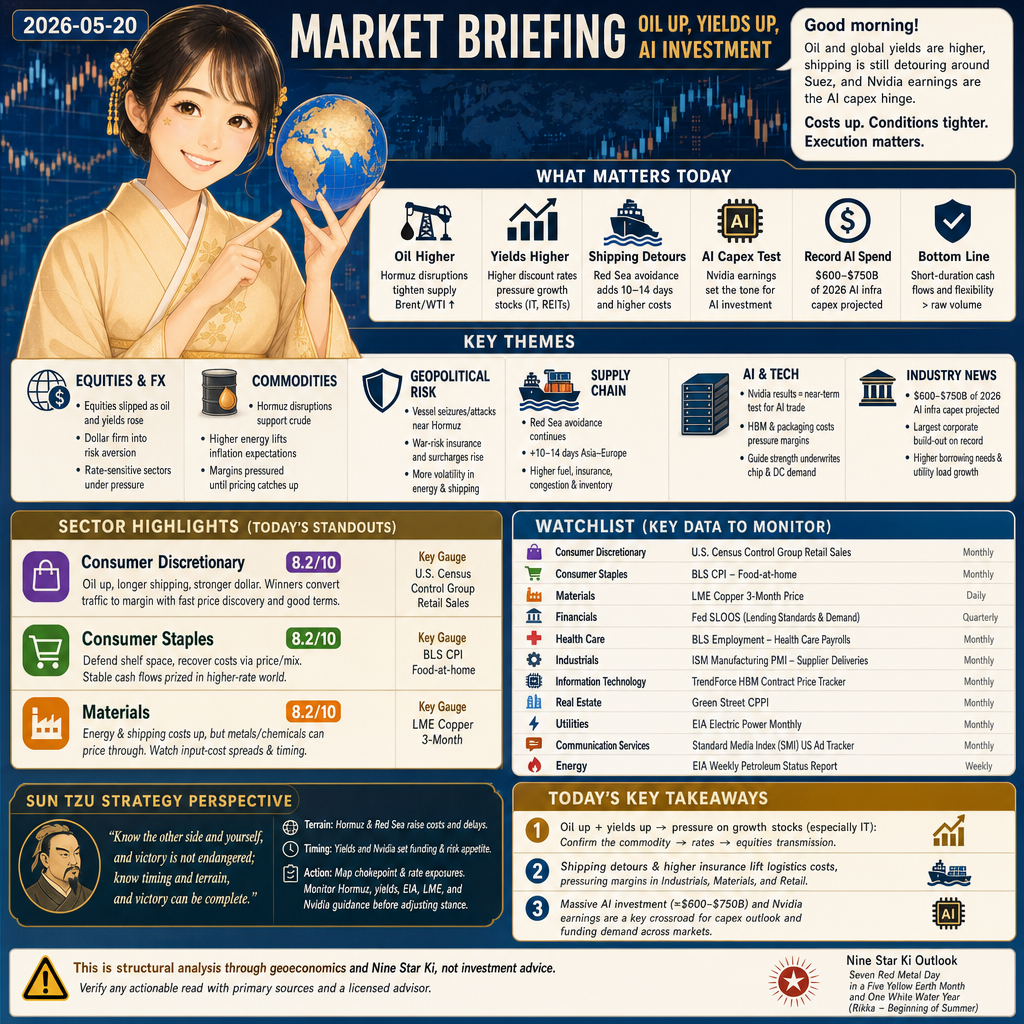
Good morning. The tape opens with oil and global yields higher (Reuters), shipping still detouring around Suez via the Cape (MarineLink), and Nvidia’s earnings as the AI capex hinge (Yahoo Finance). That mix tightens financial conditions, lifts energy and freight costs, and puts a premium on quick price pass‑through. Short‑duration cash flows and operational flexibility matter more than raw volume today.
Stocks and FX
Reuters (published on MarketScreener) reports global equities slipped as oil climbed and bond yields rose, with the dollar firming into risk aversion. Higher yields lift discount rates, compressing growth‑stock valuations while favoring shorter‑duration cash flows and balance‑sheet strength. Expect rate‑sensitive sectors (IT, REITs) to feel the pressure, while Energy and select Financials can absorb higher nominal rates if funding costs are contained.
Commodities
S&P Global Energy details renewed attacks and sharply lower transits through the Strait of Hormuz, tightening crude and product supply and supporting Brent/WTI. Higher oil feeds directly into transport, packaging, and petrochemical costs, lifting inflation expectations and keeping yields firm. That cost push squeezes margins in freight‑exposed Consumer, Industrials, and Materials until pricing catches up.
World Affairs
The Associated Press reports vessel seizures and attacks near Hormuz, elevating geopolitical risk premia. War‑risk insurance and freight surcharges rise, adding volatility to energy flows and shipping plans. The channel to markets is straightforward: higher operating costs, longer routes, and wider uncertainty bands for delivery timing.
Supply Chain
MarineLink notes ongoing Red Sea avoidance, adding roughly 10–14 days to Asia–Europe sailings, raising bunker burn and insurance, and creating equipment imbalances. Longer lead times and port congestion force higher safety stocks and tie up working capital. Expect landed costs to stay elevated and delivery schedules less predictable through Q2.
AI
Yahoo Finance (reporting Reuters) flags Nvidia’s results and outlook as the near‑term test for the AI trade. Record hyperscaler spend keeps order books full, but HBM memory and advanced‑packaging costs can pinch margins and shipments. A strong guide underwrites chip, compute, and data‑center demand; a weak print would ripple through valuations and capex pacing.
Industry News
Yahoo Finance highlights projected $600–$750B of 2026 AI infrastructure capex by major tech firms — the largest corporate build‑out on record. That scale sustains semiconductor and data‑center demand, lifts corporate borrowing needs, and raises utility load growth. Profitability timing and financing terms become central to equity and credit pricing across IT, Financials, Utilities, and Energy.
Industry Forecast
Today's Setup
2026-05-20 is a Seven Red Metal (Shichiseki Kinsei, 七赤金星) day within a Five Yellow Earth month and a One White Water year during Rikka (Beginning of Summer). Expect transaction‑heavy behavior and quick repricing: higher oil and rerouted shipping raise delivered costs, while firmer yields tighten financing; spreads and pass‑through capacity matter more than volume.
Focus Sectors
- Consumer Discretionary (8.2/10): Drivers are higher oil and extended shipping times (S&P Global Energy; MarineLink) and a firmer dollar with yields up (Reuters). Merchants with fast price discovery, resilient checkout rails, and favorable vendor terms can convert traffic into margin before fuel and freight volatility bite. Mix is likely to shift toward experiences and categories with clear pricing. Watch dollar‑sensitive cross‑border demand and war‑risk surcharges. Key gauge: U.S. Census control‑group retail sales for a clean read on discretionary spend.
- Consumer Staples (8.2/10): The setup favors companies that defend shelf space and execute price/mix to recover energy and logistics costs while yields stay elevated (Reuters; MarineLink; S&P Global Energy). Two Black Earth’s stability maps to steady cash generation and disciplined inventories, which credit and equity holders now prize. Private‑label substitution and retailer pushback are the near‑term risks if pricing outruns wages. Execution on cost recovery and promo cadence is decisive. Track BLS CPI Food‑at‑home for pass‑through pressure and trade‑down signals.
- Materials (8.2/10): Hormuz disruptions support crude and refined products (S&P Global Energy), raising energy inputs even as quick market signaling helps price metals and chemicals. Producers with hedging and flexible offtake can capture stronger realized prices; energy‑intensive smelting and chemicals face margin squeeze while Red Sea detours tie up inventory (MarineLink). Higher yields risk slowing capex demand at the margin (Reuters). Focus on input‑cost spreads, shipment timing, and order visibility. LME Copper 3‑Month remains the key read‑through for pricing power and industrial demand.
Watchlist
- Consumer Discretionary: U.S. Census Advance Monthly Retail Trade Report — control group sales (monthly retail ex‑autos, gas, building materials; cleaner read‑through to discretionary demand).
- Consumer Staples: BLS CPI — Food‑at‑home index (monthly grocery price inflation tracking pass‑through pressure and consumer trade‑down).
- Materials: LME Copper 3‑Month price (London Metal Exchange benchmark for industrial demand and pricing power).
- Financials: Federal Reserve Senior Loan Officer Opinion Survey (SLOOS) — quarterly lending standards and loan demand across business (C&I) and consumer credit.
- Health Care: BLS Employment Situation — Health care payrolls (monthly hiring trend as a proxy for demand and provider capacity).
- Industrials: ISM Manufacturing PMI — Supplier Deliveries (monthly gauge of delivery speed and bottleneck intensity).
- Information Technology: TrendForce HBM contract price tracker (monthly pricing for high‑bandwidth memory driving AI system cost and availability).
- Real Estate: Green Street Commercial Property Price Index (CPPI) — monthly private‑market commercial real estate valuation trends.
- Utilities: EIA Electric Power Monthly — U.S. generation, capacity factors, and sales by sector (tracks load growth and fuel mix).
- Communication Services: Standard Media Index (SMI) US Ad Market Tracker — monthly actual advertiser spend across media channels.
- Energy: EIA Weekly Petroleum Status Report — weekly U.S. crude and product inventories plus refinery utilization (confirms tightness and crack‑spread direction).
Caveats
A rapid de‑escalation around Hormuz or an unexpected inventory build would unwind oil and yield pressure, softening today’s cost and valuation tilt. Conversely, a sharp Nvidia guidance surprise could flip the near‑term bias for IT, Communication Services, and funding conditions. A solar‑term shift later this month can also nudge day‑level tone.
Sun Tzu Strategy View
Sun Tzu wrote: —— Know the other side and yourself, and victory is not endangered; know timing and terrain, and victory can be complete.
Today’s terrain is literal and financial: Hormuz and Red Sea routes raise costs and delays, while the yield curve and Nvidia’s timing set the cost of capital and risk appetite. Read both together to judge which sectors can pass through costs and which depend on favorable financing windows.
Action: Map exposures to chokepoint routes and rate resets; monitor Hormuz incidents, the yield curve, EIA/LME prints, and Nvidia guidance before adjusting near‑term sector stance.
Today's Points
- Higher oil and rising yields are pressuring growth-stock valuations, especially in technology. Watch the transmission from commodities to rates to equities.
- Shipping detours and higher insurance costs are lifting logistics expenses, creating near-term margin pressure for industrials, materials, and retailers.
- Large-scale AI investment and Nvidia earnings remain the key crossover point for capex expectations, funding demand, financials, and the corporate bond market.
This is structural analysis through geoeconomics and Nine Star Ki, not investment advice. Verify any actionable read with primary sources and a licensed advisor.